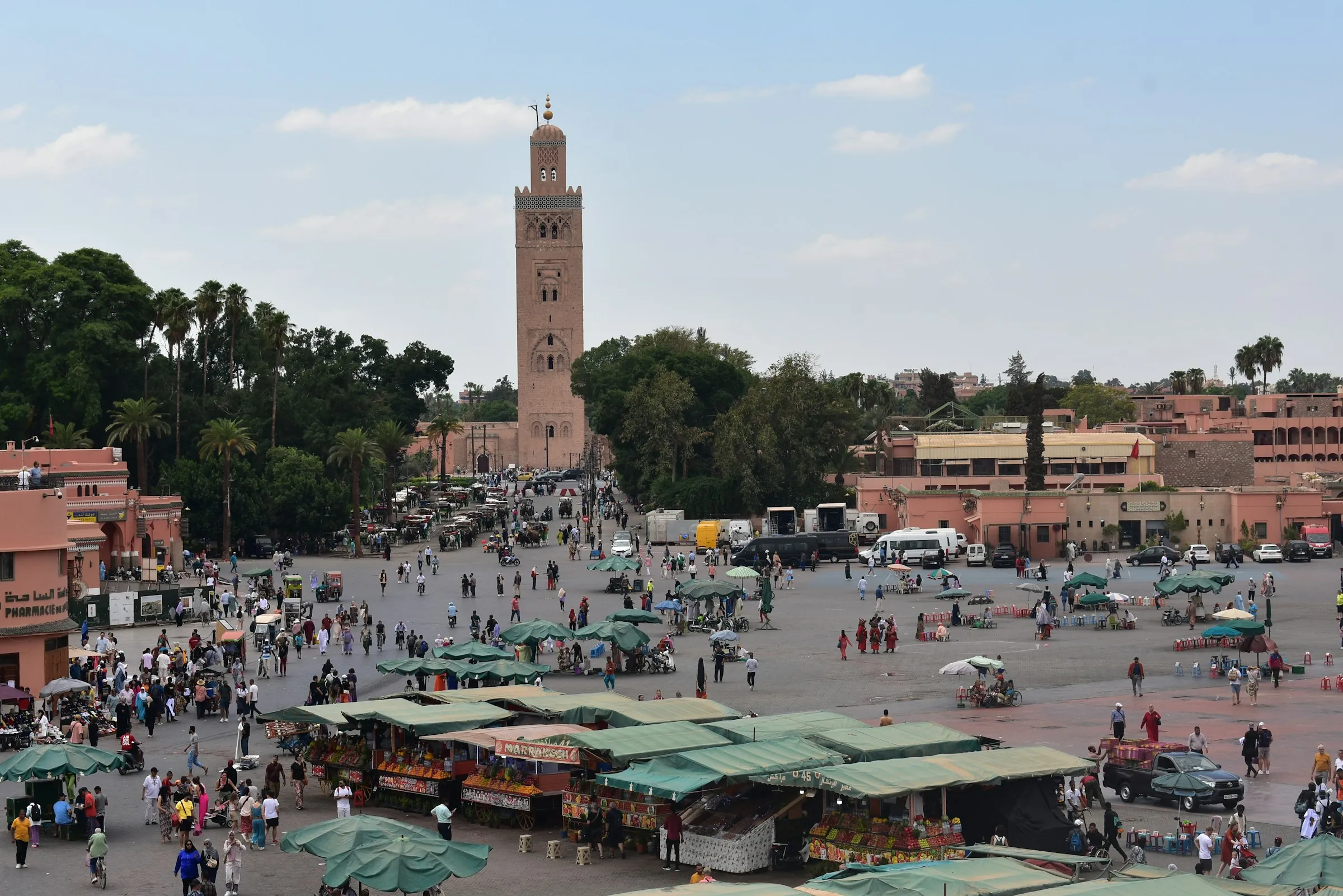
Jemaa el-Fna square is not only the beating heart of Marrakech: it is also the finest launchpad you could dream of for exploring the red city. Within a few minutes on foot, you move from the bustle of storytellers and orange-juice sellers to the fragrant lanes of the souks, to the foot of the Almohad minaret of the Koutoubia, into the silent courtyards of the palaces and all the way to the Saadian necropolises. This guide tells you precisely what to visit around Jemaa el-Fna square, how far away it is, how much time to allow and in what order to link the sites together for a smooth itinerary, without wasting time or wearing yourself out. All walking distances and durations are indicative: the medina is a maze, and the whole pleasure lies precisely in getting a little lost in it.
The medina souks: the adventure begins just steps away
From the northern edge of the square, you plunge immediately into the labyrinth of the souks. There is no transition: you leave the open light of Jemaa el-Fna and are instantly swept into covered alleys shaded by reed screens, streaked with shafts of sunlight, where the hammering of metalworkers and the calls of the merchants echo. This is the quintessential sensory experience of Marrakech, and it is free: to stroll, to look, to haggle.
The souks do not form a single block but a mosaic of specialised districts, inherited from a centuries-old guild organisation. Heading north, you cross in succession:
- Souk Semmarine: the main artery, the widest, devoted to textiles, babouches (leather slippers), scarves and souvenirs. It is the natural gateway from the square.
- Spice souk (Rahba Kedima): a small square piled high with pyramids of cumin, saffron and ras el-hanout, along with herbalists offering traditional remedies and black soap.
- Dyers' souk (Souk Sebbaghine): freshly dyed skeins of wool hung above the alleys, still dripping with vivid colours.
- Ironworkers' and coppersmiths' souk: chiselled lanterns, hammered copper trays, teapots. The noise announces the district before you even glimpse it.
- Tanners' and leather souk: babouches, poufs, leather goods. The tanneries themselves (Bab Debbagh) lie further to the north-east.
- Carpet souk (La Criée Berbère): once an auction square, today a mecca for Berber rugs and kilims.
Allow at least 1 hour for a first immersion, and far more if you enjoy haggling (an expected and good-natured practice: offer half the asking price, smile, and let the conversation do the rest). To go further into the activities and atmosphere of the district, see our page on what to do at Jemaa el-Fna.
✅ Best order of visit: tackle the souks in the morning (softer light, bearable heat, artisans opening their shops) or in the late afternoon. Avoid early afternoon in summer. Always keep the direction of the Koutoubia and the square in mind to find your bearings: its minaret serves as a beacon above the medina.
💡 In the souks, you will sometimes be offered a "guide" to a workshop or a rooftop terrace. It is often friendly, but a tip is expected and you will frequently be led towards partner shops. Stay courteous and free to choose your own route.
The Koutoubia Mosque: Marrakech's Almohad landmark
About 8 minutes on foot (~500 m) from the square, heading down towards the south-west, stands the Koutoubia Mosque, an emblematic monument of Marrakech. Its Almohad minaret from the 12th century, standing roughly 77 metres tall, dominates the city with its pink-sandstone silhouette, visible from almost everywhere. A masterpiece of Hispano-Moorish art, it served as the model for the Giralda of Seville and the Hassan Tower in Rabat: three Almohad sisters scattered on either side of the strait.
The name "Koutoubia" comes from the Arabic kutubiyyin, the booksellers, because the manuscript souk once stood at its feet. The minaret is topped with four gilded copper spheres and crowned with merlons; its four faces display different geometric patterns, the summit of elegant Almohad restraint.
Good to know: like all working mosques in Morocco, the interior is closed to non-Muslims. The visit is therefore made from the outside, but the spectacle is well worth the detour, especially at sunset when the stone catches fire. The Koutoubia gardens, on the other hand, are freely accessible: paths of rose bushes, orange and olive trees, palms, benches in the shade. It is an ideal cool interlude after the effervescence of the square, and one of the finest viewpoints over the minaret.
- Distance: ~8 min on foot from Jemaa el-Fna.
- Time on site: 20 to 30 min (exterior + gardens).
- Ticket: free (exterior and gardens).
- Best time: end of day, golden hour.
Palaces, madrasa and necropolises: monumental Marrakech
To the south and south-east of the square stretches the Marrakech of the sultans: refined palaces, Quranic schools and princely tombs. It is here that the major heritage sites are concentrated, most of them less than twenty minutes' walk away. Here is how to link them together.
The Bahia Palace
About 12 minutes on foot, the Bahia Palace is one of the jewels of the late 19th century. Built for Si Moussa and then considerably enlarged by his son Ba Ahmed, an all-powerful grand vizier, it bears a name that means "the brilliant" or "the beautiful". The palace unfolds a succession of patios, courtyards planted with orange trees, apartments with painted cedar ceilings, polychrome zellige tilework and finely chiselled stucco. Every room outdoes the next in refinement; it is a veritable lesson in Moroccan craftsmanship.
Allow 45 min to 1 hr for the visit. The palace can be crowded in the middle of the day: arrive at opening time to enjoy the patios in calm.
Place des Ferblantiers and El Badi Palace
Right next to the Bahia, the Place des Ferblantiers (Tinsmiths' Square) hums with the sound of metal artisans shaping lanterns and brass objects. It opens, through the Mellah gate, onto the El Badi Palace, in the Kasbah district. Built from 1578 by the Saadian sultan Ahmad al-Mansur "the Golden" to celebrate the victory of the Battle of the Three Kings, this palace was, in its day, one of the most sumptuous in the Muslim world: it is said to have counted some 360 rooms adorned with Italian marble, Sudanese gold and onyx.
Plundered in the 17th century by the Alaouite sultan Moulay Ismail to build Meknes, El Badi is now no more than a vast expanse of monumental ruins — ochre walls, pools, orange groves below — today inhabited by colonies of storks nesting atop the ramparts. Climb up to the terraces for a panoramic view over the medina and the Atlas. Allow 45 min.
The Saadian Tombs
Still in the Kasbah district, about 15 minutes on foot, the Saadian Tombs form a 16th-century necropolis of rare beauty. Burial place of the Saadian dynasty — including Ahmad al-Mansur himself — the ensemble was walled up by Moulay Ismail and fell into oblivion, before being rediscovered in 1917 thanks to an aerial photograph. The centrepiece is the Hall of the Twelve Columns, in Carrara marble, with dazzling zellige and stucco, which houses the tomb of the sultan's son.
The site is small and access is via a narrow corridor: the queue can be long in high season. Arrive early. Allow 30 to 40 min, including the wait.
The Ben Youssef Madrasa
In the north of the medina, a short distance from the souks, the Ben Youssef Madrasa is the oldest and largest Quranic school in the Maghreb. Founded in the 14th century then entirely rebuilt in the 16th century under the Saadian sultan Abdallah al-Ghalib, it housed up to some 900 students at its peak. After a long restoration, it reopened in 2022, magnificently enhanced. Its large patio with a central basin, its student cells, its carved cedar and its stucco make it one of the finest ensembles of Islamic architecture in Morocco. Allow 40 min. Nearby you will also find the Marrakech Museum (in the former Mnebhi Palace) and the small Almoravid Koubba, the city's only Almoravid remnant.
Ramparts, gates and the Menara
Encircling the entire medina, the red-earth ramparts and their monumental gates are worth a look. The finest is undoubtedly Bab Agnaou, a finely carved 12th-century Almohad gate that opens onto the Kasbah district (and thus onto the Saadian Tombs and El Badi). Further west, the Menara — a large basin bordered by an olive grove, with its Saadian pavilion reflected in the water before the Atlas — offers a bucolic escape, but it is too far for walking: plan on a taxi.
💡 Tickets and hours: the entry fees for the monuments (Bahia, El Badi, Saadian Tombs, Ben Youssef Madrasa) change regularly and are given here for indicative purposes only. Most sites close their ticket offices in the early afternoon for Friday prayers or depending on the season. Check on site or with your riad the day before. Bring cash in dirhams: some ticket offices do not accept cards.
Summary table of sites to visit
| Place | Walking distance from the square | Visit duration | Ticket (indicative) | Highlights |
|---|---|---|---|---|
| Medina souks | Immediate (northern entrance) | 1 hr to 3 hr | Free | Spices, leather, carpets, lanterns, babouches, dyeries |
| Koutoubia Mosque | ~8 min (~500 m) | 20–30 min | Free (exterior + gardens) | Almohad minaret ~77 m, rose gardens |
| Bahia Palace | ~12 min | 45 min – 1 hr | Paid (indicative) | Patios, zellige, painted cedar ceilings |
| Place des Ferblantiers | ~13 min | 15–20 min | Free | Metal artisans, lanterns, atmosphere |
| El Badi Palace | ~15 min (Kasbah) | 45 min | Paid (indicative) | Saadian ruins, storks, panoramic terraces |
| Saadian Tombs | ~15 min (Kasbah) | 30–40 min | Paid (indicative) | Hall of the 12 Columns in Carrara marble |
| Ben Youssef Madrasa | ~12–15 min (north medina) | 40 min | Paid (indicative) | Patio with basin, stucco, student cells |
| Marrakech Museum | ~12 min (north medina) | 30–45 min | Paid (indicative) | Mnebhi Palace, central chandelier, exhibitions |
| Bab Agnaou (gate) | ~15 min | 10 min | Free | Carved Almohad gate, access to the Kasbah |
| Majorelle Garden + YSL Museum | ~3 km (taxi ~15 min) | 1 hr 30 – 2 hr | Paid (indicative) | Majorelle Blue, bamboo, Berber Museum, YSL Museum |
| Menara | Far (taxi) | 30–45 min | Basin free / pavilion paid | Large basin, pavilion, view of the Atlas |
The Majorelle Garden and the Yves Saint Laurent Museum
About 3 km from the square, in the modern district of Guéliz (allow a taxi, ~15 min depending on traffic), the Majorelle Garden is the essential "nature and design" visit of Marrakech. The French painter Jacques Majorelle settled in Marrakech in 1919 and, from 1923, created this botanical garden around a long basin, acclimatising cacti, bamboo, palms and plants from all over the world. In 1937, he painted his villa an intense ultramarine blue tinged with violet, so personal that it now bears his name: Majorelle Blue.
Saved in 1980 by Yves Saint Laurent and Pierre Bergé from a property development, the garden is today one of the most photographed places in Morocco. The site brings together three attractions: the garden itself, the Berber Museum (housed in the former blue studio) and, a few steps away, the Yves Saint Laurent Museum, opened in 2017, which traces the work of the couturier deeply inspired by Marrakech.
- Access: taxi from the square (negotiate the price before getting in, or insist on the meter).
- Hours (indicative): the garden is open every day, generally from 9 a.m. to 6 p.m. (last entry around 5.30 p.m.); the YSL Museum is usually closed on Wednesdays.
- Ticket: paid, with separate fees for the garden, the Berber Museum and the YSL Museum (indicative).
- Tip: book online in advance and come at opening time to avoid the crowds and the intense heat.
💡 As the Majorelle Garden is very popular, tickets can sell out for the day if you turn up without a reservation. Buy your entries online the day before and combine the visit with a stroll through Guéliz, a district of cafés, galleries and designer boutiques.
Ready-made itineraries around the square
Here are two ready-to-use routes depending on the time you have. They all start from Jemaa el-Fna and are designed to minimise back-and-forth and link the districts together logically. Feel free to adapt them to your pace and to the heat.
Express itinerary: 2 hours around the square
Ideal if you are just passing through or on a stopover, to grasp the essentials without a paid monument.
- 0:00 — Departure from Jemaa el-Fna. A loop around the square, orange-juice sellers, first storytellers.
- 0:15 — Enter the souks from the north: Semmarine, Rahba Kedima (spices), the dyers' souk. Buy a souvenir or simply wander.
- 1:00 — Return towards the square, then head down to the Koutoubia (~8 min).
- 1:15 — The exterior of the minaret and a walk in the Koutoubia gardens.
- 1:45 — A leisurely return towards the square for a tea on a terrace and the sunset over the rooftops.
One-day itinerary: the grand heritage tour
The complete programme for an in-depth discovery of what to visit around the square. Bring comfortable shoes, water and a hat.
- 8:30 a.m. — Breakfast on a terrace overlooking the square as it awakens.
- 9:00 a.m. — Bahia Palace right at opening (deserted patios and soft light).
- 10:15 a.m. — Place des Ferblantiers then El Badi Palace: ruins, storks and a panoramic view from the terraces.
- 11:30 a.m. — Saadian Tombs in the Kasbah (arrive before the midday rush); a glance at Bab Agnaou along the way.
- 12:45 p.m. — Lunch in the medina. See our recommendations on where to eat at Jemaa el-Fna.
- 2:30 p.m. — Head north: Ben Youssef Madrasa and possibly the Marrakech Museum, crossing the souks.
- 4:00 p.m. — Immersion in the souks: spices, leather, carpets, lanterns. The ideal moment to haggle.
- 5:30 p.m. — The Koutoubia and its gardens at golden hour.
- 6:30 p.m. — Return to Jemaa el-Fna for the great evening spectacle: food stalls, Gnawa musicians, smoke and lights.
Next-day / extra half-day option: devote a morning to the Majorelle Garden and the Yves Saint Laurent Museum in Guéliz (taxi), then linger in the cafés of the modern district for a striking contrast with the medina.
✅ Best order of visit: start with the paid monuments in the morning (Bahia, El Badi, Saadian Tombs), when it is cool and the queues are short. Save the souks and the Koutoubia for the afternoon and end of day, which are more atmospheric. Consistently keep Jemaa el-Fna and the Koutoubia as landmarks so you never get lost.
Practical tips for visiting around the square
A few pointers to make your exploration both smooth and respectful.
- Finding your way: the medina has no grid plan. Rely on the Koutoubia minaret and the great gates. A GPS can help, but accepting that you will get lost is part of the charm.
- Dress: favour clothing that covers shoulders and knees, particularly for religious sites and out of respect for local customs.
- Photos: ask before photographing people (artisans, merchants, costumed water carriers); a small tip is often expected.
- Money: always carry cash in dirhams for ticket offices, taxis and small purchases.
- Heat: in summer, avoid visiting between 1 p.m. and 4 p.m.; stay hydrated and seek the shade of the covered souks and the patios.
- Guides: for the palaces and necropolises, an official (badged) guide genuinely enriches the visit. Agree on the fee in advance.
To prepare your stay from A to Z — transport, safety, the best season, money — refer to our page of Jemaa el-Fna practical information. And to understand why this square, listed by UNESCO as part of the oral heritage of humanity, has fascinated for centuries, dive into its history.
Around Jemaa el-Fna square there thus unfolds, within walking distance, a distillation of nine centuries of Moroccan history: the Almohad fervour of the Koutoubia, the Saadian splendour of El Badi and the tombs, the refinement of the Bahia and the madrasa, the teeming life of the souks, and even the Orientalist dream of the Majorelle Garden. Few cities in the world offer such a density of wonders so close to their central square. Take your time, look up often, and let Marrakech tell its story at the rhythm of your footsteps.
Photo : Polina Kocheva — Unsplash License