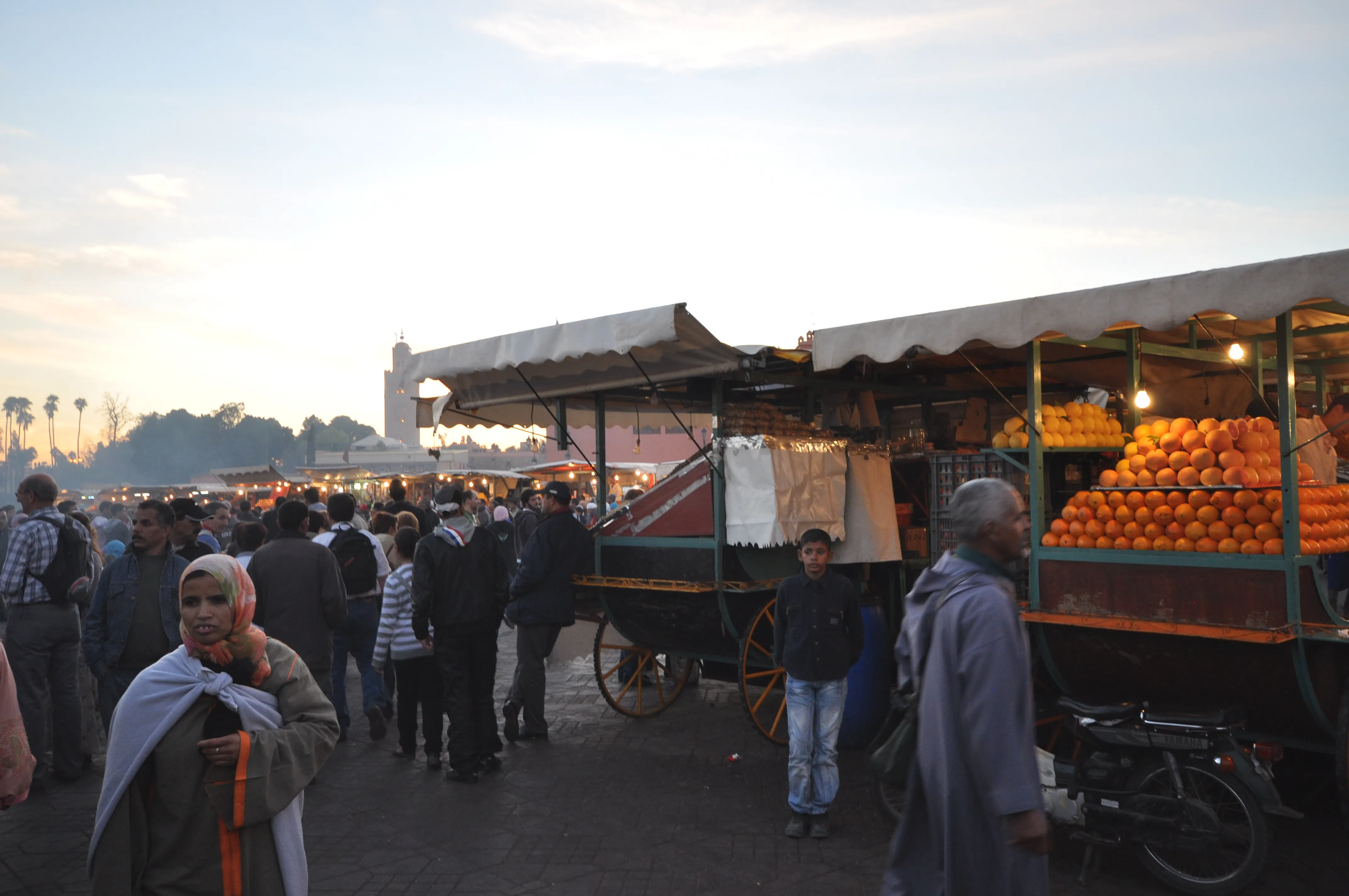
There are few places in the world where a single glance can take in nearly a thousand years of living history. The Jemaa el-Fna square, the beating heart of the Marrakech medina, is one of them. Since the city was founded by the Almoravids, this vast open space at the foot of the Koutoubia has never ceased to be a place of trade, power, justice and, above all, the spoken word. To understand its history is to grasp why UNESCO, as early as 2001, made it one of the very first "Masterpieces of the Oral and Intangible Heritage of Humanity." Follow us across the centuries, from severed heads displayed on pikes to the storytellers who, every evening still, gather the crowd into a circle.
The origin of the name: three readings of an enigma
Few Moroccan place names have spilled as much ink as that of Jemaa el-Fna (جامع الفناء). The name itself is late: it appears in the texts only at the beginning of the 17th century, long after the square was founded. This recent appearance, at a time when the space had already existed for centuries, partly explains why its exact meaning remains debated. Three main interpretations vie for the favour of historians, and each one sheds light on a facet of the site's history.
The "mosque of annihilation": the most widely accepted hypothesis
The explanation favoured today by most specialists rests on a tragic play on words. At the end of the 16th century, the powerful Saadian sultan Ahmad al-Mansur (who reigned from 1578 to 1603) set out to build, on this immense cleared plot, a great Friday mosque that he intended to name "Jemaa el-Hna," the "mosque of serenity" or "of prosperity." But a terrible plague epidemic — which struck Marrakech recurrently around the years 1598-1607 — decimated the population and halted the works. The building, barely begun, fell into ruin.
By a cruel popular irony, the name is said to have then been reversed: from the "mosque of serenity" (el-Hna), it shifted to the "mosque of annihilation" or "of ruin" (el-Fna). It is the Saadian historian Abderrahmane Es-Saadi who reports this version, which lends it considerable documentary weight. The Arabic word jamaa (جامع) does indeed denote a mosque or a gathering place, while fanâ' evokes disappearance, effacement, the end.
The shift from "Hna" (serenity) to "Fna" (annihilation) hinges on a single letter in Arabic. This linguistic tipping point, born of a building project cut short by the plague, sums up in itself the fate of a place where grandeur and death have never ceased to rub shoulders.
"The assembly of the dead": the echo of public executions
The second reading, the most spectacular, translates Jemaa el-Fna as "the assembly" or "the gathering of the dead." It refers to an attested historical reality: for centuries, the square was a site of public executions. The heads of the condemned and of rebels were displayed there on pikes, sometimes salted to preserve them, in order to serve as a warning to the population. The term fnâ' taken in the sense of "death" or "extinction" would then fit this judicial and deterrent function perfectly.
"The mosque at the end of the world"
A third interpretation, more poetic, understands fanâ' in a spatial sense: the word can denote the esplanade or the forecourt located in front of a building, but also a boundary, a frontier. Jemaa el-Fna would thus be "the mosque at the end of the world," an image of a border space set at the margins of the organised city, opening onto the infinity of the desert and the caravans coming from the South.
Bear in mind: none of these three readings has been definitively settled. An honest guide will present you with all three rather than imposing a single version. It is precisely this ambiguity that makes the richness of the place.
The square through the centuries
To grasp Jemaa el-Fna, you have to go back to the very birth of Marrakech and follow the thread of the dynasties that shaped the red city. The square was not "created" on a precise date: it was born with the city, as its natural commercial lung.
The Almoravids and the birth of Marrakech (around 1070)
Marrakech was founded around 1070 by the Almoravids, a Berber dynasty from the Sahara. The city, ideally placed between the Atlas Mountains and the great caravan routes linking sub-Saharan Africa to the Maghreb and Andalusia, quickly became a leading capital. From the outset, a vast open ground took shape at the junction of the main axes and the souks: this was the future Jemaa el-Fna. As the terminus of caravans laden with gold, salt, slaves, ivory and spices, it functioned as a market and a place of exchange from the city's earliest days.
Almohads and Marinids: the merchant heart takes root
Under the Almohads, in the 12th century, Marrakech experienced its architectural golden age with the construction of the Koutoubia mosque, whose minaret still watches over the square today. The neighbouring esplanade consolidated itself as a space of market, gathering and justice. As early as the 12th century, punishments were publicly carried out there, inaugurating a long tradition of justice-as-spectacle that would durably mark the memory of the place.
The Saadian apogee and the abandoned project (16th century)
The second half of the 16th century, under the Saadians, made Marrakech a flamboyant capital. Ahmad al-Mansur, enriched by the gold of Sudan and the victory at the Battle of the Three Kings (1578), transformed the city. It was in this period that the founding episode of the name played out: the project for a great mosque, located on the northern side of the present-day square, then its abandonment under the blows of the plague. Travellers of the time, such as the Spanish author Luis del Mármol Carvajal, described a cosmopolitan and commercial space where merchants, artisans and peoples from all around the Saharan rim crossed paths.
The Protectorate and the first heritage protection (1912-1956)
With the establishment of the French protectorate in 1912, the colonial administration, driven by Marshal Lyautey, developed a policy of preserving the old medinas and separating them from the new towns. Jemaa el-Fna benefited very early from this attention. A vizierial decree of 26 July 1921 opened the process of listing it, then a dahir (royal decree) of 20 July 1922 established its official protection. This was a fundamental milestone: the square became a heritage asset recognised and defended by Moroccan law, more than sixty years before any international recognition.
Today: an open-air theatre
In the 20th century, modern buildings rose along the edges and the square took on its contemporary appearance. But its deep vocation has not changed. Every day, more than a million annual visitors throng there; in the evening, dozens of stalls serve thousands of meals in a fragrant haze. Snake charmers, monkey handlers, henna tattoo artists, tooth-pullers, orange-juice sellers, Gnawa musicians and, of course, storytellers: the square remains a permanent spectacle, at once popular market and open-air stage. To prepare your visit, consult our guide to things to do on the Jemaa el-Fna square.
Timeline: the essential historical landmarks
The table below sums up the major stages in the history of the square, from the founding of Marrakech to the most recent international recognitions.
| Date | Event |
|---|---|
| around 1070 | Founding of Marrakech by the Almoravids; the square is born as a merchant heart and caravan crossroads. |
| 12th century | Under the Almohads, construction of the Koutoubia; the esplanade serves as a market and a place of justice where punishments are publicly carried out. |
| 1578-1603 | Reign of Ahmad al-Mansur; project for a great mosque, "Jemaa el-Hna," on the northern side of the square. |
| around 1598-1607 | Plague epidemics; the works are abandoned and the building falls into ruin. |
| Early 17th century | First appearance of the name "Jemaa el-Fna" in the texts; earliest mentions of the halqa. |
| 26 July 1921 | Vizierial decree opening the listing process for the square. |
| 20 July 1922 | Dahir establishing the official heritage protection of Jemaa el-Fna. |
| 1954 | Elias Canetti stays in Marrakech; his observations will feed "The Voices of Marrakesh." |
| 1985 | The Marrakech medina is inscribed on the UNESCO World Heritage List. |
| 18 May 2001 | Jemaa el-Fna proclaimed a "Masterpiece of the Oral and Intangible Heritage of Humanity." |
| 2008 | Inscription on the Representative List of the Intangible Cultural Heritage of Humanity. |
Justice and public executions: the dark side of the square
If today we remember Jemaa el-Fna for its storytellers and its flavours, we must not forget that the esplanade was, for centuries, a place of power and punishment. An open space at the foot of the palace and the great mosques, it naturally served as a stage for sultanic justice, which sought to be exemplary and visible to all.
From the 11th to the 19th century, the square hosted public executions. The heads of rebels, criminals and enemies of the power were displayed there, impaled on pikes, sometimes treated with salt to delay putrefaction. This spectacle of death had a political function: to assert the sovereign's authority and deter any inclination to revolt. It is this reality that feeds the interpretation of the name as "assembly of the dead."
Beware of exaggerated tourist tales: while public executions are historically attested, their scale and precise modalities vary from one era to another and remain partly documented. Be wary of the spectacular figures put forward without sources by certain improvised guides.
This judicial dimension is no mere anecdote: it explains the symbolic charge of the place and the way the square long concentrated, in a single space, the functions of market, court and scaffold. The crowd that gathered there for trade was also the audience of justice.
The birth of the oral tradition and the halqa
The true treasure of Jemaa el-Fna is neither a monument nor a stone: it is a practice, an art of speech and gathering. From the 17th century onward, the chronicles mention the existence of the halqa (حلقة), literally the "circle." This is the circle of spectators that forms spontaneously around a performer — storyteller, musician, acrobat, animal handler or barker — and which constitutes the fundamental social and scenic structure of the square.
The halqa has no raised stage, no ticket office, no fixed schedule. It springs from a talent able to hold the crowd, feeds on the direct exchange between the performer and the audience, and dissolves as soon as attention fades. At the centre of the circle, the hlaïqi (the man of the halqa) deploys all his art to captivate, make people laugh, frighten and move them. The storytellers, in particular, perpetuate an immense repertoire: epic tales, stories from the Thousand and One Nights, religious legends, historical chronicles, poetry and satirical improvisations on current events.
- The storytellers — guardians of oral memory, they pass on tales sometimes centuries old.
- The Gnawa musicians — descendants of sub-Saharan slaves, they make their guembris and metal castanets resound in their spiritual trances.
- The snake charmers — often from the Aïssaoua brotherhood, they embody the most iconic image of the square.
- The acrobats, animal handlers and healers — herbalists, tooth-pullers and fortune-tellers round out this living theatre.
This economy of the spoken word is doubled by an economy in the plainest sense: an essential part of the square's life remains nighttime dining. To savour this atmosphere of smoke and grilling, our dedicated guide shows you where to eat on the Jemaa el-Fna square without falling into tourist traps.
The UNESCO listing explained: intangible versus tangible
The international recognition of Jemaa el-Fna rests on two distinct instruments that it is essential not to confuse, because they protect realities of a different nature.
1985: the medina on the World Heritage List (tangible heritage)
In 1985, UNESCO inscribed the Marrakech medina on the World Heritage List. This inscription falls under tangible heritage: it protects physical assets — ramparts, gates, mosques, palaces, gardens and historic urban fabric. Jemaa el-Fna figures there as a component of this built ensemble, on the same footing as the Koutoubia or the Saadian tombs.
2001 and 2008: the square as intangible heritage
But the essence of Jemaa el-Fna is not in its walls: it is in its voices, its gestures and its skills. Yet, until the end of the 20th century, no international legal instrument protected this kind of living heritage. This is where a conceptual revolution comes in. On 18 May 2001, in Paris, an international jury of eighteen members proclaimed the first nineteen "Masterpieces of the Oral and Intangible Heritage of Humanity," chosen from among thirty-two candidacies. Jemaa el-Fna figured among these very first laureates — a pioneering distinction.
In 2008, following the entry into force of the 2003 Convention for the Safeguarding of the Intangible Cultural Heritage, the square was transferred to the Representative List of the Intangible Cultural Heritage of Humanity, which makes its recognition permanent.
The distinction is crucial: tangible heritage protects stones (the medina, 1985), while intangible heritage protects living practices (the halqa, the storytellers, 2001-2008). Jemaa el-Fna has the rare particularity of falling under both categories at once.
The great literary witnesses
The square has fascinated writers, and two major figures durably marked its destiny: one through his pen, the other through his action.
Elias Canetti and "The Voices of Marrakesh"
In 1954, the Bulgarian-born writer Elias Canetti, future Nobel laureate in literature, stayed in Marrakech. From this journey came "The Voices of Marrakesh," a collection of short prose pieces published in 1968. In it, Canetti captures with rare acuity the sonic atmosphere of the square: he describes the circles of the halqa, the blind beggars chanting the name of God, and above all this economy of sound and cry that structures the space. His text is today one of the most precious testimonies to the square in the mid-20th century, before the era of mass tourism.
Juan Goytisolo, saviour of the square
The role of the Spanish writer Juan Goytisolo, a lover of Marrakech where he long lived, goes beyond mere literature. In the 1990s, the square was threatened by development projects, notably that of a tower or a modern building nearby, which would have disfigured the site. In 1997, Goytisolo proposed to UNESCO the unprecedented notion of "intangible heritage" in order to protect these living treasures that the existing conventions ignored. His initiative led to the 2001 proclamation, over whose jury he in fact presided. The square owes to him, in large part, its having been saved and set up as a global model. His novel "Makbara" pays tribute to it, moreover.
Threats and safeguarding of the heritage
Recognising a heritage is not enough to preserve it. Jemaa el-Fna, precisely because it is intangible and living, remains fragile. Several threats weigh upon it.
- The disappearance of the storytellers — the craft of the hlaïqi is passed on less and less; the great traditional storytellers are ageing, and the next generation, in competition with screens, is growing scarce.
- Tourist and commercial pressure — the commodification of the spectacle can turn an authentic practice into a frozen, standardised attraction for visitors.
- Urban projects — the temptation of modern developments around the square remains a recurrent threat to its integrity.
- The question of animal welfare — the use of monkeys and snakes, long tolerated, is the subject of growing criticism and regulation.
Faced with these challenges, safeguarding goes through the documentation of the repertoires, support for the performers and transmission to the young generations. The UNESCO listing imposes on Morocco obligations of active preservation, and not a mere sealing under glass. The vitality of the square, still today, is the best indicator of the success — or failure — of this mission. To delve deeper into the historical environment of the district, discover also what there is to see around Jemaa el-Fna.
You can contribute, in your own way, to safeguarding this heritage: sit down in a halqa, listen to a storyteller all the way to the end, and leave a coin in the mat. This is how this oral art, passed down for centuries, continues to live on.
Anecdotes and historical curiosities
The history of Jemaa el-Fna lends itself to a few striking facts that help measure its singularity.
- A name younger than the square — the esplanade has existed since the 11th century, but its current name is attested only at the beginning of the 17th. For nearly six centuries, the square was therefore active without bearing the name we know it by.
- A square "without a monument" — unlike most UNESCO sites, its value rests not on a building but on a practice. It is a heritage that can be neither fully photographed nor frozen.
- The concept of the intangible was born here — without Jemaa el-Fna and Goytisolo's initiative, the very notion of "intangible cultural heritage," now applied to hundreds of traditions around the world, might not exist in this form.
- Two faces a day — the square transforms as the hours pass: a daytime market of orange juice, henna and snake charmers, it becomes at nightfall an immense open-air restaurant ringed by storytellers and musicians.
Before heading there, a few commonsense precautions are in order, particularly regarding fake guides and paid photos. Consult our advice on safety and scams at Jemaa el-Fna as well as our practical information to organise your visit with peace of mind. To go further, our blog offers other stories about Marrakech and its history.
A living heritage, between memory and present
From the Almoravid founding to the UNESCO proclamations, the history of Jemaa el-Fna tells that of a space that has managed to stay faithful to its original vocation: to gather. Market, court, scaffold, storytellers' stage — the square has changed its dominant functions over the centuries, but never its nature. It remains that immense circle where the city comes to tell its own story to itself. To understand its origins, its disputed names and its pioneering listing is to give oneself the means to look at it differently: not as a mere attraction, but as one of the last great oral theatres of humanity, still in performance.
Photo : Jorge Láscar — CC BY 2.0