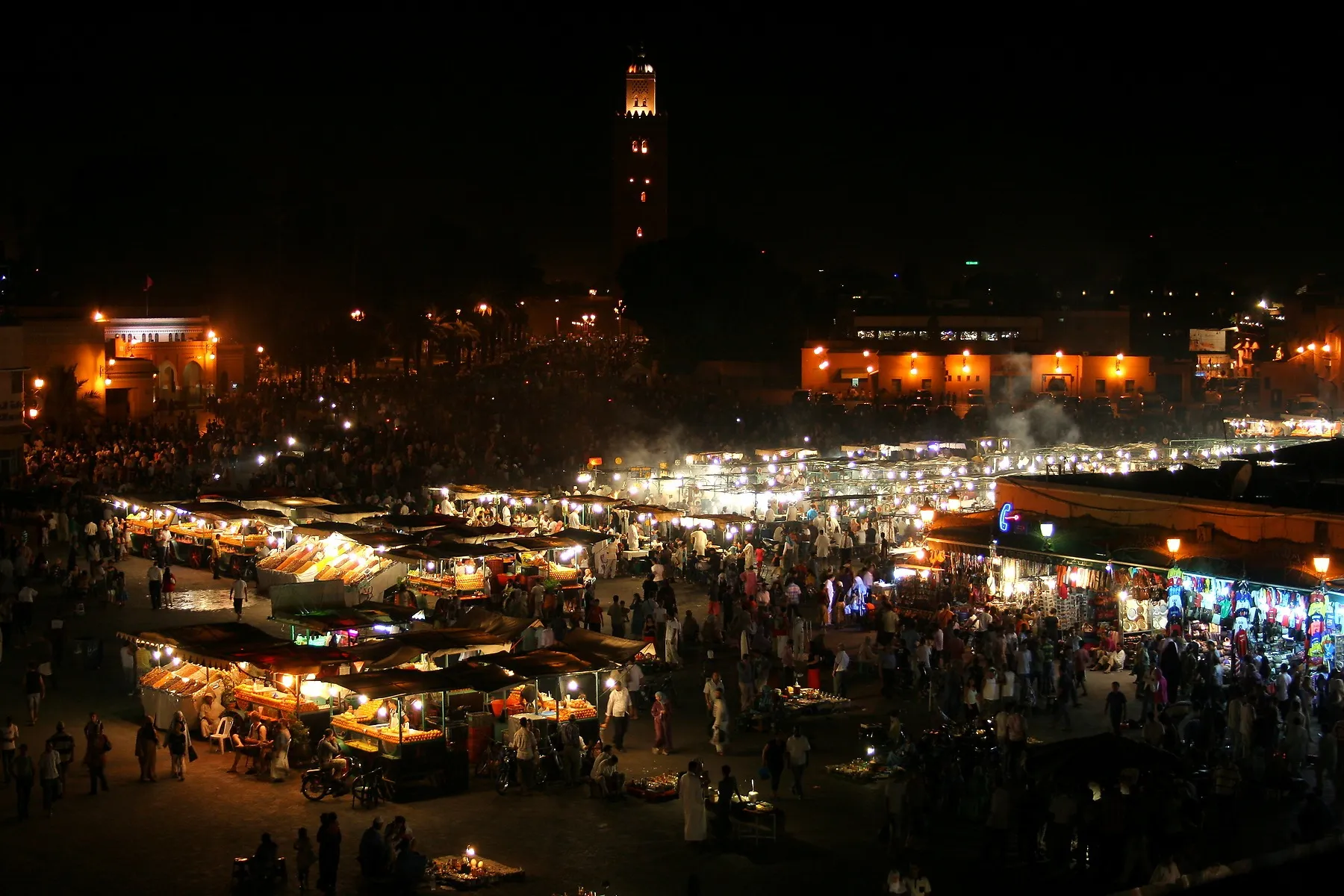
When the sun dips behind the Koutoubia and the swifts give way to swirls of smoke, Jemaa el-Fna square sheds its skin. In just a few minutes, dozens of numbered food stalls rise out of nowhere: trestles, tarpaulins, wooden benches, bare bulbs and glowing braziers. It is one of the largest open-air restaurants on the planet, serving more than 10,000 meals every night and welcoming, over the course of a year, upwards of a million food lovers from all over the world. Eating at Jemaa el-Fna is not just about nourishment: it means plunging your hands into the culinary memory of Marrakech, between tanjia (slow-cooked meat) simmered under embers, snails eaten with a pin, and orange juice pressed before your eyes. This guide tells you where to sit, what to order, how much to pay and how to sidestep the traps so you keep only the pleasure.
The stalls on the square: a pop-up restaurant built every night
Perhaps nowhere in the world is there a culinary spectacle as theatrical as the nightly build-up of Jemaa el-Fna's food stalls. In the late afternoon, the square still belongs to the storytellers, the snake charmers, the juice sellers and the Gnaoua musicians. Then, as dusk approaches, carts converge, metal frames unfold, tarpaulins are stretched taut and the large painted numbers light up. What was merely an esplanade is transformed into a labyrinth of steaming street kitchens, arranged in rows, each identified by a number visible from afar.
Each stall works like a small, self-contained restaurant, with its grill cooks, its touts-cum-waiters and its long communal tables where you sit elbow to elbow with locals and travelers. The crowds peak roughly between 8 pm and 11 pm; the first stalls, however, set up as early as 6 pm to 7 pm, and some specialties (snails, sheep's heads) are sometimes enjoyed earlier. The season, the weather and the calendar — Ramadan in particular, which upends the schedule — can shift this rhythm: treat these time slots as guides, not certainties.
The principle is simple and universal: you wander the aisles, let yourself be (gently) hooked by the touts who tout their menu in several languages, spot a stall that appeals to you, sit down and order. The dishes arrive quickly, often to share, and the bill is settled in cash. It is loud, smoky, joyful, a touch chaotic — and that is exactly what you come here for.
How the numbered food stalls are organized
The stalls are not arranged at random. You will generally notice groupings by specialty: a section for snails, a zone for grills and skewers, a corner for soups and sheep's heads, a row of juice carts around the edge of the square. The painted numbers make it possible to find a stall again from one night to the next, but be careful: locations and reputations change, and a "famous" number you heard about a few years ago is no guarantee of quality today. Trust a far more reliable indicator instead: real-time popularity.
A stall packed with Marrakchis (locals), where the dishes turn over nonstop and there is almost a queue, beats any ranking. Fast turnover goes hand in hand with freshness, cooking to order and sensible prices. Conversely, be wary of a deserted stall whose tout insists a little too much: if he has to work that hard to convince you, maybe the regulars are avoiding him.
✅ The golden rule against nasty surprises
- Choose a very busy stall, especially one full of locals: high turnover = fresh ingredients and piping-hot dishes.
- Insist on dishes served scalding hot and thoroughly cooked. Meat grilled through, a steaming soup, a crisp fry-up: heat is your best ally.
- Drink bottled water uncapped in front of you, and avoid ice cubes of unknown origin.
- Always ask the price before ordering and have them spell out what is included (bread, olives, sauces).
- Trust your nose and your eyes: a clean work surface, lively embers and a line of local diners are worth more than any sign.
What you absolutely must try: the specialties of Jemaa el-Fna
The square's menu is a distillation of everyday Moroccan cuisine, with a few treasures unique to Marrakech. Here are the must-haves, from the signature dish to curiosities for adventurous palates.
Tanjia, the signature dish of Marrakech
If you were to remember just one dish, it would be tanjia (or tangia), slow-cooked meat in a clay urn. It is the emblematic dish of Marrakech, inseparable from its working-class history. It is made by cooking lamb for a long time — sometimes beef — flavored with cumin, preserved lemon, garlic, saffron and smen (a fermented butter with a powerful aroma), all drizzled with a thread of olive oil. There are no vegetables, or almost none: the magic lies in the slowness of the cooking.
Tanjia takes its name from the tall, pot-bellied earthenware urn in which it simmers. Traditionally, a worker would fill his urn in the morning, seal it, then hand it to the fernatchi, the keeper of the hammam's furnace, who would bury it in the hot ashes of the hearth. There, over many hours — often cited as around 6 to 8 hours depending on the source and the furnace — the meat turned into tender, almost confit flesh, coated in a dense, amber sauce. On returning from work, the meal was ready. This preparation, historically male and associated with craftsmen and single men, earned tanjia its delicious nickname of "the bachelor's dish."
On the square, it is served scalding, to be pulled apart with a fork, generally accompanied by bread for mopping up. It is rich, deep, comforting. To learn more about its origins, see the Tanjia page on Wikipedia.
Snails (babbouche / ghlal), the ritual with a pin
You cannot miss the big steaming pots where mountains of snails, called babbouche or ghlal, simmer away. They are served to you in a bowl, bathed in a spiced broth with medicinal flavors: thyme, licorice, aniseed, seeds and a whole bouquet of aromatic plants. You extract each snail with a small pin, then — this is the secret — you drink the broth at the end, straight from the bowl. Marrakchis regard it as a remedy for chills and minor winter ailments. Cheap, hot and fragrant, it is the perfect snack to get you started.
Harira, the soup that warms you up
Harira is the great national soup (a hearty tomato-and-legume soup), served year-round on the square and especially present during Ramadan, when it breaks the fast. Creamy and nourishing, it combines tomato, lentils, chickpeas and a generous bunch of fresh herbs, all seasoned with spices (ginger, pepper, sometimes a hint of cinnamon). It is often enjoyed with dates or dried figs, and a few drops of lemon. For a few dirhams, it is the ideal opener, comforting and easy to digest. Details on the harira page on Wikipedia.
Skewers, kefta and mechoui: the reign of the grill
The beating heart of the square is the grills. On the braziers, skewers of lamb, beef or chicken sizzle alongside kefta, those skewers of minced meat seasoned with cumin, paprika, coriander and parsley. Served with bread, a salad of tomatoes and onions, sometimes fries, and a spicy harissa sauce, they make up the most universal meal on the square.
Look out too for mechoui: slow-roasted lamb with melting flesh, sold by weight and served with a little cumin and salt to dip into. Thrill-seekers will turn to merguez and other spicy sausages that perfume the whole neighborhood.
Sheep's head and offal: for adventurous palates
Curious food lovers will not want to miss the stalls specializing in sheep's head and offal. They serve the cheek, the tongue, the brain, sometimes the eye — considered a choice morsel — all dusted with cumin and salt. It is an authentic experience, prized by locals, that takes a little daring but rewards the curious with surprising tenderness and flavor. Alongside, you will also find tripe and various simmered offal dishes.
Fried fish, tagines and couscous
Marrakech is not by the sea, but the stalls of fried fish and seafood — small whiting, calamari, battered shrimp — are among the most popular on the square. Breaded and plunged into boiling oil, served with a wedge of lemon, they are irresistible when the fry-up is fresh and crisp.
You will also find the great Moroccan classics: the tagine, that stew simmered in its conical dish (lamb with prunes, chicken with preserved lemon and olives, kefta with eggs), and couscous, traditionally served on Fridays. These slower dishes are better appreciated in the small restaurants around the edges or in the adjacent lanes than at the grill stalls, but you come across them on the square too.
Msemen, meloui and sweets
On the layered pancake front, msemen (a square, soft, flaky flatbread) and meloui (rolled in a spiral) are enjoyed both savory and sweet: plain, with honey, with amlou, or filled. Do not leave without tasting the Moroccan pastries — gazelle horns, chebakia, briouates with honey and almonds — and the stalls overflowing with dried fruits and dates, perfect for a snack or a gift to bring home. It all ends, invariably, with a glass of scalding, sweet mint tea, the famous "Berber whisky."
Freshly squeezed orange juice: the square's refreshing icon
Even before nightfall and its food stalls, the square belongs to the orange juice carts. Lined up by the dozen, topped with pyramids of citrus, they press a fresh juice in front of you for just a few dirhams. It is one of the great pleasures of Jemaa el-Fna: simple, vitamin-packed, thirst-quenching under the Marrakech sun. Depending on the season, you will also find grapefruit juice, and sometimes more elaborate blends (pomegranate, avocado, fruit mixes).
A few precautions are worthwhile: ask for a juice pressed to order rather than one from an already-filled pitcher, and if you are sensitive, specify "no ice and no added water." Confirm the price before you hand over your glass: this is where small, unjustified surcharges sometimes creep in. Finally, keep your change ready to avoid games with the change.
⚠️ Watch out for inflated bills
The main trap on the square is not culinary but financial. A few reflexes will spare you the nasty surprise:
- Have the prices announced before you order, dish by dish, and be wary of menus with no prices displayed.
- Politely refuse unordered "extras": extra bread, olives, salads, sauces or "complimentary" skewers that then appear on the bill.
- Check the bill line by line and count what you actually ate. In case of disagreement, stay calm but firm.
- Pay in small notes and count your change on the spot.
- For a complete overview of the traps, read our feature on the scams of the square and our safety and scams page.
Rooftop terraces with a view: dine or sip tea above the fray
To catch your breath, gain some height and take in all the buzz of the square, nothing beats a panoramic terrace. The cafés lining Jemaa el-Fna offer fitted-out rooftops from which the spectacle — the rising smoke, the lights coming on, the Koutoubia in silhouette — reaches its peak at sunset. The food there is often more conventional and a little pricier than at the food stalls, but what you are really paying for is the view and the relative calm.
- Grand Balcon du Café Glacier — Regularly cited as the best vantage point over the square at sunset. Its terrace faces the entire esplanade: arrive early to grab a front-row seat at the golden hour. People come here mainly for a tea, a soft drink or a coffee while admiring the panorama.
- Café de France — A historic institution on the edge of the square, with a tiered terrace offering a classic bird's-eye view. Ideal for a first reconnaissance.
- Restaurant Argana — A well-known address on the edge of the square, appreciated for its unobstructed view from the upper floors.
- Café Zeitoun — A panoramic terrace serving drinks and Moroccan cuisine facing the action.
Our advice: combine both experiences. Start with a mint tea at sunset on a terrace to grasp the scale of the place, then head down to dine at the food stalls for the energy, the flavors and the prices. It is the best of both worlds.
What to order and at what price: the benchmarks
Here is a summary table of the flagship dishes, with a description, an indicative price range and a practical tip. The prices are given as a guide: they vary depending on the stall, the season, the quantity and your bargaining skill. Always check before you order.
| Dish | Description | Indicative price | Good to know |
|---|---|---|---|
| Tanjia | Lamb (sometimes beef) confit with cumin, preserved lemon, garlic, saffron and smen, simmered for hours in a clay urn | Variable, often the most "premium" part of a meal | The signature dish of Marrakech; order it piping hot, plan for bread |
| Snails (babbouche) | Bowl of snails in a spiced broth (thyme, licorice, aniseed, plants) | A few dirhams per bowl | Eaten with a pin; drink the broth at the end |
| Harira | Soup of tomato, lentils, chickpeas and herbs | A few dirhams per bowl | An ideal starter; often served with dates |
| Skewers / kefta | Grilled or spiced minced meat, served with bread and salad | Priced per skewer or per portion | Check the unit price; count on several skewers per person |
| Mechoui | Slow-roasted lamb, sold by weight, cumin and salt | Depending on the weight requested | Specify the quantity to avoid surprises |
| Fried fish | Small fish, calamari, shrimp, fried | Shared portion | Best when the fry-up turns over quickly |
| Sheep's head / offal | Cheek, tongue, brain, dusted with cumin | Affordable portion | For adventurous palates; specialized stalls |
| Msemen / meloui | Layered flatbreads, sweet (honey) or savory | A few dirhams each | Perfect for breakfast or a snack |
| Freshly squeezed orange juice | Fresh orange pressed at the cart | ≈ 4 to 10 MAD | Insist on juice pressed in front of you, confirm the price |
| Mint tea | Sweet green tea with fresh mint | ≈ 15 to 30 MAD (terrace) | Pricier on a panoramic terrace: you are paying for the view |
Summary price grid
To help you budget your evening, here is a grid of benchmarks. Reminder: these amounts are indicative and do not replace asking the seller before you order.
| Item | Indicative range (MAD) | Approximate equivalent |
|---|---|---|
| Full meal at a stall (per person) | ≈ 40 to 100 MAD | ≈ €4 to €10 |
| Bowl of harira or snails | A few dirhams | < €1 to €2 |
| Freshly squeezed orange juice | ≈ 4 to 10 MAD | < €1 |
| Mint tea (terrace) | ≈ 15 to 30 MAD | ≈ €1.5 to €3 |
| Drink on a panoramic terrace | Higher than the food stalls | Variable |
A celebratory meal for two, with starters, grills, a shared tanjia, drinks and sweets, generally remains very reasonable compared with European standards — it is one of the great draws of the square. Always plan for cash in small notes: the stalls do not accept credit cards.
Eating well without going wrong: expert tips
Hygiene: the right reflexes
The street food of Jemaa el-Fna has a bad reputation among anxious travelers, often unfairly. The key comes down to one word: turnover. A stall that serves dozens of meals per hour nonstop gives food no time to sit. So favor the packed stalls, dishes cooked to order and served scalding hot, and fried food that is still sizzling. Avoid lukewarm preparations that are waiting around, sauces at room temperature, abundantly rinsed raw vegetables and ice cubes of uncertain origin. Drink capped bottled water. These simple precautions are enough for the vast majority of visitors to fully enjoy the square.
Bargaining and communicating with a smile
The touts are part of the folklore: they will hail you with humor, in French, English, Spanish. Nothing obliges you to stop at the first call. Take the time to make a full tour of the aisles, watch where the locals eat, then choose. Once seated, stay in control: order precisely, refuse what you did not ask for, and keep smiling. Good humor is the best currency in Marrakech.
When to come and how to plan your evening
To experience the square at its height, aim for nightfall. Arrive around 6 pm to 7 pm for a terrace tea at sunset, then head down around 8 pm to 9 pm, when all the food stalls are running at full tilt. Marrakchi families often dine late: the atmosphere only fades around midnight. If you are traveling during Ramadan, be aware that the schedule and the offering change radically, the square coming alive mainly after the breaking of the fast.
To extend your exploration, wander the adjacent lanes and souks that border the square: you will find mechoui alleys, rotisseries, sellers of khlii (dried meat) and small shops open late. And for everything to do with logistics — schedules, access, ATMs, toilets, transport — see our practical info on Jemaa el-Fna. Finally, gastronomy is only one facet of the square: discover everything there is to see and do in our guide to what to do at Jemaa el-Fna.
A listed square, a living heritage
Eating at Jemaa el-Fna also means taking part in a recognized heritage: the square and its oral and culinary traditions are among the expressions of the intangible cultural heritage of humanity. Every grilled skewer, every urn of tanjia, every shared bowl of snails carries on a centuries-old story. To delve deeper into the kingdom's world of flavors, the reference page on Moroccan cuisine on Wikipedia offers an excellent overview.
In short: come on an empty stomach and with an open mind. Start with a harira or a bowl of snails, treat yourself to the tanjia simmered under the embers, follow with steaming skewers, finish with a honey msemen and a mint tea on a rooftop facing the setting sun. Ask the prices, refuse the extras, check the bill — and let the liveliest square in Morocco feed you with its thousand flavors.
Photo : Andrzej Kosiński — CC BY-SA 3.0