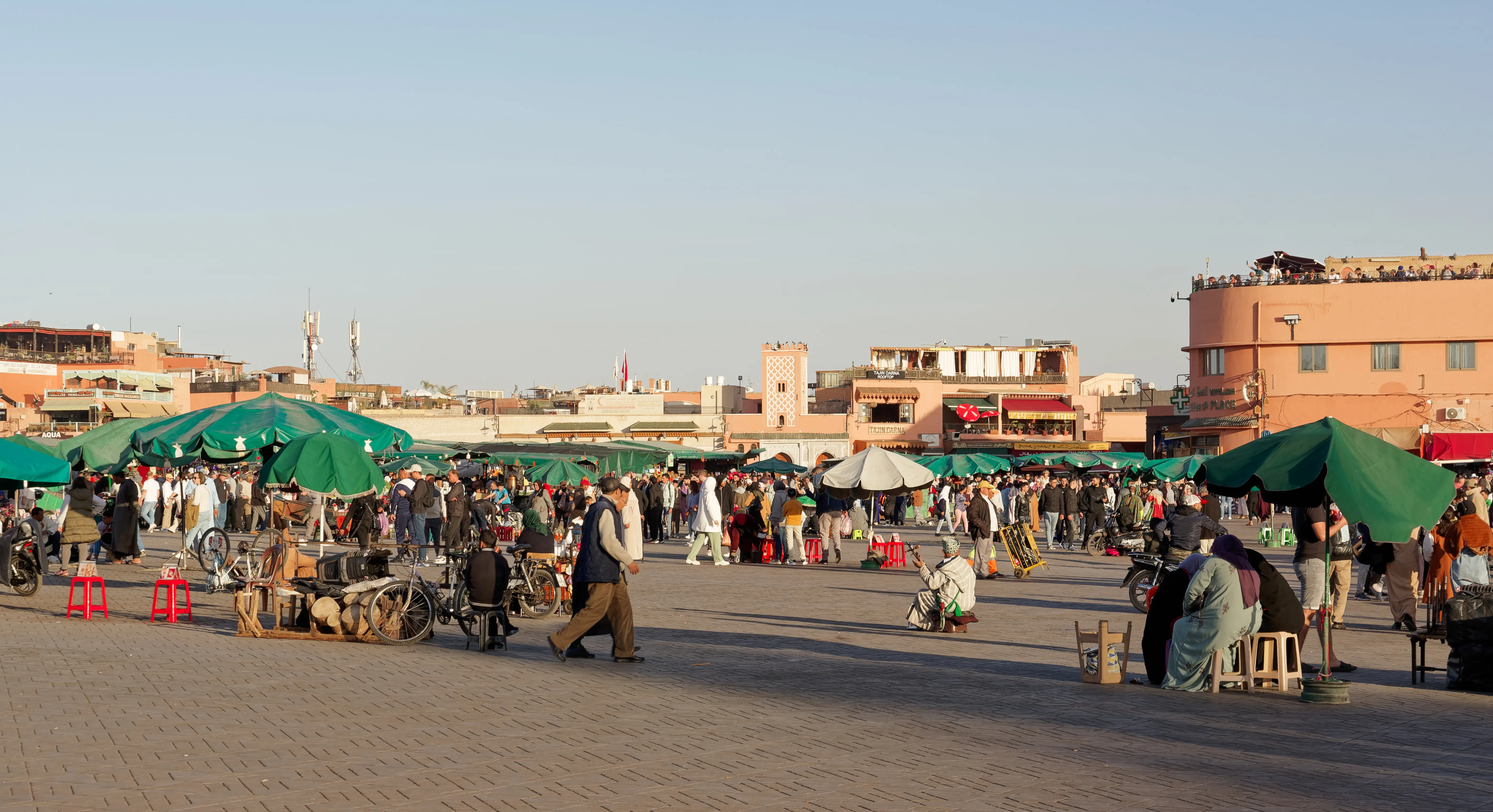
Jemaa el-Fna is the beating heart of Marrakech: a permanently open, free and lively public space where storytellers, musicians, orange-juice vendors and open-air kitchens all come together. To make the most of it without any nasty surprises, it pays to know in advance when the square comes alive, how to get there, the best time of year to visit and a rough idea of prices. This practical guide brings together the essentials — opening hours, access, ideal season, currency and indicative prices — so you can plan your visit with peace of mind. Important: all prices and hours mentioned here are indicative and can vary depending on the season, the time of day, negotiation and context; treat them as guideposts, not official rates.
Opening hours: when the square comes alive
Jemaa el-Fna has no opening hours in the strict sense: it is an open-air public space, accessible 24 hours a day and free of charge. There is no gate, no ticket and no closing time. What has made its reputation, however — and earned it a place on UNESCO's list of the Intangible Cultural Heritage of Humanity — is a daily rhythm of entertainment that is very clearly marked. Understanding that rhythm means choosing the right moment to come.
Morning: calm and soft light
Early in the day, the square is relatively quiet. Snake charmers and a few orange-juice vendors set up, café terraces open, and the atmosphere stays peaceful. It is a good window to photograph the site without the crowds, have breakfast on a terrace or simply cross the square towards the neighbouring souks. The morning light is pleasant and the heat still bearable, even in summer. The trade-off is that the festive buzz is not there yet: few musicians, few storytellers, no food stalls.
Afternoon: building momentum
From mid-afternoon onwards, the square gradually fills up. Around 5 p.m., the entertainment ramps up noticeably: troupes of Gnaoua musicians arrive, along with acrobats, fortune-tellers, monkey handlers and henna artists. This is also when the large food-stall carts begin to roll out and set up for the evening service.
Evening: the peak
The evening is the high point, the climax of Jemaa el-Fna. After sunset, the square turns into a vast open-air theatre: dozens of food stalls lined up beneath the smoke and lights, circles of spectators around storytellers and musicians, the smell of grilled meat and mint tea. This is the experience not to be missed. The food stalls generally close around 11 p.m. to midnight (indicative timing, varying with the crowds and the season). After that, the square empties out little by little but stays accessible.
Summary table of the day's rhythms
| Time of day | Atmosphere | What you'll find |
|---|---|---|
| Morning (8 a.m. – 12 p.m.) | Calm, bright | Cafés, orange juice, snake charmers, crowd-free photos |
| Afternoon (12 p.m. – 5 p.m.) | Building up | Rising activity, stalls setting up, henna, musicians |
| Late afternoon (5 p.m. – 7 p.m.) | Buzzing | Peak of the shows, sunset from the terraces |
| Evening (7 p.m. – 11 p.m./midnight) | Climax | Food stalls, storytellers, music, dense crowds |
| Night (after midnight) | Winding down | Stalls closing, quieter square but still accessible |
To know exactly what to see and when (shows, performers, iconic stalls), check out our dedicated guide: what to do at Jemaa el-Fna.
Access: how to get to Jemaa el-Fna
Jemaa el-Fna occupies a central, easy-to-spot position: it sits at the heart of the Marrakech medina, forms a vast irregular triangle and marks the junction between the city and the entrance to the souks. The great Koutoubia Mosque, with its minaret visible from afar, stands a few minutes' walk away and serves as a foolproof landmark for finding your way back. Here are the main ways to reach it.
On foot from the medina
If you are staying in a riad in the medina, the square is almost always reachable on foot within a few minutes. The lanes are narrow, sometimes labyrinthine, but all the main thoroughfares converge on Jemaa el-Fna. It is the simplest, free and most authentic option. A tip: spot the Koutoubia minaret and follow the flow of people in the evening — it leads naturally towards the square.
By petit taxi
The petits taxis of Marrakech are beige (sometimes described as ochre or cream). They circulate around town and can drop you off on the edges of the square — they cannot enter the pedestrian lanes of the medina, but stop on the main roads that border it. A petit taxi in principle carries no more than three passengers.
By horse-drawn carriage
Horse-drawn carriages ("calèches") are a picturesque, if touristy, way to reach or skirt the square, especially from the ramparts or the gardens. The fare must be negotiated before departure and depends on the duration and the route. It is more of a leisure ride than a real means of transport, but families tend to enjoy the experience.
By bus from Guéliz and the new town
From the modern district of Guéliz or other areas of the new town, several urban bus lines serve the edges of the medina and the square. The bus is very cheap (a few dirhams) but less practical with luggage or for getting your bearings on a first visit. For a short stay, a taxi or walking often remains simpler.
From Marrakech-Menara airport
The international airport Marrakech-Menara (code RAK) lies about 5 to 6 km from the centre and the square — roughly fifteen to twenty minutes by road depending on traffic. Three main options are open to you.
- Bus no. 19 (airport shuttle, operated by Alsa) links the airport to the city centre and stops close to Jemaa el-Fna (Arset El Bilk / Place stop, indicative). It runs at regular intervals throughout the day. Indicative fare of about 30 MAD one way (around 50 MAD return), payable on board. It is the most economical option. The stop is just outside the airport, behind the taxi rank.
- The petit taxi from the official airport rank: quick and practical with luggage. Expect an indicative fare of about 70 to 150 MAD depending on negotiation and the time of day; a night surcharge (often +50%) generally applies. Some drivers quote flat fares of 150–200 MAD: this is above the fair price, so negotiate or move on to the next taxi.
- A private transfer booked in advance (a driver holding a sign on arrival): the most comfortable option and haggle-free, at a fixed price agreed beforehand, a little more expensive than a taxi.
Comparison table: access from the airport (indicative)
| Means of access | Duration | Indicative cost | Comfort |
|---|---|---|---|
| Bus no. 19 (Alsa shuttle) | ~20-30 min | ~30 MAD/person | Simple, economical; less practical with luggage |
| Petit taxi (airport rank) | ~15-20 min | ~70-150 MAD (night surcharge) | Fast; negotiation or meter needed |
| Booked private transfer | ~15-20 min | Higher, fixed price | Maximum comfort; driver on arrival, no haggling |
Note: taxis and buses drop you off on the edges of the square; the last few metres to the heart of Jemaa el-Fna are on foot, as the area is largely pedestrian.
To get around the rest of the city afterwards (Gueliz, the Majorelle Garden, Hivernage), this guide to getting around Marrakech by taxi, bus or horse-drawn carriage compares each option, with indicative prices and the pitfalls to avoid.
Accessibility: reduced mobility, strollers and crowds
The square itself is broadly flat and step-free, which makes it navigable in a wheelchair or with a stroller, especially during the day when the crowds are thin. The difficulties come mainly from three factors:
- The evening crowd: in the evening, the density of people can be very high around the performance circles and between the stalls. For people with reduced mobility, families with strollers or young children, it is often more comfortable to come in the late afternoon, before the peak, or to watch the show from a terrace above.
- The surface and surroundings: the square is open and clear, but the lanes of the adjacent souks are narrow, uneven, sometimes cluttered with motorbikes and goods — trickier in a wheelchair or with a stroller.
- Noise and sensory stimulation: music, crowds, smells and solicitations can be intense; those who are sensitive will appreciate the quieter morning windows.
The café and restaurant terraces that line the square offer an elevated, restful vantage point: many are reached by stairs, and a few newer establishments have a lift, but this is not universal — it is best to check on the spot.
Where to park: nearby car parks
Since the medina is largely pedestrian, you cannot park on the square itself. If you come by car (rental, excursion), several solutions exist on the outskirts:
- Supervised surface car parks are located near the square and the Koutoubia; an attendant guides you and watches over the vehicle in exchange for a tip or a modest hourly rate (indicative). Agree the price on arrival.
- More organised car parks exist on the edge of the medina and let you finish on foot or by petit taxi.
- Many travellers choose to leave the car at the hotel/riad and reach the square another way: parking and driving in the medina are inconvenient.
Best time of year and time of day to visit
Marrakech can be visited all year round, but the city's continental, semi-arid climate makes some seasons distinctly more pleasant than others for strolling outdoors on the square.
The ideal seasons: spring and autumn
Spring (March to May) and autumn (September to November) offer the most comfortable conditions: sunny, mild days, pleasant evenings, bearable heat. These are the best times to enjoy long evenings on the square and walks through the souks. They are also the most touristy seasons: expect bigger crowds and higher demand for accommodation.
Summer: very hot
From June to August, the heat can be gruelling, often above 40 °C during the day. The square is then best experienced early in the morning and in the evening, once the furnace has died down. If you travel in summer, stay constantly hydrated, protect yourself from the sun, and save outdoor activities for the cooler hours. The upside: sometimes gentler prices and a pleasant square by night.
Winter: mild by day, cool in the evening
From December to February, the days stay mild and sunny, ideal for sightseeing, but the evenings are cool — bring a jacket to enjoy the square after sunset. Winter is a good season away from the big crowds, provided you accept cool nights.
Weather and crowds by season (indicative)
| Season | Months | Climate | Advice |
|---|---|---|---|
| Spring | March – May | Mild and sunny, pleasant evenings | Ideal period; book early, high crowds |
| Summer | June – August | Very hot, often > 40 °C | Visit early morning and evening; hydration, hat |
| Autumn | September – November | Hot then mild, very pleasant | Excellent period; lovely evenings on the square |
| Winter | December – February | Mild by day, cool in the evening | Fewer crowds; bring a jacket for the evening |
How much time to allow
For a first discovery, allow 2 to 3 hours on the square and its immediate surroundings: enough time to feel the atmosphere build, catch a few shows, drink an orange juice, settle on a terrace for the sunset and dine at the stalls. Enthusiasts will happily come back several evenings, as the atmosphere changes from one day to the next.
- Express visit (30-45 min): cross the square, take a few photos, drink a juice. Enough for a glimpse, but you miss the essentials — the evening atmosphere.
- Recommended visit (2-3 h): arrive in the late afternoon, sunset on a terrace, dinner at the stalls, street performances. The ideal formula.
- Immersion (half a day or more): combine the square with the nearby souks and monuments during the day, then come back in the evening.
To extend your discovery, explore what lies around Jemaa el-Fna (Koutoubia, souks, palaces, gardens) and dive into the history of the square to make sense of what you see.
Currency and payment on the square
Morocco's currency is the Moroccan dirham, written MAD or DH. As a rough guide, €1 equals about 10 to 11 MAD (a rate to check at the time of your trip, as it fluctuates). The dirham is what is known as a "closed" currency: you mainly obtain it locally, at cash machines (found around town, including near the square) or at exchange bureaus.
- Withdraw before coming to the square, or during the day: nearby machines can run out of notes on a busy evening.
- Break up your large notes elsewhere (a café, a shop) so you arrive with small denominations.
- Bank cards: accepted in some restaurants with a terrace and in hotels, but never at the street stalls. Don't count on them on the square itself.
- Keep your money spread out and discreet: the dense evening crowd calls for the usual anti-pickpocket vigilance.
Indicative prices: what to expect
Access to the square is completely free. Your spending concerns what you consume and the services you choose. Here is a grid of benchmarks — all these amounts are indicative and often negotiable; the real price depends on the time, the season, the stall and your ability to agree the rate in advance.
| Service | Indicative price | Good to know |
|---|---|---|
| Access to the square | Free | Open 24/7, no ticket |
| Meal at a food stall | ~40 – 100 MAD | Check prices before ordering; beware of added "extras" |
| Freshly squeezed orange juice | ~4 – 10 MAD | One of the best value-for-pleasure treats on the square |
| Henna tattoo | ~200 – 500 MAD asked | Negotiate and set it beforehand; agree the design and the total price |
| Photo (monkeys, water seller, cobras) | ~100 – 300 MAD | Agree the price before any photo; otherwise, don't take one |
| Tip for a performer/musician | ~2 – 10 MAD | An appreciated gesture if you watch a show |
Tips for spending wisely
- Ask the price beforehand for each service or dish, and have it repeated clearly.
- Negotiate with a smile: haggling is part of the culture, without aggression. An opening price can often be halved.
- Pay the agreed amount with exact change: pulling out a large note is an invitation to withhold your change.
- Compare the food stalls: menus and displayed prices vary; stalls that are very popular with locals are often a good marker.
- Henna: insist on natural henna (brown/orange), beware of "black henna" which can irritate the skin; agree the design, size and price in advance.
To choose well where and what to eat on the square and nearby, refer to our complete guide: where to eat at Jemaa el-Fna.
Final tips for a successful visit
- Dress comfortably and respectfully: walking shoes, and clothing covering the shoulders and knees is appreciated, especially for women, out of respect for local customs.
- Stay hydrated, especially in summer: bottled water, juice, mint tea.
- Keep your valuables secure in the evening crowd (a closed bag held in front of you, phone put away).
- Photograph people tactfully: ask first, and expect a performer or trader to request a small payment.
- Get up high: a terrace at sunset offers the finest panorama over the square and the Koutoubia — the most memorable keepsake for many visitors.
- Stay relaxed in the face of solicitations: a firm, smiling "no, thank you" is enough; the atmosphere stays good-natured.
Jemaa el-Fna takes a little earning — a minimum of preparation turns a potentially bewildering visit into an unforgettable moment. With the right hours in mind, the right way in, small change in your pocket and the reflex of setting prices in advance, you are ready to fully experience the permanent spectacle of Morocco's most famous square.
Further reading
- Jemaa el-Fna on Wikipedia — history, UNESCO heritage and context.
- Marrakech-Menara Airport on Wikipedia — information on RAK airport.
- Moroccan National Tourism Office (visitmorocco.com) — official information on Marrakech and Morocco.
Reminder: the hours, prices and exchange rates given in this guide are indicative and subject to change. Check sensitive information (transport prices, exchange rate, shuttle timetables) at the time of your trip.
Photo : Jakub Hałun — CC BY 4.0