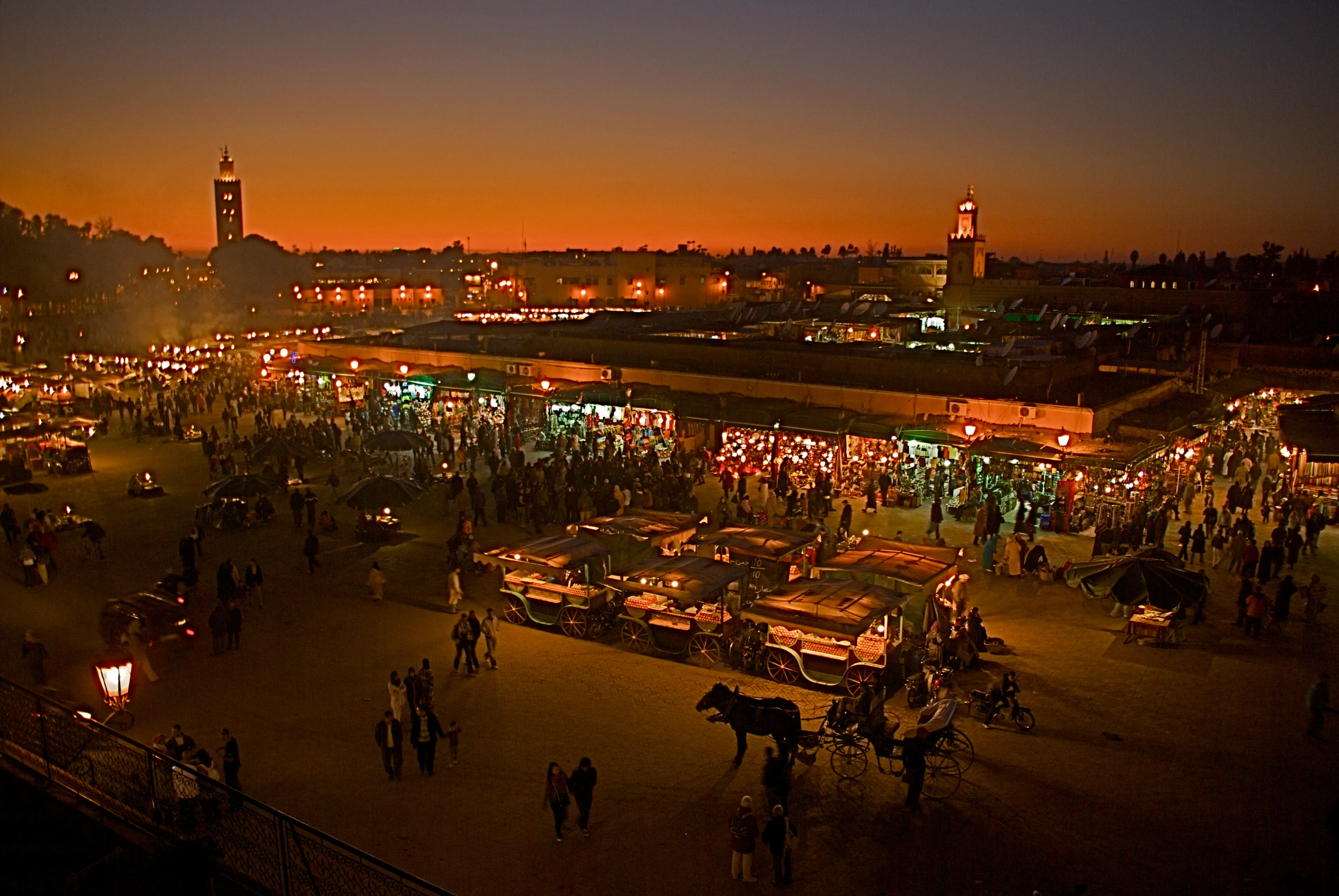
The question comes up again and again before a first trip to Marrakech: is Jemaa el-Fna dangerous? The reassuring answer fits in a single sentence: no, the square is not dangerous in the usual sense of the word. It is one of the busiest and most closely watched places in Morocco, patrolled day and night, where thousands of visitors stroll every evening without the slightest incident. The real risk is not violence — extremely rare — but scams and pushy solicitations: henna forced onto your hand, a monkey dropped on your shoulder for a "photo" billed at 200 dirhams, a helpful stranger who swears "the square is closed tonight." Nothing dramatic, as long as you understand how it works. This article explains, without scaremongering or naivety, what you actually risk, how to sidestep each trap, and how to fully enjoy the most famous square in North Africa with complete peace of mind.
Is Jemaa el-Fna square really safe?
Let's start with the essentials, because this is what worries travelers most. In terms of physical safety, Jemaa el-Fna is generally very safe. The square is the beating heart of Marrakech, an open space where Moroccan families, children, the elderly, tourists from all over the world and vendors constantly cross paths. This steady human density is a form of protection in itself: violent attacks on tourists are exceptional. Morocco, and Marrakech in particular, depends heavily on tourism, and the authorities actively work to protect the reputation of the place.
A reassuring and concrete detail: a tourist police brigade is present on the square and throughout the medina. Its officers, often in uniform, are there precisely to handle disputes, discourage overly aggressive touts and step in when a problem arises. Cases of scammers being arrested do happen: a snake charmer, for example, was detained for trying to charge a tourist an abusive price for a photo. In the vast majority of cases, simply mentioning the police is enough to bring a persistent solicitation to a halt.
That doesn't mean you should drop your guard entirely. As in any major tourist square in the world — from Barcelona to Rome to Paris — pickpockets can operate in the dense crowd, especially in the evening when the square fills up and attention drifts toward the performances. This isn't a Marrakech peculiarity but a universal reflex: keep your valuables close to your body, in a zipped pocket or a bag worn in front of you.
✅ The 3 golden rules
- Nothing is ever free: any object placed in your hand, any spontaneous "help," any "gift" comes with a demand for payment. Decline before the whole thing even starts.
- Always agree on the price BEFOREHAND: photo, henna, dish, taxi ride, service. No clear verbal agreement = no obligation to pay an inflated price.
- "No thank you," smiling, without stopping: don't slow down, don't take what's handed to you, don't follow anyone. Firm politeness is your best weapon.
A measured word about the 2011 attack
In the interest of honesty, we should mention an event some readers know about: on 28 April 2011, a bombing struck the Argana café, on the edge of Jemaa el-Fna square, killing several people of different nationalities. This tragic episode left a lasting mark. But it must be placed in its proper context: it was an isolated, one-off and now distant event, more than ten years old, with no bearing on the current day-to-day safety of the square. Since then, Morocco has considerably strengthened its security apparatus, and Marrakech is today among the most stable tourist destinations in the region. Millions of visitors stay there every year without incident. We mention this fact for the sake of transparency, not to alarm: day to day, your attention should be on your wallet and on petty scammers, not on any major security threat.
For an up-to-date, official assessment, you can always consult the France Diplomatie travel advice for Morocco, which reflects the official evaluation of safety levels country by country.
The 8 classic scams (and how to sidestep them)
Here is the heart of the matter. None of these scams is violent or genuinely dangerous: they are psychological pressure techniques designed to squeeze a few dozen or a few hundred dirhams out of you. Knowing them already neutralizes 90% of them. The principle is almost always the same: someone creates a situation where you feel indebted, awkward or caught off guard, then demands money by playing on the unease of a tourist who doesn't want to "make a scene."
| Scam | How it works | The counter-move |
|---|---|---|
| 1. Surprise photo (monkey / snake / water seller) | A charmer abruptly drops a monkey or a snake on your shoulders, or a water seller steps in next to you. The photo is taken, then 100 to 300 MAD is demanded. | Don't stop near the animals. If a creature is placed on you, step back without touching it and say "no." No photo taken without a price agreed in advance = no payment owed. |
| 2. Forced henna | A woman grabs your hand for a "little free henna," then draws a large design and demands 200 to 500 MAD. The health hazard of "black henna" thrown in as a bonus. | Keep your hands out of reach and never hold out your hand. "No thank you" and keep walking. Absolutely refuse black henna (see below). |
| 3. Fake guide / "closed" square | A stranger claims "the square is closed," that there's a "Berber festival," or that your riad is "this way," then leads you to a shop where he collects a commission. | Never follow a stranger. Trust your GPS. Use only official badged guides. The square is never "closed." |
| 4. Inflated bill at food stalls | At the evening food stalls, you're brought dishes you didn't order, or the final bill far exceeds the posted prices. | Pick a busy stall, ask the price of each dish BEFORE, refuse anything you didn't order, and check the total. |
| 5. Fake "gift" | Someone slips you a bracelet, a prickly pear, a spice "as a gift"… then demands payment once the object is in your hand. | Don't accept anything handed to you. Return the object immediately or put it down. A real gift comes with no bill. |
| 6. Wrong change | The vendor gives change for a smaller note than the one you handed over, or "forgets" part of the change while counting quickly. | Say out loud which note you handed over, count your change on the spot, and always carry small change to pay as exactly as possible. |
| 7. Taxi with no meter | The driver refuses to switch on the meter and announces an inflated flat fare on arrival, especially at night. | Insist on the meter ("meter, please") or negotiate the price BEFORE getting in. Small beige taxis in Marrakech. |
| 8. Currency exchange / fake notes | A "great rate" offered in the street, fake notes slipped into the wad, or an unfavorable rate. | Exchange money only at an official exchange office or bank. Never change money in the street. Check the notes you receive. |
You'll notice that the counter-move is almost always the same: anticipate, accept nothing passively, and set the price before the act. These scammers count on surprise and on your embarrassment. An informed traveler who knows how to say no with a smile and without guilt simply doesn't get caught.
⚠️ The "black henna" trap
Beyond the price scam, black henna poses a genuine health risk. Natural henna is brown-orange; "black henna" often contains paraphenylenediamine (PPD), a strongly allergenic chemical dye. It can trigger serious skin reactions: burns, blisters, lasting scars, lifelong allergic sensitization. If you're set on a henna souvenir, insist on natural henna (orange color), from an artist you've chosen yourself, and categorically refuse any black paste.
⚠️ The fake guide, the most common scam
This is probably the number-one solicitation in the medina. The script: a man, often affable and speaking French, spontaneously "helps" you, claims your destination is closed, or offers to show you a "craftsmen's workshop," a "cooperative," a "traditional festival." In reality it all leads to a shop where he collects a commission, or to a demand for money for his unsolicited services. The rule is simple: never follow someone who approaches you first. Official guides carry a badge and don't tout in the street.
For an even more detailed breakdown of each technique, with concrete examples and firsthand accounts, read our dedicated article: The scams of Jemaa el-Fna square, the complete guide.
Bargaining, prices and tipping: the codes to know
A large part of the unease travelers feel comes from a cultural misunderstanding: in Morocco, bargaining is not a scam, it's the norm. In the souks and for most unpriced services, the quoted price is only a starting point. Negotiating isn't rude; on the contrary, it's expected, and often experienced as a friendly exchange. Refusing to haggle is almost a breach of custom.
The method is simple and best done in good humor:
- Make a counter-offer around 40 to 50% of the first quoted price, then negotiate toward a middle figure.
- Stay smiling and relaxed: bargaining is a social game, not a confrontation. The tone always stays courteous.
- Don't be afraid to walk away: if the price doesn't suit you, thank them and leave. Very often, the vendor will call you back with a better offer.
- Only negotiate if you intend to buy: driving a price down and then refusing is frowned upon.
- Look up the going rates in advance so you don't start from too high a figure.
One caveat, though: bargaining applies to unpriced goods and services. In cafés, restaurants and stalls where prices are posted, you don't haggle — you pay the listed price (which you'll have taken care to check before ordering).
As for tipping, the "baksheesh" culture is very much present but stays modest. For a street performer (storyteller, musician, dancer, acrobat) whose act you've enjoyed or photographed, a tip of 2 to 10 dirhams is perfectly appropriate and welcome. At a restaurant, rounding up the bill or leaving a few dirhams is enough. So always keep small change on you: it spares you the awkward "I have no change" moments and lets you pay for each small service as fairly as possible.
✅ Budget tip
Spread out your money: keep a small amount in small denominations in an accessible pocket for everyday purchases (water, juice, tips, small souvenirs), and the rest separately. That way you never flash a big wad of cash, which protects you both from theft and from tempting the vendor to inflate their prices.
Respect, photos and cultural etiquette
Traveling calmly through Jemaa el-Fna also means respecting the local codes — which, in return, saves you a lot of friction. Two points deserve particular attention.
Photographing people: always ask
The square is a permanent visual feast, and the temptation to photograph everything is strong. But keep one fundamental rule of courtesy and safety in mind: always ask permission before photographing a person, whether an artist, a vendor or a passerby. Many performers make their living from their act and expect a small tip in exchange for a photo — that's legitimate and it avoids any misunderstanding. Photographing a snake charmer or a monkey handler "on the sly" is the surest way to trigger a demand for money. Agree on the principle (and ideally the amount) before you reach for your camera. For wide shots and atmosphere without any identifiable face, you're of course free to shoot.
Dress: keep it modest
Morocco is a Muslim country with cultural codes it's respectful to honor, especially in a place as iconic and popular as Jemaa el-Fna. Without imposing any rigidity, modest, covering clothing is recommended: shoulders and knees covered, particularly for women. It's not a legal requirement on the square, but a mark of respect that eases interactions, makes you better accepted and reduces unwanted stares. Loose, light clothing is also more comfortable in Marrakech's climate. Save the more casual outfits for the riad or hotel pool.
These gestures of respect aren't just constraints: they open doors. A simple "Salam" or "Choukran" (thank you), a modest outfit, a polite request before a photo — and you'll often see the mood shift toward the legendary warmth and kindness of Moroccan hospitality.
Solo women, families and cautious travelers
Visiting Jemaa el-Fna as a solo woman
This is a frequent and legitimate question. The answer is clear: Jemaa el-Fna is very manageable on your own, including as a woman. The extremely lively, crowded nature of the place works in your favor: you're never isolated, there are people everywhere, and the police presence is real. Many solo women travelers explore Marrakech without any trouble.
A few reflexes make the experience completely relaxed:
- Stay in the lively, well-lit areas of the square; avoid heading alone, at night, into the dark and deserted alleys of the medina.
- Give a firm, unambiguous refusal to solicitations and street harassment. A clear "no," without excessive smiling or striking up a conversation, usually puts an end to the persistence. Never feel obliged to respond.
- Carry yourself with confidence: walk with a purposeful step, as if you know where you're going, even while discreetly checking your phone.
- Covering clothing limits stares and unwanted attention.
- In the evening, favor the heart of the square over its outer edges, and head back along busy routes.
Street harassment (comments, attempts to start a conversation) does exist and can be annoying, but in the vast majority of cases it remains verbal and poses no physical danger. The best response is indifference and a steady step.
Traveling as a family, with children
Jemaa el-Fna is a wonderful family destination: children love the shows, the colors, the monkeys (to be watched from afar), the acrobats, the fresh orange juice and the general buzz. A few common-sense precautions apply in such a dense crowd, especially in the evening:
- Hold young children firmly by the hand: the evening crowd is packed and it's easy to lose sight of one another.
- Agree on a meeting point that's visible (a stall, an identifiable café) in case someone gets separated from the group.
- Keep children away from the animals (monkeys, snakes): beyond the photo scam, there's a hygiene and safety concern.
- Watch out for scooters and bikes around the edges of the square and in the adjacent alleys.
- Bring water and plan for breaks: the heat and the crowds can quickly tire out the youngest.
Safety in the evening and at night
The square takes on its full magic at nightfall: this is the time of the food stalls, the storytellers, the Gnaoua musicians and the joyful crowd. The evening isn't more "dangerous," but the peak crowds change two things: pickpockets take advantage of the density, and solicitations multiply. So be extra vigilant with your personal belongings, wear your bag and phone in front of you, and keep your money spread out. Once the peak activity passes and the square empties late at night, apply the usual precautions of any big city: favor busy, well-lit streets to get back, and a small taxi (meter or a price agreed in advance) rather than a long walk through a deserted medina.
Useful numbers and procedures
If you ever need help, note that the tourist police have a presence right on the square: it's your first port of call in the event of a dispute with a vendor, a solicitation that gets out of hand, or a theft. Don't hesitate to approach them. For general emergencies in Morocco, the emergency and police phone numbers are posted in most hotels and riads; ask your accommodation for them on arrival and note them down. (We prefer not to list a specific number here without being certain it's current; your riad, your hotel or the embassy will give you the exact, up-to-date contact details.) If your documents are lost or stolen, get in touch with your consulate or embassy.
⚠️ Valuables and insurance
The most effective advice against theft is still to not display what attracts attention: leave flashy jewelry, large sums and important documents in your accommodation's safe. Bring only what you need to the square. Take out travel insurance covering theft, loss and medical expenses, and keep a digital copy of your documents (passport, credit card) in your email. These precautions turn any potential incident into a mere hiccup.
In short: calm, not dangerous
So, is Jemaa el-Fna dangerous? No. It's a lively, warm, well-watched and generally safe square, where the main nuisance you're likely to encounter is a hand held out for unwanted henna or a monkey dropped on your shoulder. None of these situations is threatening; they all defuse with a smiling "no thank you," a price agreed in advance and the reflex of never accepting anything passively. Keep an eye on your belongings in the evening crowd, respect the cultural codes, trust your traveler's common sense — and you'll live one of the most unforgettable experiences in Morocco.
To best prepare your visit, continue with our practical guides: all the practical information about Jemaa el-Fna, what to see and do on the square, and where and how to eat well at the stalls and around them. You can also dig deeper into the historical and cultural background of the place on the Wikipedia page on Marrakesh, and check the latest official recommendations on France Diplomatie – Morocco.
Photo : procsilas — CC BY 2.0