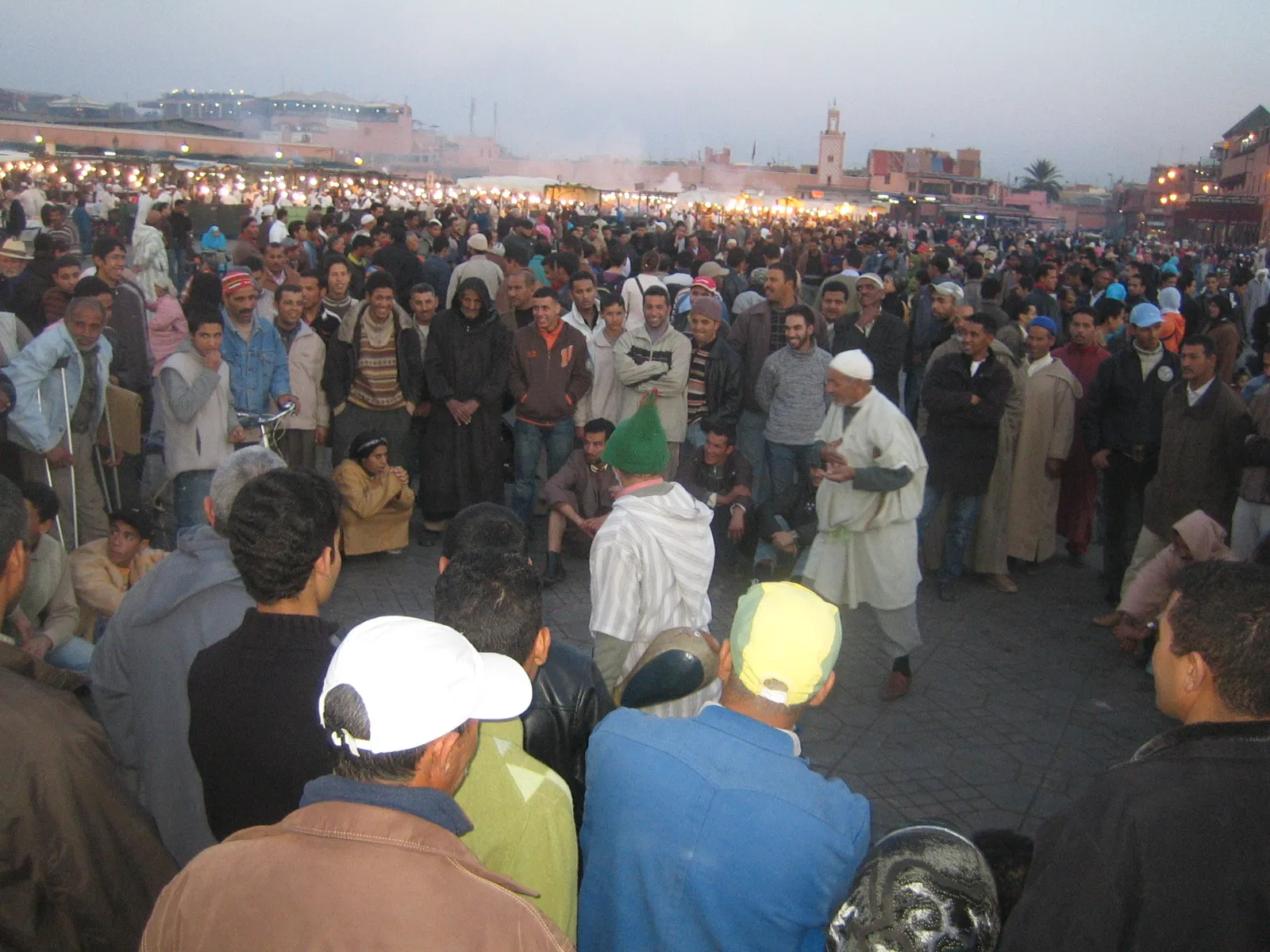
There is nowhere else on earth quite like Jemaa el-Fna square. This vast open triangle at the heart of the Marrakech medina is neither a museum nor a theatre stage: it is a living spectacle that reinvents itself every day, as it has for nearly a thousand years. Storytellers, Gnaoua musicians, snake charmers, herbalists, henna artists and costumed water sellers keep alive a unique oral and gestural heritage, recognised by UNESCO as a masterpiece of the intangible cultural heritage of humanity. This guide explains in detail what to see and what to do on the square, act by act, with indicative prices, customary tips and an honest look at the ethical questions that some practices raise.
Why is Jemaa el-Fna square unique in the world?
Set at the entrance to the medina, between the souks and the Koutoubia mosque, Jemaa el-Fna square has been the beating heart of Marrakech since the 11th century. Its name, whose origin is still debated, evokes at once an "assembly" (jemaa) and a place of ending or disappearance (fna) — a reminder of its past, when the heads of the executed were said to be displayed here. Today the place is quite the opposite: an exceptional distillation of Moroccan popular traditions expressed through music, storytelling, healing and trade.
In 2001, UNESCO proclaimed the square's cultural space a "masterpiece of the oral and intangible heritage of humanity", before inscribing it in 2008 on its Representative List. What is protected here is not a monument of stone, but a living know-how: the words of the storytellers, the gestures of the performers, the daily encounter between locals and travellers. This is also what makes the square fragile, for these traditions depend on the men and women who pass them on, often in precarious economic conditions. To understand how this place took shape over the centuries, our history of Jemaa el-Fna square traces this long memory.
The square is experienced at two speeds. By day it is quieter: a few snake charmers, orange juice vendors, monkey handlers and henna artists. It is in the evening, after sunset, that it transforms into a huge popular festival — storytellers, circles of musicians and the smoke of the food stalls. To experience both moods, plan a first visit in the late afternoon and stay into the night.
Day and night: two squares in one
Understanding the rhythm of the square is the key to missing nothing. In the morning and afternoon, the space belongs mainly to the traders: orange juice pressers lined up beneath their parasols, sellers of dried fruit and dates, a few crowds gathered around the snake charmers and herbalists. The light is beautiful for photos, the crowd thinner, the heat sometimes crushing in summer.
Everything shifts at dusk. The circles of spectators — the famous halqa — form around the storytellers and musicians. Dozens of numbered food stalls set up their trestles in minutes and drown the square in the fragrant smoke of grilled meat. The Gnaoua drums resound, the dancers warm up, the fortune tellers lay out their rugs. It is this nocturnal theatre, spontaneous and ticket-free, that has earned the square its worldwide reputation. To find out where to dine without going wrong, see our guide on where to eat on Jemaa el-Fna square.
The storytellers (hlaykia): the intangible soul of the square
If UNESCO singled out Jemaa el-Fna, it was above all for them. The storytellers, called hlaykia (singular hlayqi), are the intangible heart of the square. Standing at the centre of a circle of spectators, they unfold for an hour or more tales drawn from Arab-Berber heritage: epics, stories from the Thousand and One Nights, Sufi legends, moral or bawdy tales, improvised chronicles of current events. Their art lies as much in the text as in the performance: sweeping gestures, calculated silences, a voice that rises and falls, direct address to the audience.
It is also the most threatened tradition on the square. For a long time, a storyteller trained an apprentice who took up the torch; this oral transmission has become rare. Television, smartphones and economic pressure have reduced the number of master storytellers to a handful, often elderly. To attend a storytelling halqa is therefore to take part in the survival of a knowledge on the verge of extinction. The tales are almost always told in dialectal Arabic (Darija), sometimes in Berber: even without understanding the words, you read everything in the body and the intonation.
In front of a storyteller, slip discreetly into the circle and stay at least a few minutes. When the hat or the bowl comes round, give a small tip (2 to 10 MAD): it is the artist's only income and the gesture that keeps the tradition alive. Do not leave at the exact moment the money is collected — it puts the storyteller in a difficult position in front of his audience.
Snake charmers: heritage and ethical controversy
Their haunting music is impossible to miss: the ghaita, that nasal oboe, resounds right at the entrance to the square. Snake charmers most often belong to the Sufi brotherhood of the Aissawa, founded in the 15th century and renowned for its ritual mastery of fire and reptiles. Legend has it that the descendants of their founding saint, Sidi Ben Aissa, are protected from venom by a baraka passed down for four centuries. The show mixes cobras reared in striking position, vipers handled with bare hands and grass snakes draped over passers-by's shoulders.
Yet this practice must be presented honestly. The "charming" of the snake is a myth: snakes are deaf to the melody and in reality follow the movement of the instrument, which they perceive as a threat. Above all, numerous investigations have documented cruel conditions: venom fangs torn out, mouths sometimes sewn shut, animals caught in the wild and kept in small boxes, exposed to the sun and to permanent stress that sharply shortens their life expectancy. The subject is therefore legitimately controversial: it belongs at once to a genuine brotherhood heritage and to an animal welfare problem.
Animal ethics. Snake charmers and monkey handlers rely on animals that are often mistreated: defanged and stressed snakes, young Barbary macaques — an endangered species — separated from their mothers and kept on chains. If these practices make you uncomfortable, the most effective gesture is not to pay for a photo or a handling session: it is tourist demand that keeps the activity alive. Watching from a distance, without any transaction, remains possible.
The monkey handlers
In the same vein, handlers offer to pose with young Barbary macaques, dressed up, held on a leash or plonked without warning on passers-by's shoulders. The Barbary macaque is an endangered, protected species whose young are often taken illegally from the cedar forests of the Middle Atlas — poaching that puts the species at risk. Here again, the photo is charged for and the handling is stressful for the animal. The most responsible stance is simply to decline politely and continue on your way.
The Gnaoua: trance, guembri and Afro-Moroccan heritage
Among the most hypnotic circles on the square are those of the Gnaoua. Descendants of sub-Saharan slaves brought to Morocco, they have forged a spiritual and musical culture of rare richness, blending West African heritage, Sufi Islam and Berber influences. Their music rests on the guembri (or hajhouj), a three-string gut-strung lute-drum, the qraqeb (large metal castanets with an obsessive clatter) and the drums. The dancers, wearing tasselled caps, spin their shells in a choreography that summons trance.
Originally, this music is not entertainment but a healing ritual, the lila (or derdeba): a nocturnal ceremony where rhythms, colours and incense call the spirits to heal body and soul. On the square you will see a condensed and festive version, but the energy remains intact. Recognition of this art is twofold: the practices and know-how linked to the Gnaoua were inscribed by UNESCO on the intangible cultural heritage of humanity in 2019, and the great Gnaoua and World Music Festival of Essaouira draws hundreds of thousands of spectators every year.
Berber musicians, dancers and acrobats
The square also gives pride of place to Amazigh (Berber) musicians, with their repertoires from the High Atlas and the Souss, their bendirs and their collective chants. You will come across troupes of dancers, sometimes Chleuh performers, as well as acrobats — often from the Amizmiz region — who chain together human pyramids and somersaults. These family-friendly shows, spectacular and free of cruelty, are among the most rewarding to support with a tip.
Summary table of shows and prices
Here is a concise overview of what you will encounter, with the usual orders of magnitude. The amounts are indicative: the square runs on negotiation and tipping, never on an official rate.
| Show | What it is | Indicative price or tip | Good to know |
|---|---|---|---|
| Storytellers (hlaykia) | Oral tales at the centre of a circle | Tip 2–10 MAD | Threatened tradition; in Darija/Berber |
| Gnaoua | Trance music, guembri and qraqeb | Tip 5–20 MAD | UNESCO heritage 2019; no cruelty |
| Berber musicians / acrobats | Songs, dances, human pyramids | Tip 5–20 MAD | Family shows worth supporting |
| Snake charmers | Cobras and vipers to the sound of the ghaita | Photo 100–300 MAD demanded | Ethically controversial; agree the price first |
| Monkey handlers | Photo with Barbary macaques | Photo 100–300 MAD demanded | Endangered species; best avoided |
| Henna (neqqachate) | Temporary tattoos by hand | From ~50–150 MAD depending on the design | Insist on natural henna; price first |
| Water sellers (Guerrab) | Red costume, leather waterskin, copper cups | Photo 10–50 MAD | Mostly a photographic role today |
| Fortune tellers | Reading the future (chouafa) | Variable, to be negotiated | Language barrier common |
Henna: tattoo artists (neqqachate) and the "black henna" trap
Seated beneath parasols, stool and paste syringe in hand, the henna artists — the neqqachate — offer temporary designs on the hands, wrists or ankles: floral arabesques, geometric Berber motifs, bridal patterns. It is a lovely experience and a genuine craft, but it calls for an important health precaution.
Beware of "black henna". Natural henna gives a brownish-orange tint that darkens over a day or two. "Black henna", of an intense and immediate black, often contains paraphenylenediamine (PPD), a strongly allergenic chemical dye. It can cause severe skin reactions, sometimes long-lasting. Always insist on natural henna and refuse any product that promises an instant black result.
Always agree on the design and the price before the first drop touches your skin: some artists start with a small flower announced as cheap, then extend the design over the whole forearm and demand an unrelated sum. A clear rate, a defined motif, left hand or right, and you will avoid the nasty surprise. This kind of disagreement is among the great classics listed in our article on the scams of Jemaa el-Fna square.
The square's small trades: water, teeth, herbs and fire
The water sellers (Guerrab)
The most photographed silhouettes on the square, the Guerrab wear a flamboyant red costume with pompoms, a wide fringed hat, a goatskin waterskin slung across the shoulder and gleaming copper cups, announced by a bell. Once indispensable for quenching the thirst of merchants and travellers, they hardly sell any water today: their role has become essentially photographic. A pose with them costs money, usually 10 to 50 MAD depending on your negotiating skills.
The street dentists
A folkloric curiosity on the way out, the street "dentists" spread out on a cloth heaps of pulled teeth and second-hand dentures, offering extractions and prosthetics right there on the pavement. The spectacle is more of an ethnographic testimony than recommendable care — to be observed, certainly not to be tried.
Herbalists (attarine) and fire-eaters
The herbalists (or attarine) lay out stalls of dried plants, spices, roots, alum stones and traditional remedies, accompanied by voluble explanations of their supposed virtues. As night falls, the fire-eaters shoot their sprays of flames above the circles, adding a spectacular touch to the nocturnal festival. Here again, a small tip is welcome if you stop to watch.
The fortune tellers (chouafa)
Seated on rugs, the chouafa read the future in cards, in the palm or in shells. The experience is picturesque but often limited by the language barrier, and the rate is negotiated case by case. To be approached with a smile and without expecting any revelation.
Photos, tips and money: the rules of the game
The square runs on a performance economy: every gesture is paid for. This is not a scam in itself, it is the artists' wage. The misunderstanding arises when the terms are not set in advance. Two principles are enough to spend a serene evening.
Photos are never free. Photographing a snake charmer, a monkey handler or a water seller entails a payment. The amounts demanded commonly run from 100 to 300 MAD, sometimes per person or per photo. Agree on the price BEFORE taking out your phone, or else photograph the scene from a distance, without framing a particular artist. If a snake or a monkey is placed on your shoulders without warning, move away politely but firmly: you are not obliged to pay for a service you did not request.
For the artists you want to support — storytellers, Gnaoua, Berber musicians, acrobats — a tip of 2 to 10 MAD (up to 20 MAD for a real moment) is appreciated and sufficient. Keep small change in a separate pocket: you give what you want, without having to flash a large note.
A few useful reflexes: never show the contents of your wallet, do not change money with strangers on the square, and beware of the spontaneous "guides" who latch onto you. For an overview of the common pitfalls and the right reflexes, our page dedicated to safety and scams on Jemaa el-Fna details all of this.
The panoramic terraces: seeing the square from above
To grasp the full scale of the spectacle, nothing beats a rooftop terrace, especially at the golden hour of sunset, when the smoke of the food stalls rises through raking light and the call to prayer from the Koutoubia resounds. Two historic addresses overlook the square:
- Le Grand Balcon du Café Glacier: probably the most famous viewpoint, looking straight down onto the swarm of circles and stalls. You buy a drink for the price of the view — arrive early to secure a table by the railing.
- Le Café de France: a venerable institution, another iconic terrace offering a slightly different panorama over the square and the rooftops of the medina.
On these terraces, drinks are expensive by Moroccan standards: it is the "ticket" for the view, not a scam. Order a mint tea or an orange juice, settle in about twenty minutes before sunset, and let the square light up before your eyes. To organise the rest of your visit (opening hours, transport, toilets, cash machines), see our practical information on Jemaa el-Fna.
How to make the most of the square: a suggested itinerary
Here is a simple way to string together the discoveries and experience the square in all its richness, stress-free and while supporting the right artists:
- Late afternoon: arrive around 5 pm. The heat drops, the light is beautiful. Take a first exploratory stroll, spot the circles, drink a freshly squeezed orange juice (check the displayed price first).
- Sunset: head up to a panoramic terrace for the overall view and the magical moment of the day-to-night switch.
- Early evening: go back down into the fray. Approach a circle of storytellers, listen to the Gnaoua, watch the acrobats. Hand out your small tips.
- Dinner: settle at a numbered food stall or head to a quieter address (see our dining guide).
- All evening long: keep your bag in front of you, your phone in a closed pocket, and enjoy. The square is generally safe and very busy, but anti-pickpocket vigilance remains in order in the crowd.
Travelling responsibly on Jemaa el-Fna
Jemaa el-Fna square is a fragile treasure. What you choose to support shapes what will survive tomorrow. By giving a tip to the storytellers, you help keep alive an oral tradition on the brink of extinction. By applauding the Gnaoua, the Berber musicians and the acrobats, you encourage respectful and humane arts. Conversely, by refusing to pay for a photo with a defanged snake or a young macaque torn from its forest, you reduce the economic pressure that fuels these practices.
Approaching the square with curiosity, respect and a little loose change is the best way to honour this place inscribed on the heritage of humanity by UNESCO. Jemaa el-Fna is not a stage set: it is a community of men and women who, every evening, restage a thousand years of living memory. It is up to you to become, for the span of an evening, a kind-hearted spectator.
Photo : Carlos ZGZ — CC0