In Marrakech, haggling is not a battle, and even less a scam: it is an ancient social code, a way to get acquainted, to exchange, and to settle together on a fair price. On Jemaa el-Fna square as in the souks, most goods and services have no fixed price. The first number the seller announces is only an opening bid, a starting point that you are not only allowed but expected to discuss. To refuse to negotiate is a little like missing out on half the experience.
The most useful rule of thumb fits in a single sentence: the first price quoted to a tourist is often 2 to 3 times the real price. A starting counter-offer of around 40 to 50% of the amount quoted is therefore a good anchor, before working your way up gradually to an agreement that suits both parties. It all plays out in good humour, with a smile, without aggression or bad faith.
This guide explains why people haggle in Morocco, how to do it effectively, where it applies (and where it never does), the useful phrases to know, and the mistakes that push the bill up. The goal: that you walk away with a lovely souvenir, a good memory, and the feeling of having played the game.
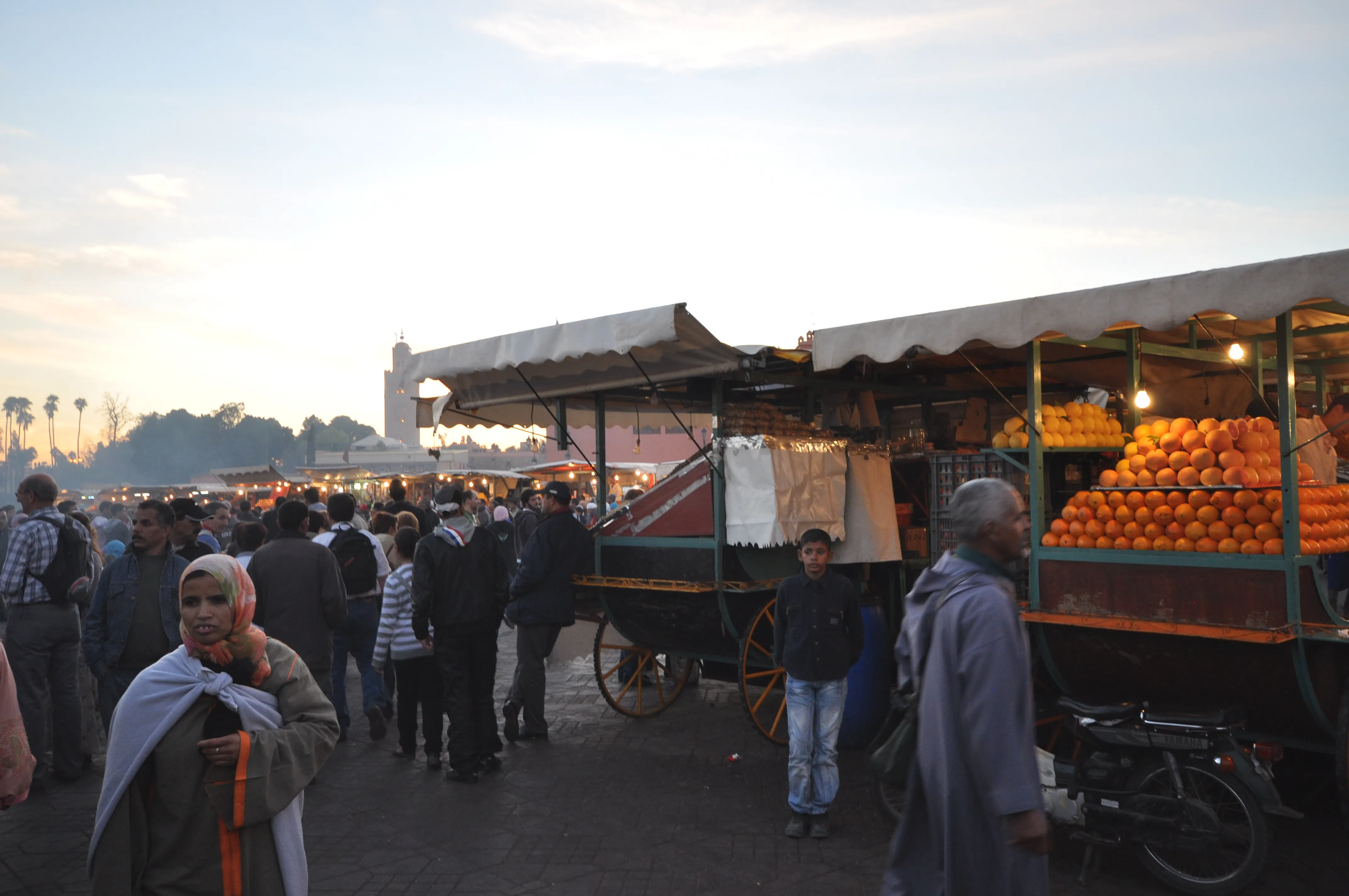
Why do people haggle in Marrakech? A cultural code, not a scam
Haggling (in colloquial Arabic, people speak of the souq, the market, and the discussion that comes with it) is a commercial practice deeply rooted in the Mediterranean and Middle Eastern world. Historically, in an economy without price tags or barcodes, the price was built case by case, according to the relationship, the time of day, the quantity and the perceived quality. This system survives intact in the souks of the medina.
You have to understand that, for the merchant, negotiation is not an attempt to cheat you: it is a conversation, almost a social ritual. You are offered tea, jokes are cracked, mock indignation is feigned, and you move closer in stages. A customer who bargains with a smile is respected; a customer who accepts the first price without flinching is, deep down, a little disappointing. Haggling is a form of commercial politeness, an exchange in which each party looks after its own interest.
That does not mean anything goes. Certain practices, notably around henna, photos with animals or self-appointed “guides”, genuinely qualify as abuse when the price is imposed after the fact. The line is simple: real haggling happens before the transaction, out in the open, and always leaves you free to walk away. Anything that traps you once the service has begun is no longer haggling; it is coercion. To tell the two apart, our feature on security and scams at Jemaa el-Fna details the mechanisms worth knowing.
The 40-50% rule: how to set your counter-offer
Here is the method most seasoned travellers follow, step by step:
- Ask the price while showing polite but measured interest. Do not gush too loudly over the object you covet.
- Listen to the first price without reacting. It is the opening bid, deliberately high.
- Counter with around 40-50% of that amount. If you are told 400 dirhams, offer 150 to 200.
- Let the seller come up, and come up yourself in small increments. The negotiation usually plays out over 3 to 5 back-and-forths.
- Converge on a middle price that feels fair to you. If you cannot reach a deal, say thank you and move on.
These are only benchmarks: a rare object, quality craftsmanship or an antique piece is negotiated less aggressively than a mass-produced souvenir. Conversely, the more common the item (babouche slippers, scarves, lamps, magnets), the wider the room to negotiate. Visit several stalls before buying: comparing three sellers instantly gives you a sense of the real price.
The techniques that really work
Effective haggling has less to do with arithmetic than with attitude. Here are the most powerful levers, all tried and tested in the medina of Marrakech.
- Stay smiling and relaxed. The tone is that of a game, never of a conflict. A laugh, a joke, a compliment about the shop is worth more than icy firmness.
- Know how to walk away. This is by far your best asset. A “thanks, I’ll think about it” along with a few steps towards the exit often makes the price drop instantly. If the seller calls you back, you have found their floor.
- Have small change ready. Take out only the agreed amount, in 20 and 50 dirham notes and coins. Never flash a thick wad: it immediately pushes prices back up.
- Set a mental budget before you start and stick to it. Decide the most the object is worth to you, independently of the first price.
- Don’t give away that you love it. If the merchant senses you absolutely want this item, the negotiation is lost before it starts. Show polite, comparable interest in several pieces.
- Buy in bulk. Three scarves or two pairs of babouches negotiate far better than a single piece. “How much for the three?” is a magic phrase.
- Take your time. Urgency is a seller’s technique, not a reality. “Last price, just for you, I’m closing” should never rush you.
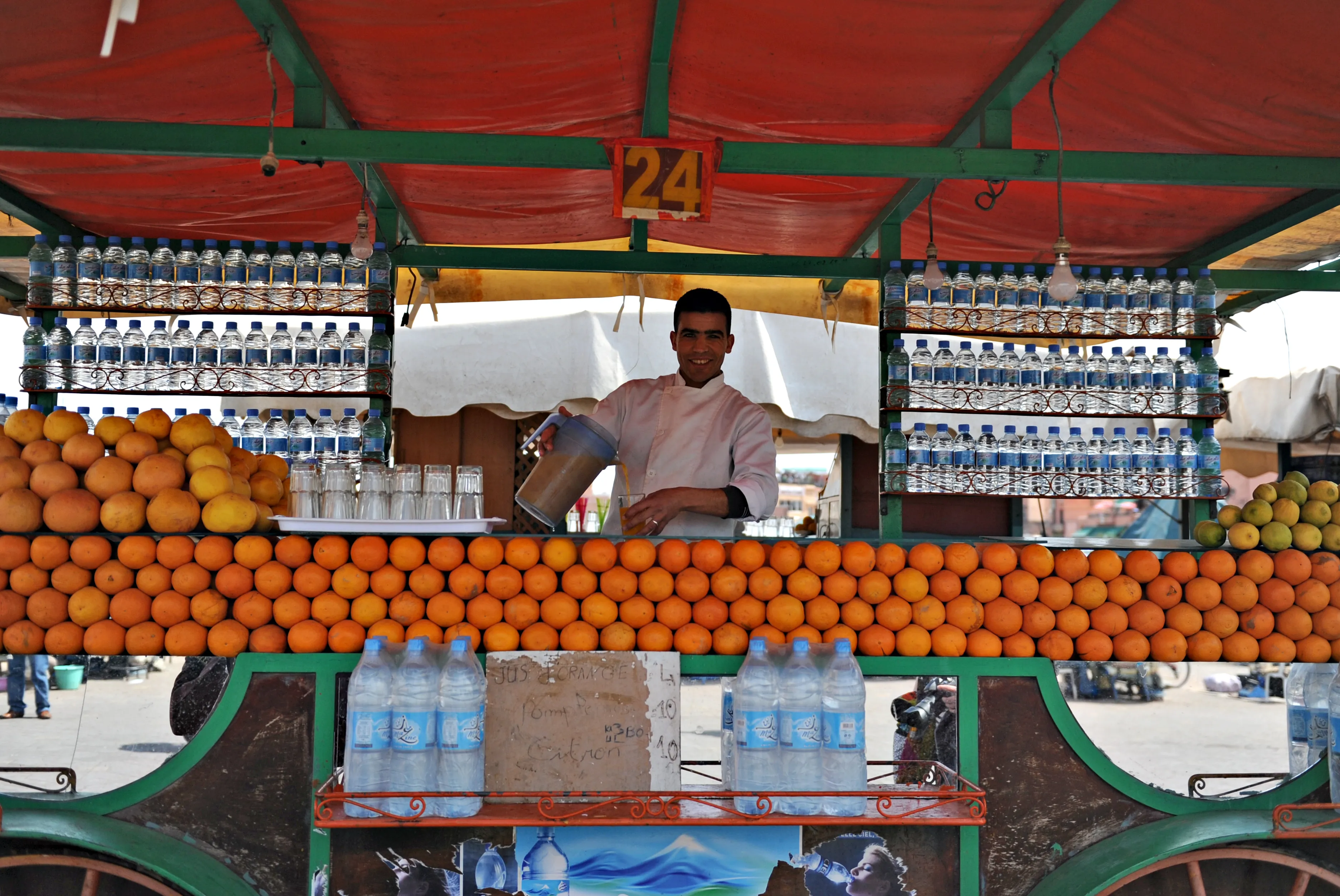
Where do you haggle, and where do you NEVER haggle?
This is the point visitors most often get wrong. Negotiating everywhere, all the time, would make you look clumsy, even rude. The dividing line is actually fairly clear.
You haggle for anything without a displayed price: the crafts of the souks (rugs, leather, copper, pottery, lamps, textiles), souvenirs, henna, photos with the square’s performers, rides in meterless taxis, and certain tourist services.
You do not haggle where a price is displayed or institutional: modern grocery stores and mini-markets, pharmacies, restaurants with a menu and prices, cafés and terraces with a menu, museum or monument tickets, bus tickets, petrol stations. In these places, the price is the price.
The special case is the food stalls of Jemaa el-Fna. You do not really “haggle” over a tagine the way you negotiate over a rug. What is essential, however, is the reflex to ask the price of each dish BEFORE ordering and to refuse the extras (bread, olives, sauces) that appear “on the house” and then turn up on the bill. This is less negotiation than good ordering hygiene. For everything about the stalls and their prices, see our guide on where to eat at Jemaa el-Fna.
| Situation | Haggle? | The right reflex |
|---|---|---|
| Souk crafts | Yes, freely | Counter at 40-50%, compare 3 stalls |
| Henna, photos with performers | Yes, but BEFORE | Price and size fixed in advance, in writing if needed |
| Meterless taxi | Yes | Set the fare before getting in, or insist on the meter |
| Food stall | No (but…) | Ask the price first, refuse the extras |
| Restaurant, café with a menu | No | The displayed price is the price |
| Grocery, pharmacy, museum | No | Fixed price, don’t push it |
For a complete overview of the rates charged on the square, our reference article gives a price guide for Jemaa el-Fna item by item.
A few useful phrases for haggling
You don’t need to speak Arabic: French is very widely understood in Marrakech, and often English too. But dropping in a few words of Darija (Moroccan Arabic) lightens the mood and instantly earns you goodwill — and sometimes a better price.
- “Salam alaykoum” — Hello (the customary greeting, always opens the exchange).
- “Bcharraf / Bchhal hada?” — How much is this?
- “Ghali bezzaf!” — That’s too expensive!
- “Naqqas chwiya” — Lower it a little (the price).
- “Akher taman?” — Is that your last price?
- “La, choukran” — No, thank you (to be said with a smile, ready to leave).
- “Wakha” — Okay, it’s a deal.
- “Choukran bezzaf” — Thank you very much.
Say them with a smile, without striving for perfection. The effort counts more than the accent, and it often turns an anonymous transaction into a real moment of connection.
The mistakes to avoid
Some missteps sabotage the negotiation or, worse, put the traveller in an uncomfortable position. The most common ones:
- Starting a negotiation with no intention of buying. Haggling all the way to the end and then leaving is frowned upon: it is a lack of respect for the seller’s time. If you are not serious, just look.
- Being aggressive or contemptuous. Slashing prices with disdain gives offence. Moroccan haggling is convivial; humour disarms far better than harshness.
- Accepting the first price. Not only do you overpay, but you strip the exchange of its flavour. The seller themselves expects to bargain.
- Haggling over pennies. Fighting for ten minutes to save 5 dirhams on a handcrafted item that took an artisan a long time to make makes no sense. Haggle on principle, not down to the last coin.
- Pulling out all your money. Flashing a wad, or paying for a 20 dirham item with a 200 note (and “never seeing” your change again), are classic mistakes. Anticipate the small change.
- Letting a service begin before the price is set. This is the golden rule, especially for henna and photos: nothing starts until the amount is clearly agreed.
Haggling: a pleasure more than a chore
Ultimately, haggling in Marrakech is a social game from which you can draw a great deal of pleasure. It is neither a war nor a trap: it is a way to meet people, to fall into the rhythm of the medina, and to leave with objects that carry a story. The “fair” price does not really exist; there is only the price you and the seller agree on, with a smile.
Keep in mind the three pillars: stay smiling, know how to walk away, set the price first. With these reflexes and the 40-50% rule, you will move through the souks and across Jemaa el-Fna square with the ease of a regular. And if you occasionally overpay by a few dirhams — it happens to everyone — tell yourself that the difference, for you, is trifling, and that it fed a human exchange you will not forget.
To dig deeper into the culture of the square, UNESCO inscribed the cultural space of Jemaa el-Fna on the intangible cultural heritage of humanity: haggling is, in its own way, part of the living spectacle.
Frequently asked questions
Do you really have to haggle in Marrakech?
Yes, everywhere the price is not displayed: souks, crafts, henna, photos with performers, meterless taxis. It is expected and considered normal. In fixed-price businesses, however (grocery stores, pharmacies, restaurants with a menu, museums, buses), you do not haggle.
How much can you bring the price down?
The first price quoted to a tourist is often 2 to 3 times the real price. A starting counter-offer at 40-50% of the amount asked is a good anchor. The final price usually lands between 50 and 70% of the initial price, sometimes less for very common souvenirs.
Is it rude to haggle?
No, quite the opposite: accepting the first price without discussion is disappointing for the seller. Haggling is a friendly conversation, to be conducted with a smile and humour. What is rude is negotiating at length and then leaving with no real intention of buying, or being contemptuous.
How do you haggle without speaking Arabic?
No problem: French is very widespread in Marrakech. A few words of Darija (“ghali bezzaf” for “too expensive”, “naqqas chwiya” for “lower it a little”) lighten the mood and work in your favour, but a smile and gestures are more than enough.
Do you haggle over the price of food at Jemaa el-Fna?
Not really. At the stalls, you don’t negotiate a tagine the way you do a rug. The right reflex is to ask the price of each dish before ordering and to refuse unrequested extras (bread, olives, sauces) that are often added to the bill. Always check the total before paying.