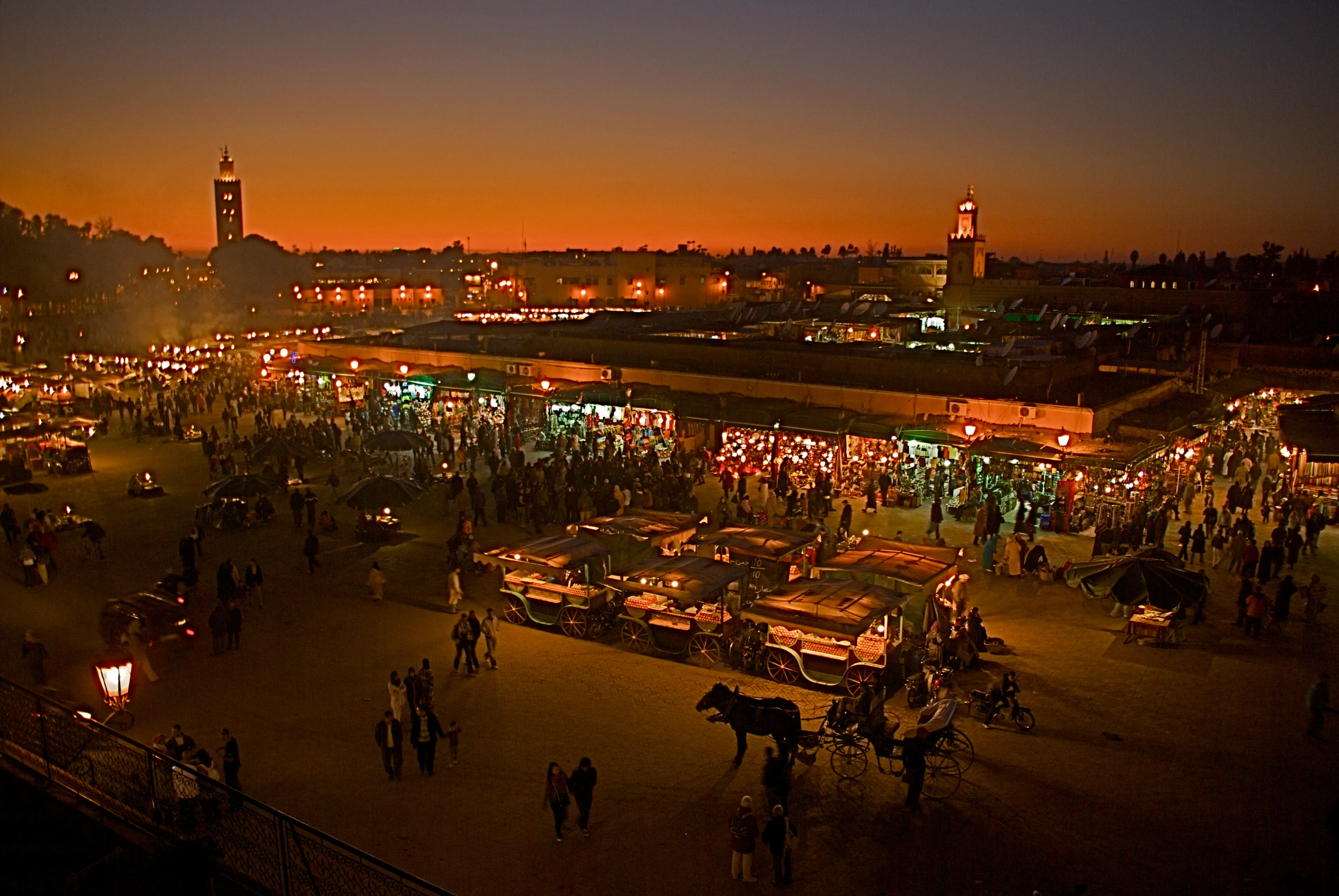
There is Marrakech by day, and there is Marrakech by night. And then there is Jemaa el-Fna at dusk, which belongs to neither category: it is a world of its own, an open-air theatre that is assembled and dismantled before your very eyes every single day. Around 5 p.m., as the light begins to gild the ochre façades, the square shifts. Dozens of food stalls spring up in a matter of minutes, the first drums start to sound, and a smell of charcoal and grilled meat settles in, never to leave you.
This daily transformation is no set piece staged for tourists: it is a living oral tradition that UNESCO listed as far back as 2001 as a masterpiece of the intangible cultural heritage of humanity. Storytellers, musicians, herbalists, fortune-tellers and cooks keep centuries-old traditions alive here. Come nightfall, the square does not merely wake up: it turns into the largest popular stage in Morocco.
In this guide, we take you hour by hour through this metamorphosis. What to see, when to arrive, where to sit for sunset, what to eat, how much to budget and how to avoid the classic pitfalls. The goal: for you to experience Jemaa el-Fna at night like an insider, not like a passing onlooker.
Why the square changes everything at sunset
By day, Jemaa el-Fna is already lively: snake charmers, orange-juice vendors, water carriers in costume, horse-drawn carriages. But it remains a vast stone esplanade, baked by the sun. It is from late afternoon onwards that the magic truly happens.
Around 5 p.m., the food-stall crews arrive with their handcarts. In less than an hour they set up tables, benches, tarpaulins and stoves. The bare light bulbs flicker on one by one, the braziers glow red, and an enormous cloud of white smoke rises above the square. At the same time, the circles form: the halqa, those ring-shaped gatherings around a storyteller, a troupe of musicians or an acrobat.
The contrast is striking. Where there was empty space, you suddenly find an ephemeral city of light, noise and smells. It is this moment of transition, at dusk, that remains the most photogenic and the most moving. The crowd thickens, mixing Marrakchi families out to dinner, young Moroccans, visitors from all over the world and the workers of the square.
Jemaa el-Fna at night: what to see and hear
At night, Jemaa el-Fna is above all a sensory experience. Close your eyes for a moment: you will hear, layered one over another, the metallic clatter of the qraqeb (the large iron castanets of the Gnaoua), the round rumble of the guembri (a three-stringed bass lute), the ululations, the laughter, the sizzle of the grills and the calls of the touts.
The circles of storytellers and musicians (halqa)
The beating heart of the square is the halqa. Each circle tells a different story:
- The storytellers (hlaykia): guardians of the oral tradition, they unfold epics, moral tales and legends in colloquial Arabic. Even without understanding the language, the theatricality of their gestures and the reaction of the audience make it worth stopping for.
- The Gnaoua musicians: heirs of a brotherhood of sub-Saharan origin, they play a hypnotic trance music, somewhere between spirituality and celebration. The guembri, the qraqeb and the repetitive chants can hold you spellbound for long minutes.
- The Berber troupes and dancers: drums, flutes and Atlas rhythms, sometimes accompanied by dancers.
- The acrobats and gymnasts: often young men forming human pyramids and stringing together somersaults.
The other figures of the square
Around these circles gravitate other colourful characters: herbalists and healers lining up vials and plants, henna tattoo artists, fortune-tellers, tooth-pullers (a folkloric and disconcerting spectacle), monkey handlers. The snake charmers, however, are mostly present during the day and pack up once night falls; so do not count on seeing them in the evening.
A word of honesty: some of these practices (monkeys kept on a leash, photos with animals) raise ethical questions and often lead to persistent solicitations. You are free to walk on by. To go further into everything that awaits you, see our dedicated guide to what to see and do on the square.
Sunset from a rooftop terrace: the best vantage point
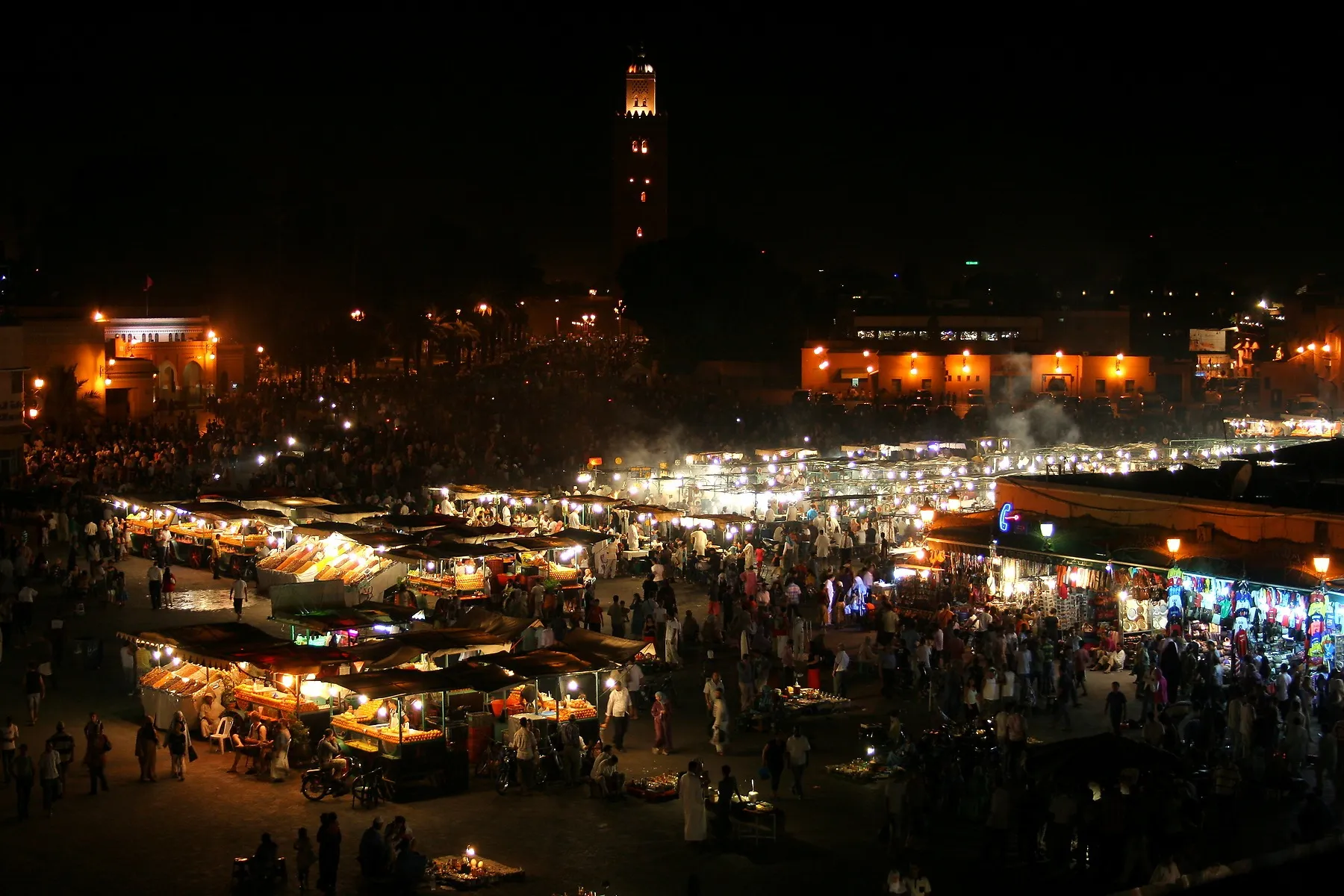
If there is one ritual not to miss, it is watching the sunset from one of the terraces that line the square, with the Koutoubia minaret as a backdrop. When the sun disappears behind the mosque, the square is bathed in golden and orange reflections, the smoke from the grills begins to rise, and the lights come on: it is an unforgettable spectacle, and one of the most beautiful panoramas in all of Marrakech.
Two addresses win unanimous praise:
- Le Grand Balcon du Café Glacier, on the south-east corner of the square. It is the most famous vantage point, overlooking the sea of people directly. A purchase is generally required (a mint tea or a juice is enough).
- Le Café de France, a historic institution, also very well placed to take in the whole square at a glance.
A few practical tips for the terrace:
- Arrive early, ideally 30 to 45 minutes before sunset, to snag a table on the square side (the best ones go quickly).
- Be prepared to wait a little for service at peak times.
- A simple drink earns you the view; there is no need to order a full meal.
- Check the exact time of sunset depending on the season (around 6 p.m. in winter, up to past 8 p.m. in high summer).
Eating in the evening: the largest open-air canteen in Morocco
Once night falls, Jemaa el-Fna turns into a gigantic open-air restaurant. The numbered food stalls line up, each with its large trays of raw produce on display, its communal benches and its tout who calls out to you with humour. You eat elbow to elbow, often using bread instead of cutlery, in a lively, noisy and convivial atmosphere.
The must-tries
- The skewers (kebabs) of minced meat (kefta), chicken or lamb, grilled in front of you.
- The Marrakchi tanjia, meat slow-cooked in an earthenware jar: the city’s emblematic dish.
- The snails (babbouche), served in a spiced herb broth, said to be good for digestion. An experience to try at least once.
- The harira, a traditional soup made with tomatoes, lentils and chickpeas, comforting and inexpensive.
- The grilled sheep’s head and offal, for the more adventurous palate.
- The freshly squeezed orange juice at the colourful stalls, and the dried fruit from the neighbouring stands.
What to expect price-wise
Prices are indicative and can sometimes be negotiated. Roughly speaking, count on:
| What you order | Range (MAD) |
|---|---|
| Bowl of harira | 5 to 15 |
| Plate of snails | 10 to 20 |
| Orange juice | 5 to 15 |
| Plate of skewers / grilled meat | 40 to 80 |
| Full meal at a food stall | 40 to 100 |
The essential reflex: always ask the prices BEFORE ordering and check what is brought to you. Some stalls automatically drop off bread, olives or sauces “on the house” that later appear on the bill. Stay smiling but firm, and confirm the total. To choose your stall and avoid unpleasant surprises, our guide on where to eat around the square details the best options, from food stalls to restaurants with a terrace.
Hour-by-hour plan for a successful evening
Here is a typical run-through to make the most of Jemaa el-Fna, from the day/night transition to the nocturnal climax. The times are indicative and vary with the season.
| Time | What happens | What you do |
|---|---|---|
| 4:30 – 5 p.m. | Food stalls go up, musicians arrive | You arrive at a leisurely pace and soak up the atmosphere |
| 5 – 6 p.m. | The square fills up, the circles form | You head up to a terrace for the sunset |
| 6 – 7 p.m. | Sunset over the Koutoubia, lights come on | Photos, mint tea, panoramic view |
| 7 – 8:30 p.m. | Smoke fills the square, the halqa are in full swing | You come down and tour the circles |
| 8:30 – 10 p.m. | Climax: dense crowd, music, total spectacle | You dine at a food stall |
| 10 p.m. – midnight | The crowd gradually thins, the stalls start packing up | A final stroll, orange juice, back to calm |
In practice, arriving around 5 p.m. to catch the day/night shift and allowing 2 to 3 hours on the square makes the ideal formula. Since the square is open, free and accessible around the clock, you can stay as long as you like; most of the activity and the food stalls hold on until around 11 p.m. to midnight.
Safety, scams and good manners in the evening
Good news: Jemaa el-Fna is generally safe in the evening, very busy and well supervised, including a regular police presence. Thousands of Moroccan families spend the evening here. That said, the dense crowd and the ambient excitement call for a few common-sense precautions.
Points to watch:
- Pickpockets take advantage of the crowds. Keep your phone and wallet in a closed pocket or in front of you, and avoid flashing valuables and large bills.
- Paid photos: as soon as you photograph a musician, a monkey handler or a water carrier, you will be asked for money. This is legitimate for the performers; agree on the amount in advance (a few dirhams) or refrain.
- Forced henna: some tattoo artists may grab your hand and start a design without your consent, then demand a high price. Decline firmly and keep your hands to yourself. Beware too of black henna, which can be irritating.
- The food-stall touts are persistent but good-natured: you are under no obligation to sit down at the first call.
- Negotiate and confirm prices everywhere, for food as well as for services.
None of this should worry you unduly: with a little vigilance, the evening remains a pure pleasure. Our safety & scams guide reviews each pitfall in detail, and our practical information gathers opening hours, access and logistical tips to plan your visit.
Insider tips for a memorable evening
- Dress comfortably and bear in mind the cool of the evening: nights can be chilly in Marrakech outside the summer season.
- Bring cash (small dirham notes): most food stalls and performers do not take cards.
- Alternate between terrace and immersion: the view from above gives you the scale of the spectacle, wandering at ground level gives you the emotion.
- Taste at least one street specialty, even a simple harira soup, to live the experience to the full.
- Look up at the illuminated Koutoubia: it watches over the square and serves as a landmark so you do not get lost.
- Stay open and respectful: a smile, a “salam” and a bit of humour open many doors on this square where the spoken word reigns supreme.
Jemaa el-Fna at night is not an attraction you tick off a list: it is an encounter. The encounter with a city that, every night for centuries, has gathered to tell stories, play music, eat together and celebrate life. Let yourself be carried by the current, lose yourself for a few hours in this whirlwind of light and smoke, and you will understand why this square, described as a unique place by UNESCO and recounted in a thousand tales, remains the beating heart of Marrakech.
Frequently asked questions
What time should you arrive at Jemaa el-Fna in the evening?
The ideal is to arrive around 5 p.m. to witness the square’s metamorphosis: the food stalls going up, the musicians arriving and the circles forming. That way you enjoy the sunset light, then the build-up of the atmosphere to its peak between 8 and 10 p.m. Allow 2 to 3 hours on the square.
Until what time does the square stay lively at night?
The square is open and free around the clock. Most of the activity, the shows and the food stalls carry on until around 11 p.m. to midnight, when the stalls start to pack up. After midnight the atmosphere gradually winds down, but the square never truly closes.
Where can you watch the sunset over Jemaa el-Fna?
The two best terraces are the Grand Balcon du Café Glacier (south-east corner) and the Café de France, both with a sweeping view over the square and the Koutoubia minaret. Arrive 30 to 45 minutes before sunset to get a good table; a simple drink is generally enough to enjoy the view.
Is Jemaa el-Fna dangerous in the evening?
No, the square is generally safe in the evening, very busy and supervised. The main nuisances are pickpockets in the crowd and small scams: paid photos, forced henna, inflated bills. Keep your valuables secure, always agree on prices in advance and firmly decline unwanted solicitations.
How much does a meal at the food stalls cost in the evening?
Count on around 40 to 100 dirhams for a full meal at a food stall, depending on what you order (skewers, grilled meat, soup, snails). Prices are indicative: always ask before ordering and check what is brought to you, as some “complimentary” extras may appear on the bill.