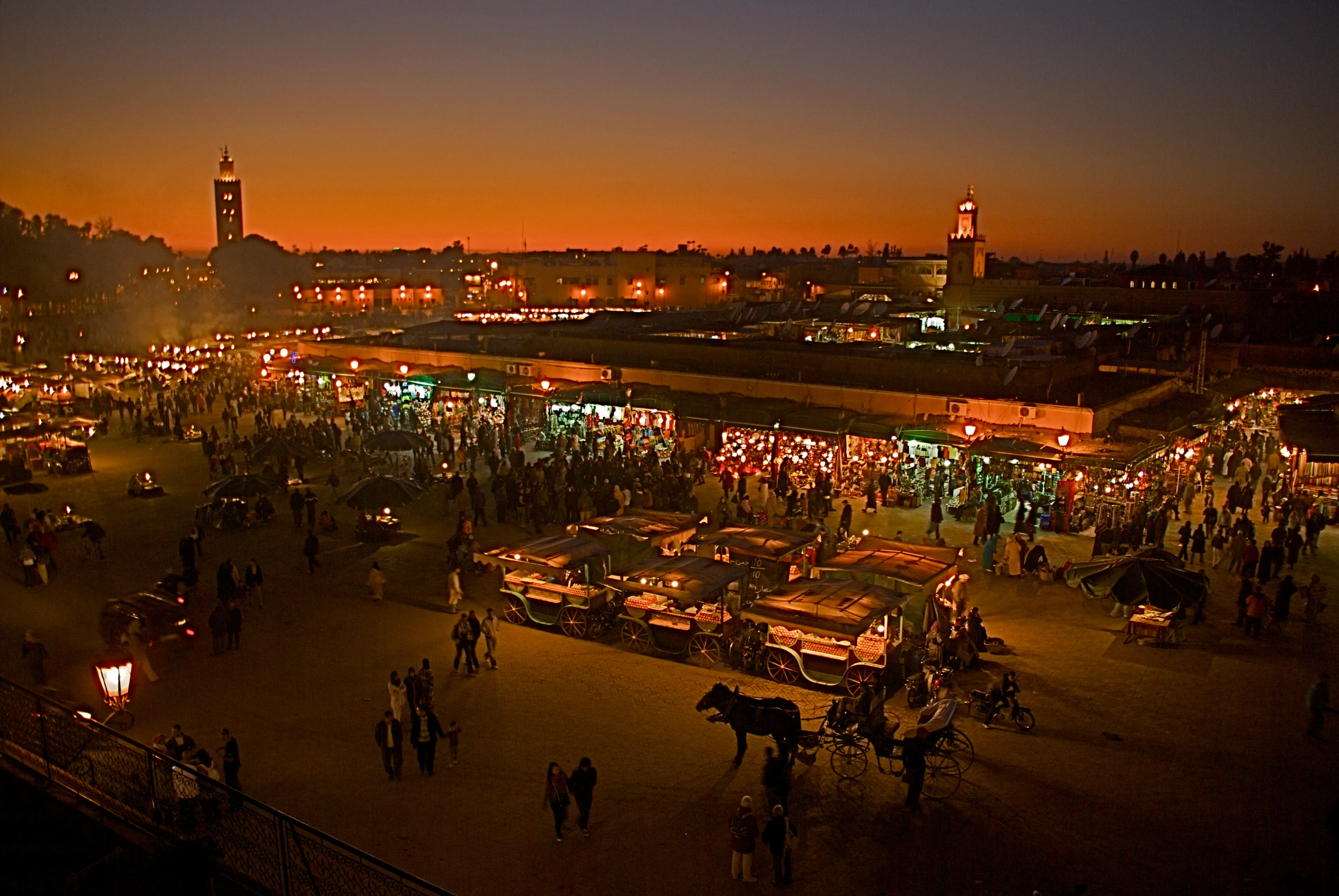
No, Jemaa el-Fna is not dangerous in the sense of a physical risk. It is one of the busiest and most closely watched places in Marrakech, safe both by day and late in the evening. The real risk is minor: pickpocketing in the crowd and heavy commercial pressure. With a bit of common sense, you have nothing to fear.
Let’s be clear and honest, without minimizing or dramatizing. Tens of thousands of visitors cross the square every week without the slightest incident. Violent crime against tourists is rare there, and the constant presence of crowds, established traders, Moroccan families, and a tourist police force makes the square very unfavorable to assaults. The nuisance you’ll encounter is commercial (touts, solicitations) rather than criminal. Here, concretely, is what the reality on the ground says.
- Physical danger: low. Violent assaults against tourists are rare in Marrakech.
- Main risk: the pickpocket in the crush, especially in the evening.
- At night: the square stays safe because it is so lively; the risk rises in the dark alleys of the souks once the shops have closed.
- Useful numbers: Police 19, Ambulance 15, Gendarmerie 177.
- Verdict: broadly safe. Stay alert about your belongings, keep calm, and enjoy.
Is Jemaa el-Fna really dangerous?
No, not in the usual sense of the word. Marrakech is a major tourist destination, and Jemaa el-Fna is its beating heart: a UNESCO-listed square, criss-crossed by traders, cafés, food stalls, and a police presence both visible and discreet. It is not a dangerous place, far from it.
Serious crime (armed assaults, kidnappings, grave violence) is exceptional against visitors. What you will encounter belongs to an entirely different register:
- Opportunistic petty crime: pickpocketing, poorly closed bags opened in the crowd.
- Commercial pressure: touts, pushy vendors, fake guides.
- Verbal street harassment: repeated solicitations, remarks, especially toward women.
None of these three points is a “danger” in the strict sense, but all call for a sensible attitude. The good news: they are easy to handle once you know them. For some perspective on the atmosphere and history of the square, the reference article on Wikipedia about Jemaa el-Fna gives good context.

What are the real risks on the square?
Rather than thinking in terms of “dangerous / not dangerous,” it is more useful to rank the actual risks and know how each one is neutralized. Here is a summary table.
| Risk | Real level | When | How to avoid it |
|---|---|---|---|
| Pickpocketing | Moderate | In the evening, in the crush and at the stalls | Closed bag worn across the body in front of you, nothing in back pockets |
| Touts / fake guides | High (but harmless) | All day long | Firm refusal, don’t follow, find your own way |
| Street harassment | Moderate | All day, especially for women | Don’t engage, neutral tone, busy areas |
| Jostling / dense crowds | Low | At peak times in the evening | Keep your distance, hold children and bag close |
| Physical assault | Very low | Rare, mostly deserted alleys at night | Stay on the lit square, avoid dangerous back streets |
| Traffic (scooters, horse-drawn carts) | Moderate | When crossing the square and its edges | Look both ways, scooters weave everywhere |
The key takeaway: the pickpocket is the only risk that really touches your wallet, and traffic is probably the most tangible physical danger on the square, well ahead of any assault. Scooters and horse-drawn carts weave through the crowd at all hours: stay alert when crossing.
How to protect yourself from pickpockets at Jemaa el-Fna?
Pickpocketing is encouraged by the density of the crowd, especially in the evening when the square fills up for dinner and shows. It is nothing like systematic, but a few reflexes make it almost impossible:
- Closed bag, worn in front of you. A shoulder bag brought around to your stomach, hand resting on it in the crush, is your best insurance. Avoid an open backpack on your back.
- Nothing in back pockets. Phone and money go in a closed inner pocket or a money belt hidden under your clothes.
- Small change kept separate. Have a few coins and small notes in dirhams (MAD) ready in an accessible pocket to pay for a juice or a stall, without flashing your whole wad.
- Beware of distractions. A sudden shove, someone who “helps” you or spills something on you: these are classic maneuvers while an accomplice acts. Keep your hand on your belongings.
- Only one means of payment on you. Leave the rest (a backup card, cash, your passport) in the safe of your riad.
Is Jemaa el-Fna safe at night?
Yes, and it is even the best time to discover it. Contrary to intuition, the square is often safer in the evening than late in the afternoon in an empty alley, because it teems with people. As night falls, the food stalls light up, the storytellers, the Gnaoua musicians, and the circles of spectators form, and whole Moroccan families come to dine there. This crowd is your best protection: you are never isolated on the square.
The important nuance concerns the surroundings, not the square itself:
- On the open, lit square: very safe, lively until late.
- In the souk alleys after the shops close (around 9-10 pm): darker, more deserted, best avoided alone. It is there, and not on the square, that the risk rises.
- On the way back to the riad: scout your route by day, or take a petit taxi ordered by your accommodation rather than one hailed at random.
By day as by night, the silhouette of the illuminated Koutoubia serves as a reliable landmark for reorienting yourself toward the square. Keep your phone charged, an offline map, and your riad’s address written down (ideally in Arabic) to show a taxi.
By day or by night: what safety differences?
Many visitors wonder which moment is “the riskiest.” In reality, day and night each have their particularities, but neither is truly dangerous.
| Criterion | By day | By night |
|---|---|---|
| Atmosphere | Calm in the morning, hot and dusty at midday | Buzzing, shows, food stalls |
| Crowd | Moderate | Very dense (so more pickpockets, but more witnesses) |
| Touts | Numerous, snake charmers, henna | Numerous at the stalls, more restaurant touting |
| Pickpocketing | Low | Moderate (stay alert) |
| Perceived safety | High | High on the square, lower in the closed souks |
| Key tip | Cover up from the sun, manage solicitations | Stay on the lit square, watch your bag |
The message is simple: the square stays safe 24/7 in its lively zone. Just adjust your vigilance over your belongings (higher in the evening) and over your route (avoid deserted alleys at night).
What about street harassment and women’s safety?
This is a subject in its own right, because it colors the experience of many women visitors. Let’s say it plainly: a woman alone will attract more solicitations than a couple or a group — remarks, invitations to tea, unwanted compliments. This is the work of a minority of men in the street, it is not representative of Moroccan hospitality, and it almost never amounts to physical danger in the very heart of such a busy square.
The right reflexes come down to a few words:
- Don’t engage in conversation or stop; a nod of the head and keep going.
- A clear, neutral refusal: a firm “La, choukran” (no, thank you), without an awkward smile.
- Stay in busy areas, avoid dark alleys alone in the evening.
- Ignore the provocations that follow a refusal: their aim is to make you react.
We cover all of this — dress, evening atmosphere, solo-traveler reflexes — in our dedicated guide to visiting Jemaa el-Fna as a woman traveling alone, worth reading if you travel without company.
Should you confuse insecurity with scams?
No, and this is an essential distinction. Most of the “bad experiences” recounted about Jemaa el-Fna do not stem from crime but from commercial scams: fake guides who demand money after having “escorted” you, henna applied to your hand by force, a photo with a monkey or a snake billed at a steep price, an inflated bill at a stall.
These practices are annoying and cost a few dirhams, but they do not threaten your physical safety. As they are subjects in their own right, we devote a full dossier to them: see our guide to tourist scams at Jemaa el-Fna to know exactly how to recognize and defuse them. This article, for its part, focuses on safety and crime in the strict sense.
Which emergency numbers to know in Marrakech?
In case of a real problem, Morocco has simple emergency numbers. Note them in your phone before you leave:
- Emergency police: 19 (in town, including Marrakech) — for a theft, an assault, any incident.
- Ambulance / SAMU: 15 — medical emergency.
- Royal Gendarmerie: 177 — outside urban areas, on the roads.
- Fire brigade / Civil protection: 15 as well.
On the square, a tourist brigade (police officers in uniform and plainclothes) is present to specifically assist visitors: don’t hesitate to approach them if you have a problem. In case of theft, filing a report at the police station is essential if you want to make an insurance claim. Finally, keep the number of your embassy or consulate in Marrakech or Rabat, useful if you lose your passport.
Which neighborhoods around the square are safe?
Jemaa el-Fna is the pivot of Marrakech’s medina, and the neighborhoods surrounding it are, on the whole, as safe as the square itself, with the same rule: the livelier and more lit, the calmer.
- The medina (souks to the north): very busy by day, safe, but labyrinthine. At night, once the shops have closed, favor the busy thoroughfares.
- The Koutoubia area (southwest): open, lit, with its gardens; pleasant and safe in the evening.
- Guéliz (the new town): modern, wide, very safe, but about twenty minutes’ walk away.
- The riads of the medina: a good, well-rated riad is a valuable anchor point; its staff call taxis and know the good routes.
None of these neighborhoods should be “avoided” on principle. Ordinary urban common sense is enough: stay on the lively thoroughfares, turn back if an alley seems too deserted, and trust your instinct.
Essential tips for a worry-free visit
To gather everything above into a quick checklist:
- Wear your bag closed, in front of you, especially in the evening in the crowd.
- Carry only what you need on you; leave the rest in the riad safe.
- Firmly refuse touts and solicitations, without stopping.
- Stay on the lit square in the evening, avoid deserted alleys alone.
- Watch the traffic: scooters and horse-drawn carts weave everywhere.
- Note the emergency numbers (Police 19, Ambulance 15) and your riad’s address.
- Take out travel insurance covering theft and medical costs.
To prepare the logistics (opening hours, transport, ATMs, connectivity, taxis), our practical information on Jemaa el-Fna page usefully complements these precautions.
Finally, for official and up-to-date information — always worth checking before departure — consult the travel advice for Morocco from France Diplomatie. The indications in this article reflect the situation observed in 2026; we invite you to cross-check this advice with the official sources current at the time of your trip.
Frequently asked questions
Is Jemaa el-Fna dangerous?
No, not in the sense of a physical danger. It is one of the busiest and most closely watched squares in Marrakech. The only real risk is pickpocketing in the crowd, easy to avoid with a closed bag worn in front of you. Violent assaults against tourists are rare there.
Is Jemaa el-Fna safe at night?
Yes, it is even the best time to visit. The square comes alive with families, stalls, and shows, and this crowd is protective. Stay on the lit square, watch your bag, and avoid venturing alone into the dark alleys of the souks after the shops close.
Are there many pickpockets in Marrakech?
Pickpocketing does exist, especially in the evening crush on the square and at the stalls. It remains avoidable: wear your bag closed in front of you, nothing in your back pockets, and beware of staged jostling used as a distraction.
What are the emergency numbers in Morocco?
Emergency police 19, ambulance and medical emergencies 15, Royal Gendarmerie 177 (outside town). On the square, a tourist brigade specifically assists visitors. In case of theft, file a report at the police station for your insurance.
Can a woman visit Jemaa el-Fna alone safely?
Yes. The main nuisance is verbal street harassment, bothersome but without real physical danger on such a busy square. A clear refusal, a confident attitude, and choosing the lively areas are enough to enjoy the square with peace of mind.
Should you avoid certain neighborhoods around the square?
No neighborhood should be avoided on principle. The medina, the Koutoubia, and Guéliz are safe, especially on the lively, lit thoroughfares. The only precaution is to avoid, alone and at night, the deserted, dark alleys once the shops have closed.
Are the police present at Jemaa el-Fna?
Yes. A tourist police force, in uniform and in plainclothes, is present at all times on the square to help visitors. Its presence, added to the constant crowd and the established traders, makes Jemaa el-Fna a very closely watched environment.
Are tourist scams dangerous?
No, they are a matter of commercial abuse, not crime: fake guides, forced henna, a photo with an animal billed at a high price. They cost a few dirhams and some annoyance, without threatening your safety. We cover them in detail in our dossier dedicated to scams.
The final word
Jemaa el-Fna is not a place to be afraid of: it is a living, noisy, sometimes overwhelming square, but fundamentally safe and hospitable. Physical danger is low there; the only real risk to your wallet is pickpocketing, which is neutralized with a closed bag and a bit of attention. The takeaway: protect your belongings, keep calm in the face of solicitations, stay in the lively areas in the evening, and you will experience the square as it truly is — one of the most fascinating urban spectacles in the world, in complete serenity.