To visit Jemaa el-Fna in a single day, the best strategy fits in one sentence: start early and start with the quiet, and save the square itself for last. In practical terms, spend the morning on the still-peaceful square and the nearby monuments (the Koutoubia is right there), dive into the souks as the stalls come to life, take a break out of the heat in the early afternoon, then come back to the square for the grand moment: sunset from a rooftop terrace, followed by the nightly transformation of the esplanade into the largest open-air canteen in Morocco.
This rhythm follows the real life of the square. Jemaa el-Fna isn’t a museum with a ticket and a set route: it’s a living organism that completely changes face between 9 a.m. and 9 p.m. Visiting it out of step means risking finding it crushed by the sun and half-asleep in the afternoon, or crowded and exhausting if you turn up famished in the middle of the crush. Well orchestrated, a single day is more than enough to grasp its essence.
Here is a complete itinerary, tested and timed, from the medina waking up to nightfall. Adjust the timings to the season (the sun sets around 6 p.m. in winter and after 8 p.m. in high summer), but keep the overall logic: a quiet, cultural morning, an afternoon in the shade, a spectacular evening.
Overview: the day at a glance
Before the details, here’s the skeleton of the day. The times are indicative and designed for a mild season; shift them by an hour or two depending on the light.
| Time slot | Where | What you do |
|---|---|---|
| 8:30 – 9:30 a.m. | The square waking up | Coffee on a terrace, first photos, calm atmosphere |
| 9:30 – 10:30 a.m. | The Koutoubia & its gardens | The emblematic minaret, the gardens, a landmark of the medina |
| 10:30 a.m. – 1 p.m. | The souks | Wandering, crafts, haggling, the heart of the medina |
| 1 – 2:30 p.m. | Lunch | A meal in the shade, on a terrace or in a medina restaurant |
| 2:30 – 4 p.m. | Break / heritage | A nap, a riad, or a cool indoor visit (museum, madrasa) |
| 4 – 5:30 p.m. | Back toward the square | The square comes alive, the food stalls go up |
| 5:30 – 7 p.m. | Sunset | Terrace with a view of the Koutoubia, mint tea |
| 7 – 10 p.m. | The big evening | Halqa circles, music, dinner at the food stalls |
Count on a full day, but without rushing: the distances are short, everything is done on foot, and the square stays your anchor point. For a fuller overview of the attractions, our guide to what to see and do at Jemaa el-Fna lists all the shows and curiosities you’ll come across.
The morning (8:30 – 10:30 a.m.): the square waking up and the Koutoubia
The morning is Jemaa el-Fna’s best-kept secret. Around 8:30–9 a.m., the esplanade is almost empty: a few orange-juice vendors set up their colorful carts, the first water sellers (the guerrab, in red costumes and pom-pom hats) wander by, and the low-angled light gilds the ochre façades. It’s the best time to photograph the square without the crowds and feel its true scale.
Settle onto the terrace of a café overlooking the square for a Moroccan breakfast: msemen (flaky pancake), bread, olive oil, mint tea. You take in the whole esplanade while it gently wakes.
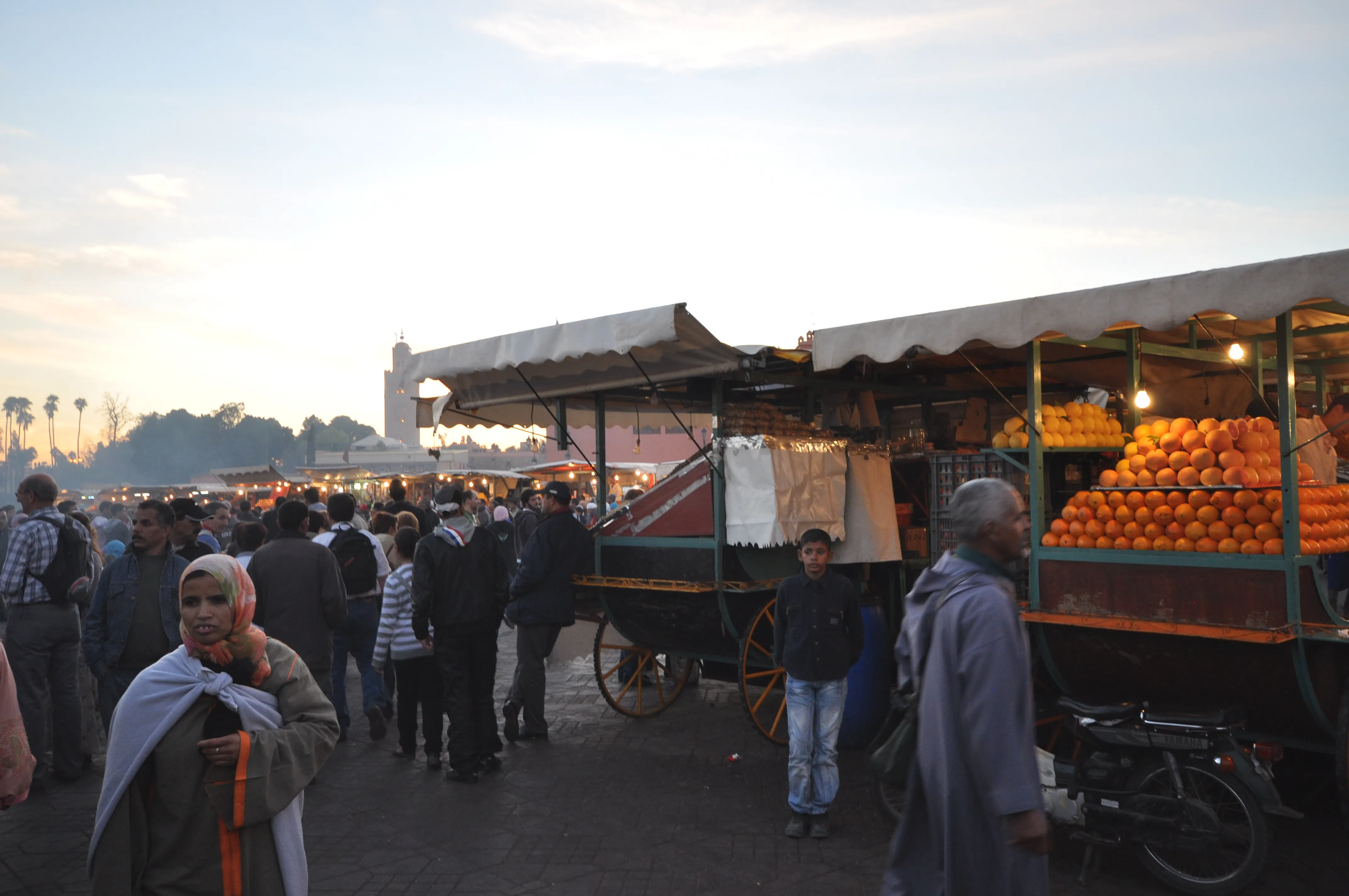
Heading to the Koutoubia
Less than a ten-minute walk to the southwest stands the Koutoubia, the largest mosque in Marrakech and its absolute emblem. Its 77-meter minaret, completed in the 12th century under the Almohads, serves as a landmark visible from almost anywhere in the medina: when you’re lost in the souks, look for it. It’s also the architectural big brother of the Giralda in Seville and the Hassan Tower in Rabat.
The interior of the mosque is not open to non-Muslims, but you can admire the exterior perfectly, and above all you can stroll through the Koutoubia gardens that surround it: rose bushes, orange trees, shaded paths and pools offer a bubble of coolness and quiet a stone’s throw from the tumult. In the morning the light there is superb and the crowds are thin. To go further on this neighboring monument and the other sites within walking distance, see our guide to around Jemaa el-Fna.
Late morning (10:30 a.m. – 1 p.m.): diving into the souks
Heading up toward the north of the square, you tip into an entirely different world: the souks of Marrakech, that covered labyrinth of stalls that begins where the square ends. It’s the natural extension of Jemaa el-Fna, and one of the largest traditional markets in the Arab world.
Around 10:30–11 a.m., the shopkeepers have raised their shutters and business is in full swing without being stifling yet. Each sector has its specialty, often inherited from the craftsmen’s guilds:
- Souk Semmarine: the main artery, textiles, babouche slippers, souvenirs.
- Souk of the dyers (Souk Sebbaghine): skeins of colorful wool hung out to dry, very photogenic.
- Souk Haddadine: the ironworkers’ quarter, to the sound of hammers.
- Souk Chouari: woodwork and basketry.
- The spice square (Rahba Kedima): pyramids of spices, herbalists, baskets.
It’s also the playground of haggling, which is part of the folklore and is practiced with a smile. The first prices quoted are deliberately high; make your offer calmly, without aggression, and don’t hesitate to walk away if the numbers don’t add up. Be wary, on the other hand, of the spontaneous “guides” who latch onto you to lead you to one shop or another: a firm “no thank you” is enough. Our guides on what to know before visiting and safety detail these little traps.
Lunch (1 – 2:30 p.m.): recharging in the shade
At midday, the heat rises and your legs call for a break. Two schools of thought are open to you.
The terrace-with-a-view option: many cafés-restaurants line the square and offer a balcony over the esplanade. There you eat simple food (tajine, Moroccan salad, skewers) while overlooking the bustle. The value for money isn’t always unbeatable, but the view has its price and it’s worth savoring.
The authentic-medina option: by ducking one or two alleys in, you’ll find more delicious and often more affordable spots, from popular canteens to lovely restaurants set up in riads. To choose with peace of mind, our guide to where to eat at Jemaa el-Fna reviews the food stalls, terraces and good tables of the neighborhood.
A few Marrakchi specialties to aim for at least once:
- Tanjia: meat slowly confit in an earthenware jar, the city’s signature dish.
- Tajine of chicken with preserved lemon or lamb with prunes.
- Pastilla, a sweet-and-savory pie for big appetites.
- The freshly squeezed orange juices of the square, a few dirhams a glass.
Early afternoon (2:30 – 4 p.m.): the lull to fill wisely
This is the moment of the day when the square is least interesting: the sun at its zenith, a mineral and overwhelming esplanade, shows running in slow motion. Rather than exhausting yourself, do as the Marrakchis do and escape the heat. Three good ideas:
- A nap at the riad. If you’re staying in the medina, this is the ideal moment for a real break, cool around the patio.
- A quiet heritage visit. Several major sites are a short distance away: the Bahia Palace and its painted ceilings, the Saadian Tombs, the Ben Youssef Madrasa (a former Quranic school with dazzling decoration) or the Museum of Marrakech. You visit them in the shade, far from the crowds.
- A hammam or a tea break. To really slow down and experience a local ritual.
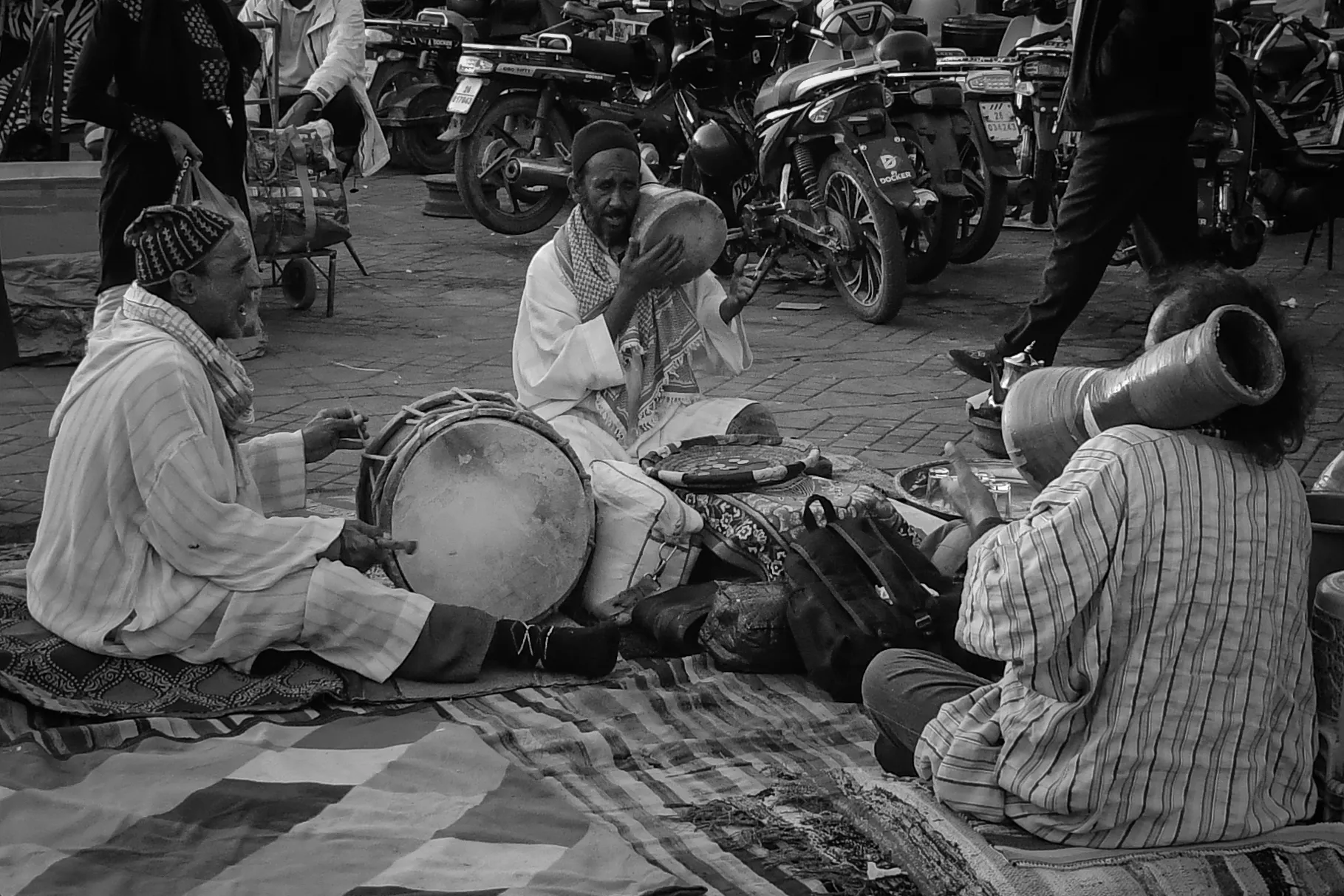
This breather isn’t wasted time: it recharges you for the most intense part of the day, which begins in the late afternoon.
Late afternoon (4 – 5:30 p.m.): the square wakes up
Around 4–5 p.m., a shift takes place. The food-stall crews arrive with their carts and, in less than an hour, put up tables, benches, tarps and stoves. The circles — the famous halqa — begin to form around a storyteller, a troupe of musicians or an acrobat. The crowd thickens, mixing Marrakchi families, young people from the neighborhood and travelers.
This is the time to reposition yourself smartly: head back down toward the square and scout the terrace from which you want to admire the sunset. The best tables, on the square side, go fast.
Sunset (5:30 – 7 p.m.): the highlight of the show
If you had to keep just one moment of the day, it would be this one. Watching the sunset from a terrace overlooking Jemaa el-Fna, with the minaret of the Koutoubia as a backdrop, ranks among the most beautiful panoramas in all of Marrakech. When the sun disappears, the square takes on golden reflections, the smoke of the grills begins to rise and the lights come on one by one.
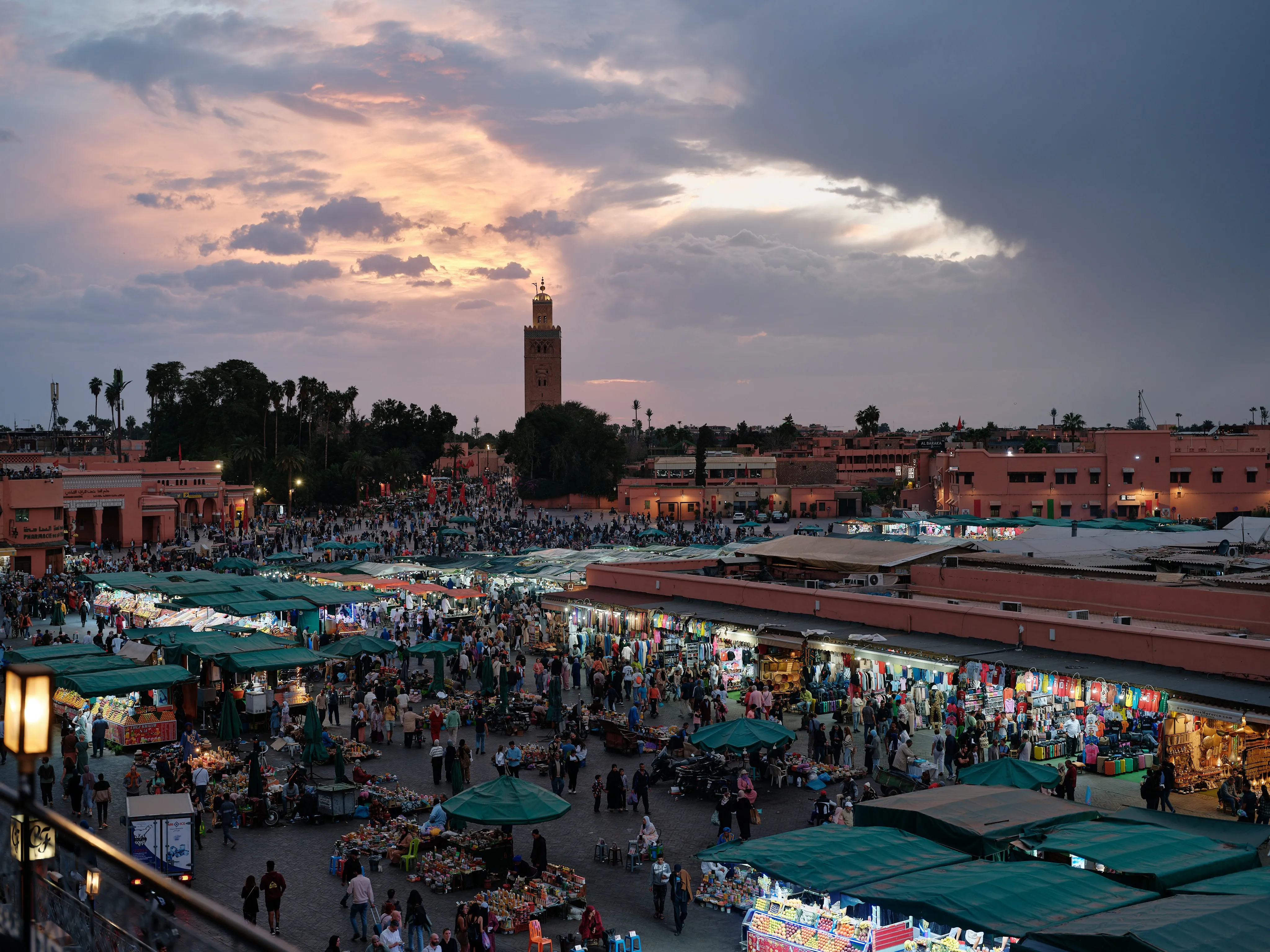
Two spots command unanimous agreement:
- Le Grand Balcon du Café Glacier (southeast corner): the most famous viewpoint, directly overhanging the human tide.
- Le Café de France: a historic institution, also very well located.
The evening (7 – 10 p.m.): the great nightly theater
As night falls, Jemaa el-Fna reaches its peak. The smoke of the braziers fills the esplanade, drums resonate, and the square turns into an immense open-air restaurant. It’s the summit of the day, and above all a sensory experience.
Come down from the terrace and make the rounds of the circles: storytellers (hlaykia) who unfurl epics in colloquial Arabic, Gnaoua musicians and their hypnotic trance on the guembri and the qraqeb, Berber troupes from the Atlas, acrobats stringing together human pyramids. Even without understanding the language, the theatricality of the gesture is worth the detour.
Then sit down at a numbered food stall for dinner: kefta skewers, tanjia, snails (babbouche) in a spicy broth, comforting harira. You eat elbow to elbow, in a lively and noisy atmosphere. This effervescence isn’t a set for tourists: it’s a living oral tradition that UNESCO listed as far back as 2001 as part of the intangible cultural heritage of humanity.
To experience this evening in detail — what to see circle by circle, where to sit, what to taste and how to avoid the traps — dive into our full article devoted to Jemaa el-Fna in the evening and at night.
Can you really see it all in a single day?
Yes, for the essentials. A well-orchestrated day lets you experience the three faces of the square (a calm morning, daytime bustle, a nighttime spectacle), add the Koutoubia and a good dose of the souks, and taste the legendary street food. That’s plenty to understand why Jemaa el-Fna is the beating heart of Marrakech.
What a single day doesn’t allow: going deep into all the monuments of the medina (the Bahia, the Saadian Tombs, the Ben Youssef Madrasa each deserve their own time), exploring the souks in depth, or piling up experiences (hammam, cooking class, excursion). If you have two or three days, spread things out: save the monuments for another morning and treat yourself to two sunsets, so addictive is the ritual.
One last piece of advice: don’t try to “make the most of” every minute. Jemaa el-Fna is earned by letting yourself float in it. The best memory will probably be born of an unplanned moment — a storyteller who captivates the crowd, a tea shared at just the right time, the Koutoubia lighting up in the dusk.
Frequently asked questions
Is one day enough to visit Jemaa el-Fna?
Yes. A well-organized day lets you discover the three moods of the square (a calm morning, a lively afternoon, a spectacular evening), tack on the nearby Koutoubia and a wander through the souks, and have dinner at the food stalls. To also go deep into the monuments of the medina, plan for two to three days instead.
What’s the best order to visit the square during the day?
Start early with the calm square and the Koutoubia (morning), follow with the souks in the late morning, have lunch in the shade, take a cool break in the early afternoon (heat and a square in slow motion), then come back for sunset from a terrace and the nighttime spectacle. In short: cultural in the morning, rest in the afternoon, festive in the evening.
What time should you go to Jemaa el-Fna to avoid the crowds?
In the morning, between 8:30 and 10 a.m., the square is almost empty and the light is superb: ideal for photos and a quiet first look. The crowd peaks in the evening, between 8 and 10 p.m. — the liveliest moment, but also the densest.
What is there to see around Jemaa el-Fna in one day?
Within walking distance: the Koutoubia and its gardens (5–10 min), the souks (just north of the square), and, for cool breaks, the Bahia Palace, the Saadian Tombs, the Ben Youssef Madrasa or the Museum of Marrakech. Everything is done on foot from the square, which stays your anchor point.
How long should you stay on the square in the evening?
Count on 2 to 3 hours in the evening to fully enjoy the sunset, make the rounds of the circles of musicians and storytellers, and have dinner at a food stall. The square is open and free 24/7; the bulk of the action lasts until around 11 p.m.–midnight.