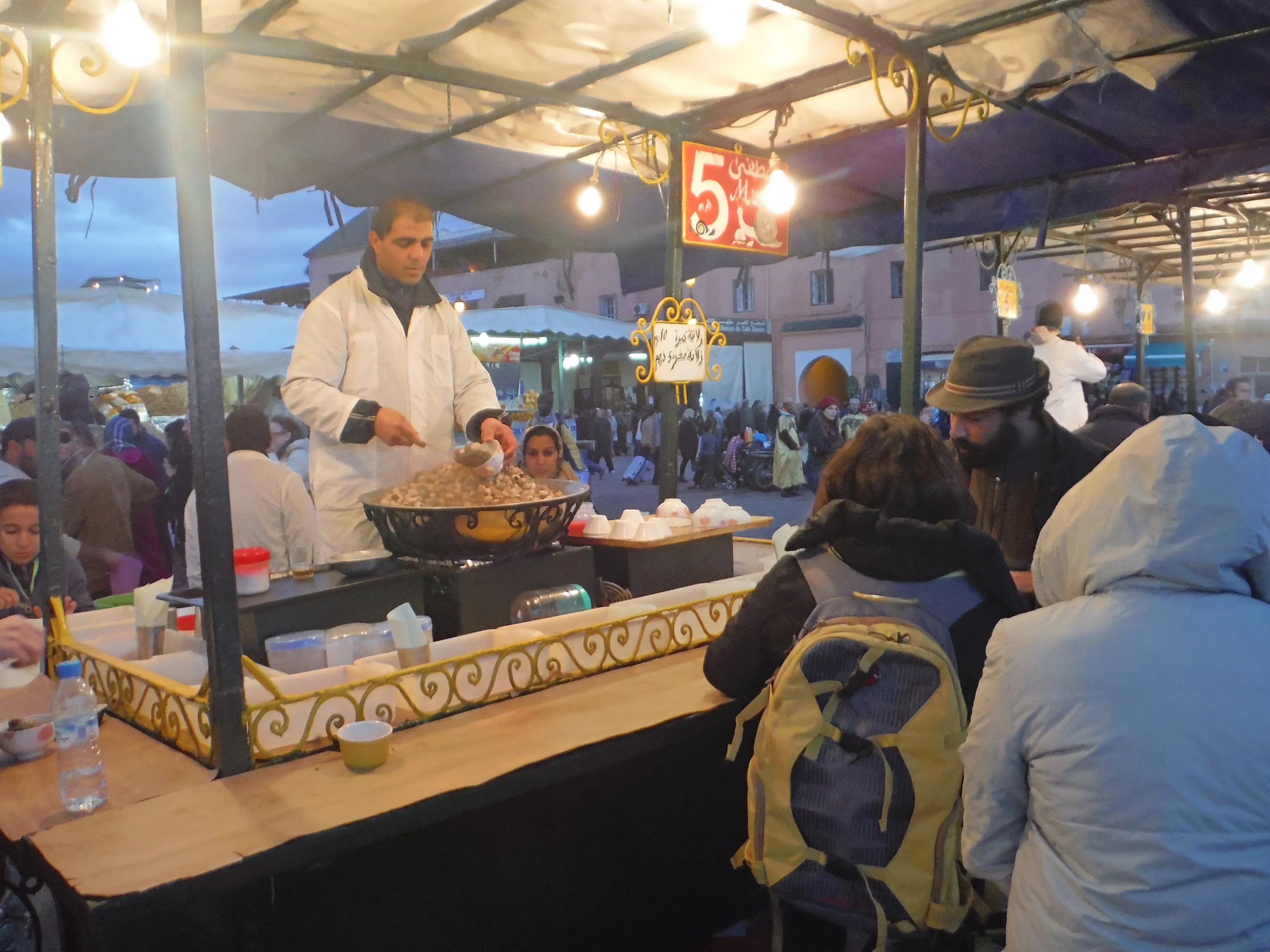
Eating snails at Jemaa el-Fna, what Marrakchis call babbouche (or ghlal), is one of the most authentic experiences the square has to offer. As soon as night falls, dozens of carts roll in, topped with huge copper cauldrons where hundreds of tiny snails simmer in a brown, steaming broth. You’ll spot them from afar by the crowd of locals standing around, bowl in hand, a pin between their fingers.
In practice, you’re served a small bowl of snails bathing in their spiced broth, for next to nothing (often 5 to 15 dirhams). You pull the meat from each shell with a pin or a toothpick, eat it, and — this is the best part — you drink the broth at the end, said to be excellent for digestion. It’s a hot, hearty, cheap street snack that locals eat mostly in the evening and in winter.
Unlike the French snail in garlic butter, the Moroccan babbouche is not fatty at all: everything rides on its medicinal broth, a blend of a dozen herbs and spices steeped for hours. It’s a dish you taste as much for the ritual and the atmosphere as for what’s in the bowl.
What exactly is babbouche?
Babbouche refers to the small land snails cooked the Moroccan way. You’ll find them all over the country, but Jemaa el-Fna has turned them into one of its culinary emblems, right up there with tanjia or harira. The snails are first purged and washed at length (often the day before) to clean them out, then simmered in an aromatic broth until the meat comes away easily.
The result has little in common with the Burgundy snail. There’s no garlic-parsley butter here: the star is the fragrant broth the shells bathe in. The meat itself is firm, slightly earthy, with a note that’s a touch mushroom-like. Above all, it’s a vehicle for all the spices in the broth.
Nutritionally, the snail is rich in protein and very low in fat. Paired with a herbal broth, that makes it a snack Marrakchis consider fortifying, especially prized when the evenings turn cool.

The secret: a broth with 12 spices
The whole appeal of babbouche lies in its therapeutic broth, a complex infusion that can hold more than a dozen ingredients, sometimes fifteen. Each vendor has their own recipe, jealously guarded, but you’ll almost always find the same core of aromatics. Among the most distinctive:
- Thyme (zaïtra) — the herbal base, warm and lightly minty.
- Licorice root (erk sous) — brings the sweet-bitter depth and an inimitable roundness.
- Green anise (habbat hlawa) — the aniseed, digestive note, very present in the finish.
- Cumin, caraway and pennyroyal mint (fliyou) — the trio that recalls Moroccan herbal teas.
- Bitter orange peel, hot chili and green tea — for bitterness, heat and tannin.
- Depending on the stall: wormwood, lavender, gum arabic, mustard seeds…
These are exactly the aromatics that enthusiasts and traditional recipes keep citing, from the Gastro Obscura feature on Moroccan snails to family cookbooks. The whole thing simmers for hours, until you get a dark, almost medicinal liquid whose aroma fills the entire stall.
How do you eat snails with a pin?
The move is simple, but it has its little ritual. You’re handed a bowl and a pin (sometimes a toothpick). Here’s how it goes:
- Prick the meat at the mouth of the shell with the tip of the pin.
- Twist gently as you pull: the snail comes out in one piece, with its little spiral at the end.
- Eat the meat (people usually leave the final coil, which is more bitter, though feel free if you’re game).
- Drop the empty shell into the bowl set aside for it.
- Once the bowl is done, drink the broth straight from the bowl, like a soup.
Regulars run through the snails at top speed, standing around the cart. Take your time: it’s a convivial dish, made for chatting with the vendor and your counter neighbors. A bowl is enjoyed in five to ten minutes.
What virtues are attributed to babbouche?
In Morocco, snail soup isn’t just a snack: it’s a folk remedy. The virtues attributed to it rest almost entirely on the broth and its plants. It’s traditionally credited with properties that are:
- Digestive — thanks to anise, caraway and pennyroyal mint (the most often cited argument).
- Warming — a classic for winter evenings and cold snaps.
- Anti-cold and decongestant — the hot, spiced broth to clear the airways.
- Anti-rheumatic — a widespread belief, especially among older people.
Let’s be clear: these benefits belong to traditional medicine and popular belief, not to scientific proof. That takes nothing away from the pleasure or the very real comforting effect of a hot bowl on a cool evening.

How much does a bowl of snails cost?
It’s one of the cheapest dishes on the square. Expect to pay 5 to 15 dirhams (€0.50 to €1.50) for the small bowl, depending on size and stall. A tiny price that makes it an ideal snack to try without breaking the bank.
| Item | Indicative price | ≈ € |
|---|---|---|
| Small bowl of snails | 5 – 10 MAD | €0.50 – €1 |
| Large bowl | 10 – 15 MAD | €1 – €1.50 |
| Broth refill | often free | — |
These amounts are indicative and vary from one vendor to the next. The habit stays the same as everywhere on the square: ask the price before being served. On a dish costing a few dirhams, scams are rare, but it’s best to settle the price of the bowl from the start to avoid any surprises. To place this cost within your whole evening, check out our price guide for Jemaa el-Fna.
Hygiene: can you eat the snails safely?
It’s the question every visitor asks. The good news: the snails are simmered continuously at high temperature in their broth, which sharply limits microbial risks. The main point to watch, as with all street food, comes down to the freshness and the turnover of the stall.
A few common-sense reflexes:
- Choose a stall packed with locals. High turnover = cauldrons regularly refreshed and snails that don’t sit around.
- Check that the broth is boiling or simmering when you’re served: heat is your best guarantee.
- Look at the cleanliness of the cart, the bowls and the utensils.
- If you have a sensitive stomach, start with a small bowl to test your tolerance.
To go further on this topic and know which stalls to favor, our dedicated page on where to eat at Jemaa el-Fna spells out the best practices. And to sidestep the square’s few pricing traps, take a look at our guide to safety and scams at Jemaa el-Fna.
Where and when to try babbouche on the square?
The snail carts set up mainly in the late afternoon and evening, when the square comes alive and the big food stalls raise their tarps. You’ll recognize them by their large copper cauldron and their little counter where you eat standing up.
The best season remains autumn and winter: the dish is reputed to be warming, and that’s when Marrakchis eat the most of it. But you’ll find it year-round. Look for the stalls where people are lining up, settle in at the counter, and let the atmosphere carry you: it’s as much a moment of cooking as a slice of life on the square.
Frequently asked questions
What exactly is babbouche?
Babbouche (or ghlal) refers to small land snails cooked the Moroccan way, simmered at length in a broth of herbs and spices. It’s a street snack emblematic of Jemaa el-Fna, served hot in a small bowl and eaten with a pin.
What do Jemaa el-Fna snails taste like?
The meat is firm, slightly earthy, with a note that recalls mushroom. But most of the flavor comes from the broth: aniseed, herbal and lightly spicy, marked by thyme, licorice and green anise.
Should you drink the broth?
Yes, it’s actually the highlight of the dish. Once you’ve finished the snails, you drink the broth straight from the bowl. It’s the broth that concentrates all the spices and the digestive virtues attributed to babbouche.
How much does a bowl of snails cost?
Expect around 5 to 15 dirhams (€0.50 to €1.50) for the small bowl, depending on the stall. It’s one of the cheapest dishes on the square. Always ask the price before being served.
Is it dangerous for the stomach?
The snails simmer continuously at high temperature, which limits the risks. Choose a stall packed with locals, check that the broth is simmering, and start with a small bowl if you have a sensitive stomach.
What spices are in the broth?
The broth can hold more than a dozen ingredients: thyme, licorice root, green anise, cumin, caraway, pennyroyal mint, bitter orange peel, chili, green tea, and sometimes wormwood, lavender or gum arabic. Each vendor has their own secret recipe.