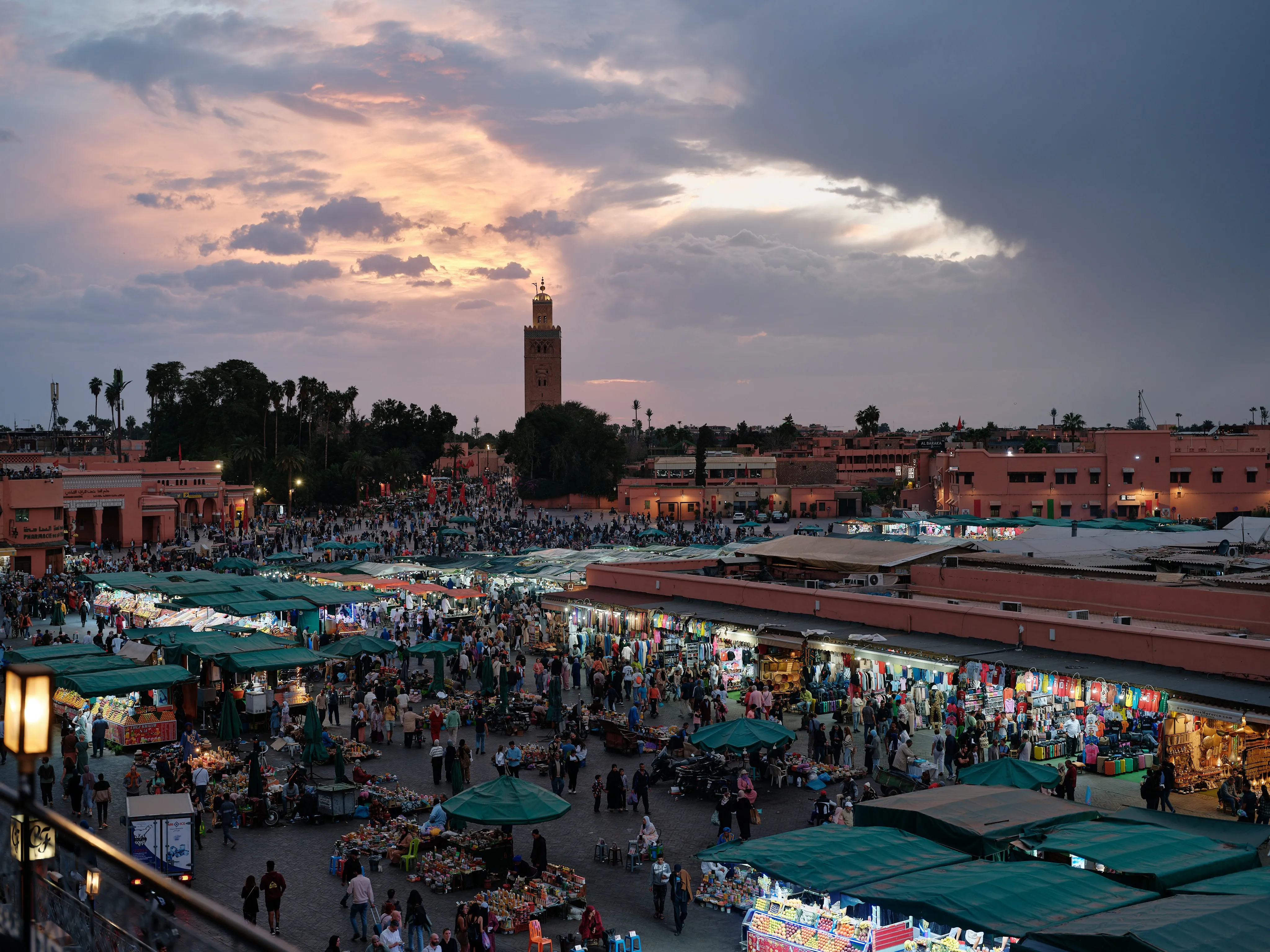
Sunset is the most magical moment to experience Jemaa el-Fna. In barely half an hour, the vast ochre esplanade shifts from its daytime market atmosphere to its great nightly spectacle: the light gilds the façades, the Koutoubia minaret turns pink on the horizon, the first lamps of the food stalls flicker on and plumes of white smoke rise from the braziers. This is the daily metamorphosis that made the square a legend.
In practical terms, aim for the window 30 to 45 minutes before the official sunset time, settle onto a rooftop terrace (the Grand Balcon du Café Glacier remains the star viewpoint) and stay until night falls completely. You’ll then witness what regulars call Marrakech’s “blue hour”, when the sky turns violet and the square blazes with light.
This article focuses on the moment and the light: why dusk transforms the square, what time it happens depending on the season, where to stand so you don’t miss a thing and how to nail your photos. For a detailed comparison of the venues, see our guide to the terraces overlooking the square.
Why is sunset THE magic moment?
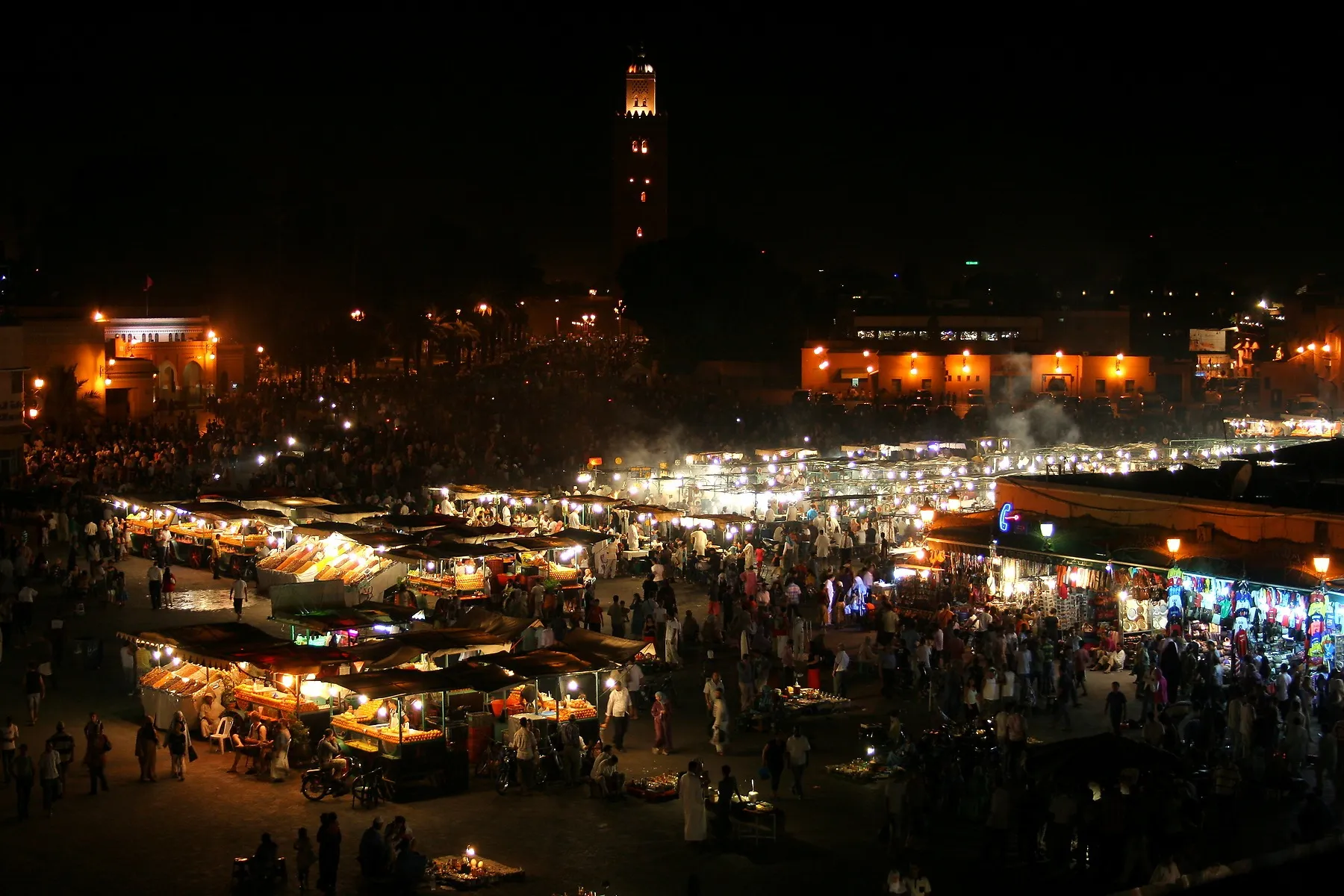
All day long, Jemaa el-Fna moves at a gentle pace: orange juice vendors, snake charmers, herbalists, a few circles forming under the sun. It’s pleasant, but it isn’t yet the main event. Everything changes at sunset. Within a few minutes, a hundred or so numbered food stalls are set up, the gas lamps come on, the Gnaoua musicians strike up their trance rhythms and the crowd pours in. The square fills up, breathes, comes alive.
This shift, in the half-light between dog and wolf, is exactly what makes Jemaa el-Fna a masterpiece of the oral and intangible heritage of humanity, a distinction granted by UNESCO back in 2001. Witnessing this transformation is to understand, live, why this square is not a mere tourist market but a living theatre that reinvents itself every evening.
Above all, the light is incomparable. Marrakech is nicknamed the “red city” for its ramparts and its ochre pisé façades: in the low, raking evening sun, these warm tones literally catch fire. Photographers call this window the golden hour, those 30 to 60 minutes when the light is soft, warm and free of harsh shadows. On Jemaa el-Fna, it flatters both the crowd and the silhouette of the Koutoubia.
The light on the Koutoubia: the backdrop of dusk
It’s impossible to talk about sunset without mentioning the Koutoubia. This 12th-century Almohad minaret, standing around 77 metres tall, dominates the entire south-west of the square and serves as a landmark for all of Marrakech. At sunset, it becomes the natural anchor of the panorama: the sun disappears behind it, and its pink sandstone silhouette stands out against a sky graded from orange to pink and then violet.
From the terraces around the square, the Koutoubia sits slightly to your right when you face the esplanade. It’s the dream alignment for a photo: the sea of people and the smoke in the foreground, the illuminated minaret in the background. After sunset, the building stays lit and offers a second highlight, more graphic, against the darkness.
What time does the sun set depending on the season?
This is the key question for timing your visit. The sunset time varies considerably throughout the year in Marrakech. Here are some rough benchmarks (to be confirmed with the day’s weather, as the times shift by a few minutes each day):
| Period | Sunset (approx.) | Arrive on the terrace around |
|---|---|---|
| December – January (winter) | 5:30 – 6:00 pm | 5:00 pm |
| February – March | 6:15 – 6:45 pm | 5:45 pm |
| April – May | 7:00 – 7:30 pm | 6:30 pm |
| June – August (summer) | 7:30 – 8:15 pm | 7:00 pm |
| September – October | 6:45 – 7:15 pm | 6:15 pm |
| November | 5:45 – 6:15 pm | 5:15 pm |
In short: in summer, plan for a late dinner, as the sun sets around 8 pm and the square only reaches its peak between 9 pm and midnight. In winter, everything shifts earlier: night falls early (around 6 pm), the atmosphere gets going faster and it quickly turns chilly on the terrace — pack a light sweater.
Where to stand for the sunset?
You have two main options, which complement each other: up high for the panorama, or in the heart of the crowd for immersion. The ideal plan combines both.
On a terrace, for the overall view
The cafés bordering the square open panoramic terraces from which you can take in the entire esplanade. The most famous is the Grand Balcon du Café Glacier, on the south-east corner, directly overlooking the crowd and perfectly aligned with the Koutoubia. It’s the postcard viewpoint, but also the most crowded at dusk. The Café de France (east side, several levels) offers an excellent alternative, often a little less besieged, with a view stretching towards the Atlas Mountains.
All these terraces operate on a compulsory purchase basis: a mint tea or an orange juice (usually 15 to 40 dirhams, indicative price) is enough to settle in for the show. There’s no entrance fee. For details on venues, prices and table tips, see our full comparison of the terraces.
At ground level, for immersion
The other experience is to stay down in the square as it transforms. You’re then in the middle of the halqa (circular gatherings) forming, the musicians settling in, the food stalls being assembled by torchlight. The evening light filters through the smoke of the grills and creates an almost cinematic atmosphere. It’s more intense, noisier, more alive — and free.
The best plan? Head up to a terrace 45 minutes before sunset for the overall view and the metamorphosis, then come back down into the crowd once night falls to have dinner at the food stalls and experience the atmosphere from the inside. That way you get the panorama and the immersion.
The day-to-night metamorphosis, minute by minute
To really grasp why this moment is unique, here’s how the square evolves over roughly an hour around sunset:
- T–45 min: the light turns golden, the ochre façades catch fire. The daytime traders (juice, henna, monkeys) are still there. The crowd starts to swell.
- T–20 min: the numbered food stalls go up at lightning speed. The first smells of grilled meat, merguez and fried fish fill the air. The musicians tune their instruments.
- T–0 (sunset): the sun disappears behind the Koutoubia. The sky moves from orange to pink. This is the peak beauty of the light.
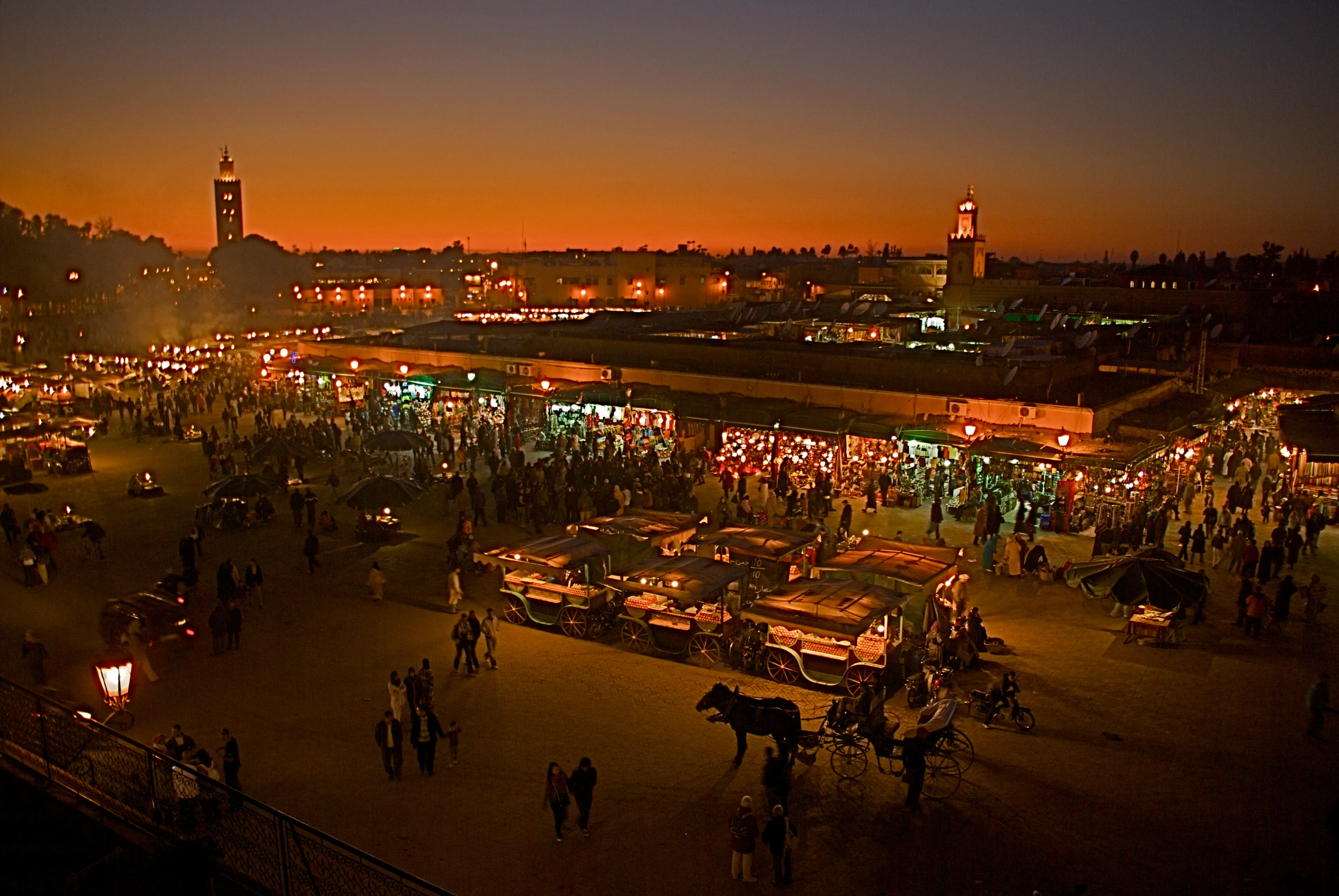
- T+15 min: the blue hour. Lamps come on everywhere, white smoke rises in columns, lit from below. The hubbub intensifies.
- T+30 min and beyond: full night. The square is an ocean of lights and sounds. The circles of storytellers, Gnaoua musicians and acrobats are in full swing.
To learn everything about this nighttime atmosphere once darkness has set in, read our dedicated guide to Jemaa el-Fna in the evening and at night.
Our photo tips for a successful sunset
Dusk over Jemaa el-Fna is a photographer’s dream, but a few reflexes make all the difference:
- Arrive early and scout your frame before the light drops. From the terrace, look for the alignment of crowd + smoke + Koutoubia.
- Make the most of the golden hour just before sunset: the warm, raking light flatters the ochre façades. Shoot into the sun for silhouettes, or with the sun behind you for saturated colours.
- Don’t put the camera away after sunset. The blue hour (15 to 30 minutes afterwards) delivers the most spectacular images: violet sky, lights switched on, illuminated smoke.
- Steady yourself. In low light, rest your phone or camera on the balustrade to avoid blur. Switch on night mode if you have one.
- Respect the performers. Photographing snake charmers, dancers or water carriers (Guerrab) up close almost always involves a small payment. From the terrace, on the other hand, you’re free to photograph the panorama.
What to do just before and after sunset?
To make the most of the window, plan the end of your day around sunset. Beforehand, take advantage of the soft light to explore the square by day, visit the Koutoubia gardens or wander through the adjacent souks. Afterwards, it’s time for dinner: the food stalls set up at dusk serve skewers, tanjia, harira, fried fish and snails until late into the night.
To choose your stall and avoid the traps, check our guide on where to eat at Jemaa el-Fna. And so you don’t miss any of the shows, musicians and storytelling circles that come alive at nightfall, everything is detailed in what to see and do on the square.

Frequently asked questions
What time does the sun set at Jemaa el-Fna?
It depends on the season. In summer (June to August), the sun sets around 7:30–8:15 pm; in winter (December–January), more like 5:30–6:00 pm. In the shoulder seasons, count on somewhere between 6 and 7:30 pm. Always check the exact time for the day, and watch out for the shift during Ramadan.
Where should I stand to see the sunset over the square?
The best viewpoint is a rooftop terrace, such as the Grand Balcon du Café Glacier (south-east corner) or the Café de France. They offer a head-on panorama with the Koutoubia in the background. Another option: stay in the heart of the crowd to experience the metamorphosis from the inside.
Do you have to pay to watch the sunset?
No, the square is free and open-air. If you go up to a terrace, there’s no entrance fee but there is a compulsory purchase (a tea or an orange juice, usually 15 to 40 dirhams). From the square itself, the spectacle costs nothing.
When should I arrive so as not to miss the moment?
Arrive 30 to 45 minutes before the official sunset time. You’ll have time to settle in, order, and above all witness the whole transformation: golden light, lamps coming on, smoke rising and the blue hour.
Is sunset a good time for photos?
Yes, it’s the best photo window of the day. The golden hour flatters the ochre façades and the Koutoubia, and the blue hour (just after sunset) offers spectacular images of the illuminated square. Steady your camera in low light and set aside a small payment to photograph the performers up close.
How long should I stay to enjoy the sunset and what follows?
Allow at least 1.5 to 2 hours: 45 minutes before sunset for the golden light and the metamorphosis, then the blue hour, then dinner at the food stalls once night has fallen. This is the window when the square is at its very best.