A horse-drawn carriage in Marrakech costs, in 2026, roughly 150 to 250 MAD for half an hour and 250 to 400 MAD per hour for the whole carriage (up to 4-5 people), a price to negotiate before you climb aboard. The main stand is located beside Jemaa el-Fna square, on the Mohammed V avenue side, near the Koutoubia. A classic ride lasts from 30 minutes to 1 hour 30 depending on the route you choose.
In brief
- Where: the official stand on the edge of Jemaa el-Fna square, on the Koutoubia and Mohammed V avenue side.
- Indicative 2026 price: 150-250 MAD for half an hour, 250-400 MAD per hour, per carriage (not per person).
- Routes: ramparts and gates of the medina, the Menara garden, the Palmeraie, Gueliz and gardens.
- Ideal duration: 45 min to 1 h for a real tour, 1 h 30 for the Palmeraie.
- Best time: late afternoon, when the heat drops and the light is beautiful.
- Always do: set the price, duration and route before boarding, and choose a driver whose horses are visibly in good health.
The horse-drawn carriage — koutchi in Darija — has been part of the Marrakech scenery for more than a century. It is a slow, comfortable way to discover the city, between two walking visits, without fighting the traffic or the heat. This independent guide gives you the real prices to negotiate, the routes worth taking, the traps to avoid and, above all, an honest note on the welfare of the horses, because not all drivers are equal.
Where to take a horse carriage in Marrakech?
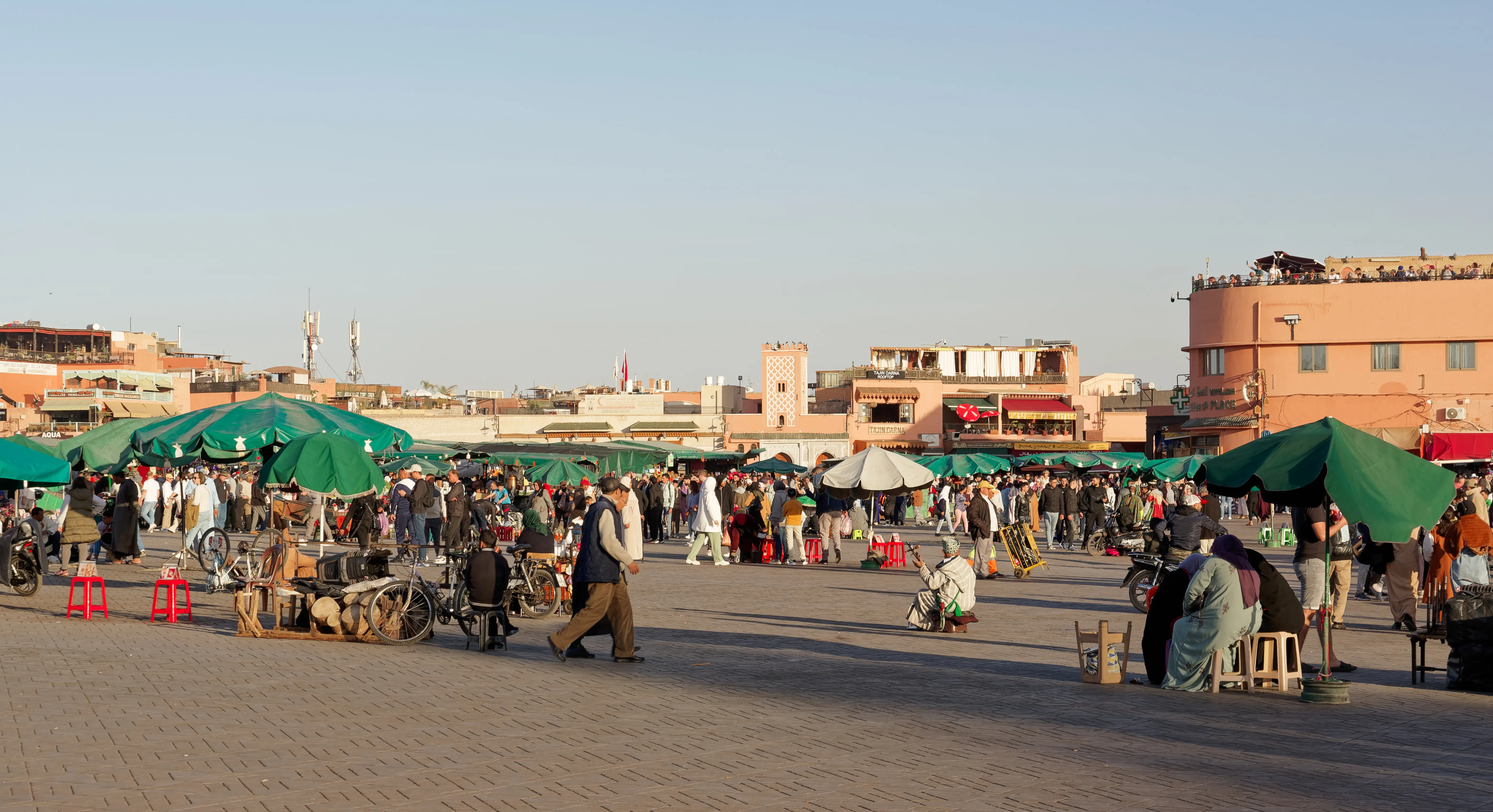
The simplest and most reliable starting point is the carriage stand on the edge of Jemaa el-Fna square, on the side of Mohammed V avenue and the Koutoubia mosque. It is a stand recognised by the city: the carriages are parked there in a line, numbered, and wait for customers. You cannot miss it as you arrive on the square from Gueliz.
Other stands exist around town — near the Menara, in front of certain large hotels in the Hivernage, or on the edges of the gardens — but the Jemaa el-Fna one remains the most central and the most convenient for starting a route. It also has the advantage of being a landmark: after your walk on the square, among the many things to do at Jemaa el-Fna, you will always find a carriage to move on to a tour of the ramparts.
Do you need to book in advance?
No. No reservation is necessary: the carriages wait on site all day and a good part of the evening. You choose the carriage, you discuss the price, you climb aboard. Booking through a hotel or agency is possible but almost always ends up costing more, because a commission is added. By going directly to the stand, you keep control of the negotiation.
How to recognise an official stand?
An official stand gathers several carriages lined up, often with plates or numbers. Be wary of a lone driver who approaches you in the middle of the street with a “special” offer: it is not necessarily a scam, but you will have neither a point of comparison nor any recourse. Staying at the stand lets you compare the horses, the carriages and the prices from one driver to another. To avoid unpleasant surprises more broadly on the square, also read our dedicated guide to scams and traps at Jemaa el-Fna.
How much does a horse carriage cost in Marrakech in 2026?
Prices are free and negotiable: there is no meter. The prices below are indicative 2026 ranges observed departing from Jemaa el-Fna. They are meant per carriage (the whole vehicle, up to 4 or 5 people), and not per passenger — this is a crucial point of the negotiation.
| Service | Duration | Indicative 2026 price (per carriage) |
|---|---|---|
| Short trial ride | 20-30 min | 120-200 MAD |
| Ramparts and gates tour | 45 min-1 h | 200-300 MAD |
| Menara + gardens route | 1 h-1 h 15 | 300-400 MAD |
| Grand Palmeraie loop | 1 h 30-2 h | 400-600 MAD |
| Short point-to-point trip | one trip | 80-150 MAD |
A few benchmarks to put these amounts in context: by way of comparison, an orange juice on the square costs 5-10 MAD, and a taxi from the square to Gueliz around 30-50 MAD. The carriage is therefore a leisure activity, not a mere means of transport — you pay for the experience, the pace and the point of view.
How to negotiate the price of a carriage?
Negotiation is expected and part of the game. Here is the method that works:
- State the exact route and duration you want (“the ramparts, one hour”). A vague price leads to a dispute.
- Have it made clear that the price is for the whole carriage, not per person. Repeat it out loud.
- Offer around 60% of the first price quoted, then work up slowly towards an agreement.
- Compare two or three drivers at the stand before deciding.
- Confirm the final price before boarding, ideally by repeating it in front of the driver.
The first price quoted is almost always inflated for tourists, sometimes double. Staying friendly and firm is generally enough. If a driver refuses to set a clear price in advance, move on to the next carriage: it is the sign of a future disagreement.
Is the tip compulsory?
No, but a small tip (10-20 MAD) is appreciated if the driver has been honest, pleasant and his horses are well treated. It is also a way to encourage good practices. Never feel obliged to give more under pressure.
What are the typical carriage routes?
The carriage shines on the main avenues and open areas, where cars crawl and where walking would be long under the sun. Here are the most requested itineraries departing from Jemaa el-Fna.
The tour of the ramparts and the gates of the medina
This is the classic route par excellence, and often the best value for money. The carriage runs along the red earthen ramparts (the famous ochre 12th-century walls) and passes several historic gates: Bab Agnaou, Bab er-Robb, Bab Doukkala. Allow 45 minutes to 1 hour. You see the medina from the outside, the gardens that border the walls and, depending on the itinerary, the Koutoubia. Ideal for a first approach to the city.
The Menara and gardens route
This tour leads west, towards the Menara garden, its large basin and its pavilion backed by olive trees, with the Atlas as a backdrop on clear days. The carriage cannot always go everywhere, but the round trip runs along beautiful tree-lined avenues. Allow 1 hour to 1 h 15. A good choice in the late afternoon, when the light gilds the palm trees.
The grand loop through the Palmeraie
Longer and more expensive, this route reaches the Marrakech Palmeraie, to the north-east, a vast area planted with date palms. The slow pace of the carriage suits it well. Allow 1 h 30 to 2 hours round trip. Beware: as the Palmeraie is far away, part of the trip is done on roads — check that the route suits you before setting off, and that the horses are in a state to do it without suffering from the heat.
A tour on the Gueliz and new-town side
Less touristy, this route crosses the new town of Gueliz, its avenues, its cafes and its gardens such as the Majorelle Garden (which is then visited on foot). It is another facet of Marrakech, more modern, appreciated by those who have already done the medina. Allow about 1 hour.
What is the best time for a carriage ride?
The best window is the late afternoon, generally between 4 pm and 7 pm depending on the season. The heat drops, the light turns golden, and you can move on to the sunset from the square or a cafe terrace. It is also more comfortable for the horses, which do not work under the full midday sun.
Avoid the heart of the day in summer (12 pm-4 pm): the heat can be crushing (often more than 38 °C in July-August), unpleasant for you and gruelling for the animals. The morning (9 am-11 am) is a good alternative in high season: cooler air, quieter avenues, better availability of drivers.
In the evening, a ride is possible and pleasant, but the big routes (Menara, Palmeraie) lose their interest once night falls. In that case, keep the carriage for a short tour around the square and the illuminated Koutoubia.
A carriage ride with children: is it a good idea?
Yes, the carriage is one of families’ favourite activities in Marrakech. The slow pace, the height of the seat and the presence of the horse delight young children, and it gives a rest from the long walks in the medina. A few practical tips:
- Hold toddlers firmly: carriages have no seatbelts and some streets are cobbled.
- Bring water, a hat and sunscreen, especially in the afternoon.
- Choose a short route (30-45 min) with young children to avoid boredom.
- Negotiate the price separately, as the children’s attention quickly distracts from the discussion.
To organise your whole visit with little ones, our guide Jemaa el-Fna with the family nicely complements this carriage outing with the other activities suited to children.
Animal welfare: how to choose a responsible driver?
This is the most important point of this article, and we address it head-on: not all carriages treat their horses the same way. Taking a carriage is not reprehensible in itself — it is an old trade that supports families — but your choice of driver has a direct impact on the life of the animal. By selecting a well-maintained team, you reward good practices and you encourage the rest of the profession to follow.
Before boarding, take a minute to observe the horse:
- General condition: the animal should be neither too thin (ribs too prominent) nor injured. The coat should be clean.
- Hooves and shoes: they should look in good condition, not cracked or neglected.
- Harness: well adjusted, without sores or chafing at the collar and the mouth.
- Water and shade: a good driver keeps water available and leaves his horses in the shade between rides.
- The horse’s behaviour: it should be calm, not exhausted or panting, especially in strong heat.
A few simple rules for the responsible traveller:
- Refuse to board if the horse seems in pain, injured or exhausted. Move on to another team — and say why, politely.
- Avoid the big routes during the hottest hours: that is when the animals suffer the most.
- Do not overload the carriage: respect the number of seats (4-5 people maximum depending on the vehicle).
- Favour drivers who take care of their mounts; a good tip to those ones helps things move forward.
The city of Marrakech has, over the years, put in place regulatory measures (water points, checks, awareness campaigns). Progress exists but remains uneven: the vigilant eye of the visitor remains the best lever. To go further on this question, read our feature on animal welfare at Jemaa el-Fna, which also covers the monkeys and snakes of the square.
Carriage, taxi or walking: what to choose?
The carriage is not the fastest nor the cheapest way to get around. Here is how to place it:
- To get around efficiently: the petit taxi (beige) is faster and much cheaper (30-50 MAD for a trip in town). Insist on the meter or set the price beforehand.
- To explore the medina: nothing replaces walking, because the alleys of the souks are closed to cars and carriages.
- For a leisure experience: the carriage wins hands down on the main avenues, the ramparts and the gardens, at a pace that leaves time to look and to take photos.
In short, you do not take a carriage to get from point A to point B at the best price, but for the pleasure of the ride — a moment apart in the discovery of Marrakech.
Frequently asked questions
How much does a horse carriage cost in Marrakech in 2026? Allow roughly 150-250 MAD for half an hour and 250-400 MAD per hour for the whole carriage (up to 4-5 people), to negotiate before boarding. The big routes such as the Palmeraie rise to 400-600 MAD.
Is the price per person or per carriage? Per carriage. This is a point to confirm clearly with the driver before setting off, because some try to charge per passenger. Repeat the total price out loud before boarding.
Where to find the carriages at Jemaa el-Fna? At the stand on the edge of the square, on the Mohammed V avenue and Koutoubia side. The carriages are parked there in a line all day. No reservation is necessary.
How many people can ride in a carriage? Generally 4 people comfortably, 5 at most depending on the vehicle. Do not overload the team, for your comfort as well as the horse’s.
What is the ideal duration of a ride? 45 minutes to 1 hour for a real tour (ramparts, gardens). Allow 1 h 30 for the Palmeraie and 30 minutes for a simple trial ride with young children.
Can you take a carriage in the evening? Yes, and it is pleasant for a short tour around the square and the illuminated Koutoubia. On the other hand, the big routes lose their interest once night falls.
Is it ethical to take a carriage? It depends on the driver. Choose a team whose horse is in good health and well harnessed, avoid the hottest hours, do not overload the vehicle and reward good practices. Your vigilance has a real impact.
Is a tip needed? It is not compulsory, but 10-20 MAD are appreciated if the driver has been honest and takes care of his horses.
Key takeaways
The carriage remains one of the most beautiful ways to take the pulse of Marrakech: slow, panoramic, ideal for running along the ochre ramparts, heading to the Menara or strolling as a family. The point to remember comes down to two gestures: always set the price, duration and route before boarding (150-250 MAD for half an hour, per carriage), and take a minute to check the condition of the horse before choosing your driver. These two reflexes turn a simple tourist attraction into an authentic and responsible moment.
To prepare the rest of your stay, explore our complete overview of things to do around Jemaa el-Fna. Want some context on the city? The Marrakech on Wikipedia entry and the official website of the Moroccan National Tourism Office usefully complete this guide.
Indicative 2026 information, given as a benchmark and to negotiate on site. This guide is independent: we neither sell nor book carriages.