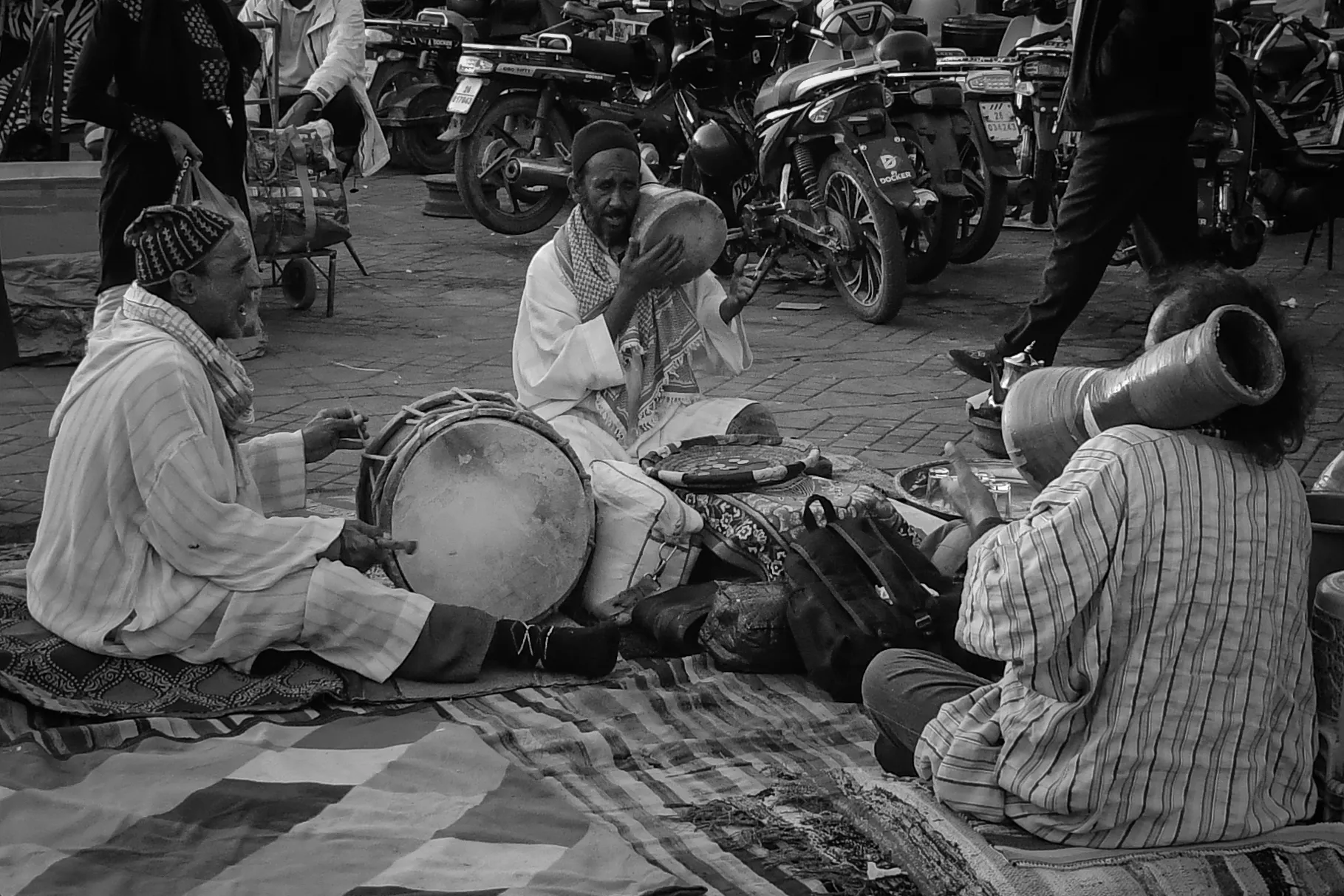
The meaning of “Jemaa el-Fna” is one of the most fascinating riddles in Marrakech. The name is most often translated as “the assembly of the dead” or “the mosque of annihilation,” but the truth is murkier: historians themselves do not agree. Three major theories compete, and none commands full consensus.
What we do know for certain is that the name appears in written texts only at the beginning of the 17th century — nearly five centuries after the Almoravids founded the city. In other words, Morocco’s most famous square existed for a long time without bearing the name that would make it legendary. Behind those two Arabic words lie an unfinished mosque, an outbreak of plague, an ambitious sultan and, perhaps, the memory of public executions.
In this article, we break down the etymology of Jemaa el-Fna word by word, then examine the three theories of the name one by one, along with the historical facts that support or temper each. Enough, at last, to understand why this place name — as beautiful as it is macabre — continues to intrigue travellers from all over the world.

The etymology: what do “Jemaa” and “Fna” mean?
To understand the debate, we must first separate the name’s two components, both of which come from Arabic.
“Jemaa” (جامع / جماعة) is the clearer of the two. It denotes both an assembly, a gathering and, in its religious sense, a mosque — more precisely the great mosque where the Friday congregational prayer is held (jâmi’). It shares its root with “djemââ” (the group, the community). On the square, the two meanings coexist: a place of popular gathering AND a reference to a vanished religious building.
“Fna” (الفناء) is far more ambiguous, and this is where all the mystery begins. The Arabic word fanâ’ carries at least two families of meaning:
- Death, extinction, annihilation: the root f-n-y evokes disappearance, ending, nothingness. In Sufism, fanâ’ even denotes the effacement of the self in God.
- The courtyard, the esplanade, the open space in front of a building: the term finâ’ designates the cleared area at the foot of a structure.
Theory No. 1: “the assembly of the dead” and public executions
This is the most widespread version among guides, and the most chilling. It reads fna as “death” and casts the square as the stage for public executions.
According to this tradition, the great esplanade served, from the Middle Ages onward, as a place of execution and display. The heads of the condemned and of rebels were said to be stuck on pikes or nailed to the neighbouring gates, as a warning. Some sources trace these gruesome practices back to a very early period, around the year 1050, in the earliest days of Marrakech. “The assembly of the dead” would then refer to the crowd of the executed — or to the throng of onlookers gathered for the spectacle of punishment.
This theory has the power of the image on its side, along with a measure of historical reality: in Marrakech, as in many pre-modern capitals, executions were public and served as a political warning. But it has a major weakness: no source proves that the name comes from this, and the place name appears only much later, in the 17th century. The “assembly of the dead” explanation therefore looks more like an appealing popular reconstruction than a documented certainty.
Theory No. 2: “the mosque of annihilation” and al-Mansour’s plague
This is the hypothesis that historians consider the most solid today, and it rests on an early testimony. It reads jemaa as “mosque” and tells the story of an aborted building project.
At the end of the 16th century, the powerful Saadian sultan Ahmad al-Mansur (who reigned from 1578 to 1603), enriched by gold from Sudan, undertook to build a monumental mosque at the centre of the square. According to the chronicler Abderrahmane es-Saâdi, the building was at first meant to bear a luminous name: Jemaâ el-Hna, “the mosque of tranquillity” (el-hna meaning quietude, happiness).
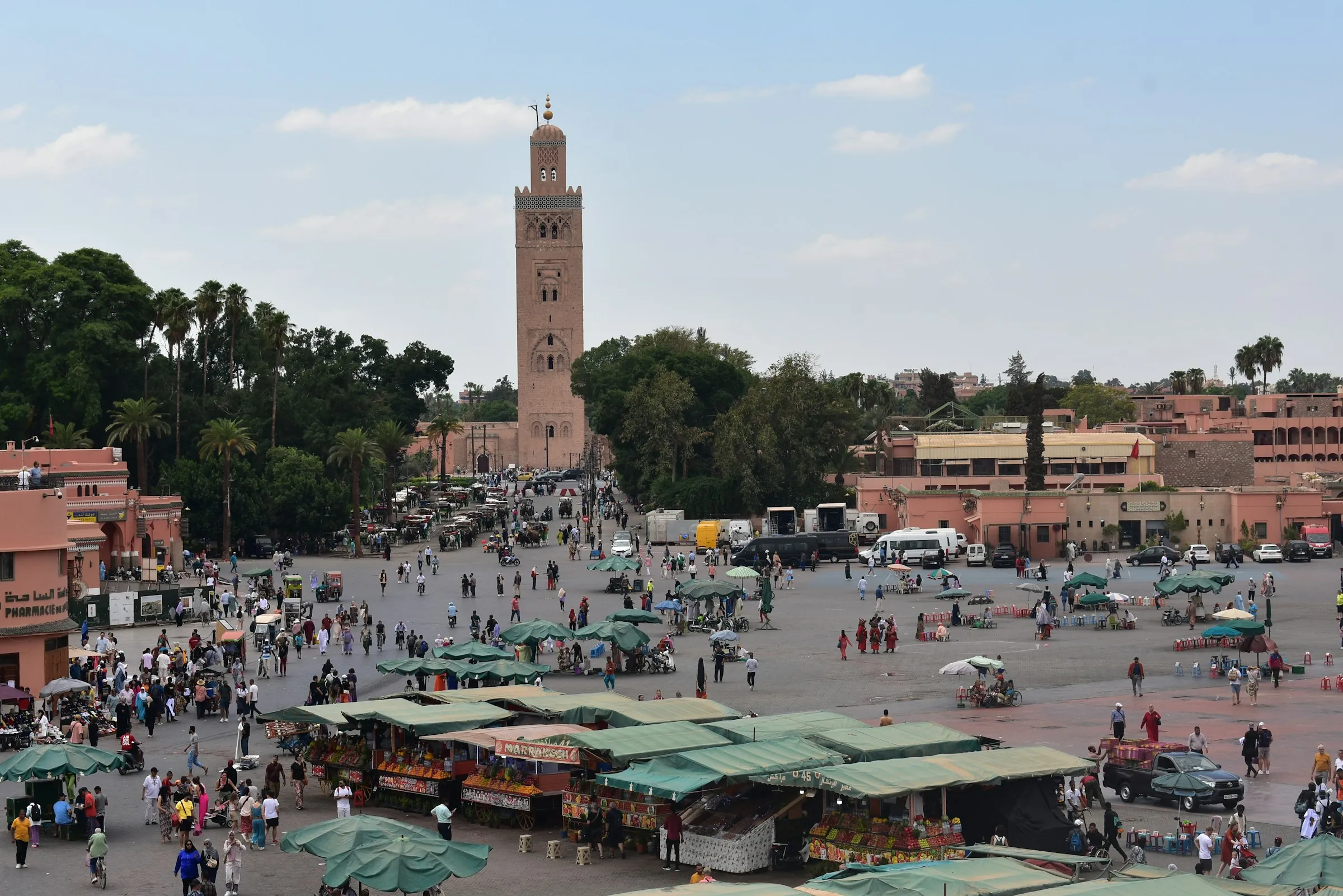
But the project turned to tragedy. An outbreak of plague ravaged Marrakech, decimating part of the population — and carrying off the sovereign himself in 1603. The building site was abandoned, the mosque left as an unfinished ruin, then dismantled. By a bitter irony, the inhabitants renamed the place with a play on words: from Jemaâ el-Hna, “the mosque of tranquillity,” it became Jemaa el-Fna, “the mosque of annihilation” or “of ruin.” The name would thus have been born of a sarcastic pun on an architectural dream swallowed by death.
This theory has a decisive advantage: it rests on a 17th-century chronicler, a contemporary of the events, which fits perfectly with the date the name appears in the texts. It also elegantly explains why jemaa would refer to a mosque that no longer exists: it could only have been a building that was never completed.
Theory No. 3: “the mosque of the world’s end”
More poetic, this third reading appeals to lovers of words. It starts again from the mystical sense of fanâ’ — extinction, disappearance, the ending of all things — to translate the name as “the mosque of the world’s end” or “of nothingness.”
The interpretation plays on the idea of a threshold place, a point where the known world comes to an end. It echoes Sufi vocabulary, in which fanâ’ is the effacement of the ego in the divine, and lends the name a metaphysical aura: a square suspended at the edge of the void, between the visible and the invisible. Some also see in it an evocation of the ruined mosque become a gateway to the beyond.
Alluring as it is, this version remains the least documented of the three. It belongs more to literary reverie — the kind that has inspired so many writers who came to Marrakech in search of an absolute elsewhere — than to historical demonstration. But it says something true about the square: its evocative power far exceeds its geographical reality.
So what is the real meaning?
Let us sum up the three lines of thought in a table, along with what sets them apart:
| Theory | Reading of “Fna” | Strength | Weakness |
|---|---|---|---|
| Assembly of the dead | Death (executions) | Powerful image, real historical basis | No source links the name to executions |
| Mosque of annihilation | Ruin, annihilation | Supported by a 17th-century chronicler | Rests on a single testimony |
| Mosque of the world’s end | Nothingness, mystical extinction | Strong poetic charge | Late interpretation, poorly documented |
The theory of Ahmad al-Mansur’s aborted mosque prevails among historians, because it is the only one backed by an early source and consistent with the date the name appears. But the absence of absolute certainty is part of the place’s charm: Jemaa el-Fna keeps its secret, and every visitor can project their own reading onto it.
One thing is certain: this name born of a catastrophe is today synonymous with life. Since 2001, the cultural space of the square has been recognised by UNESCO as a masterpiece of the intangible cultural heritage of humanity, and inscribed in 2008. Storytellers, musicians and halqa keep alive the oral tradition that makes its heart beat.
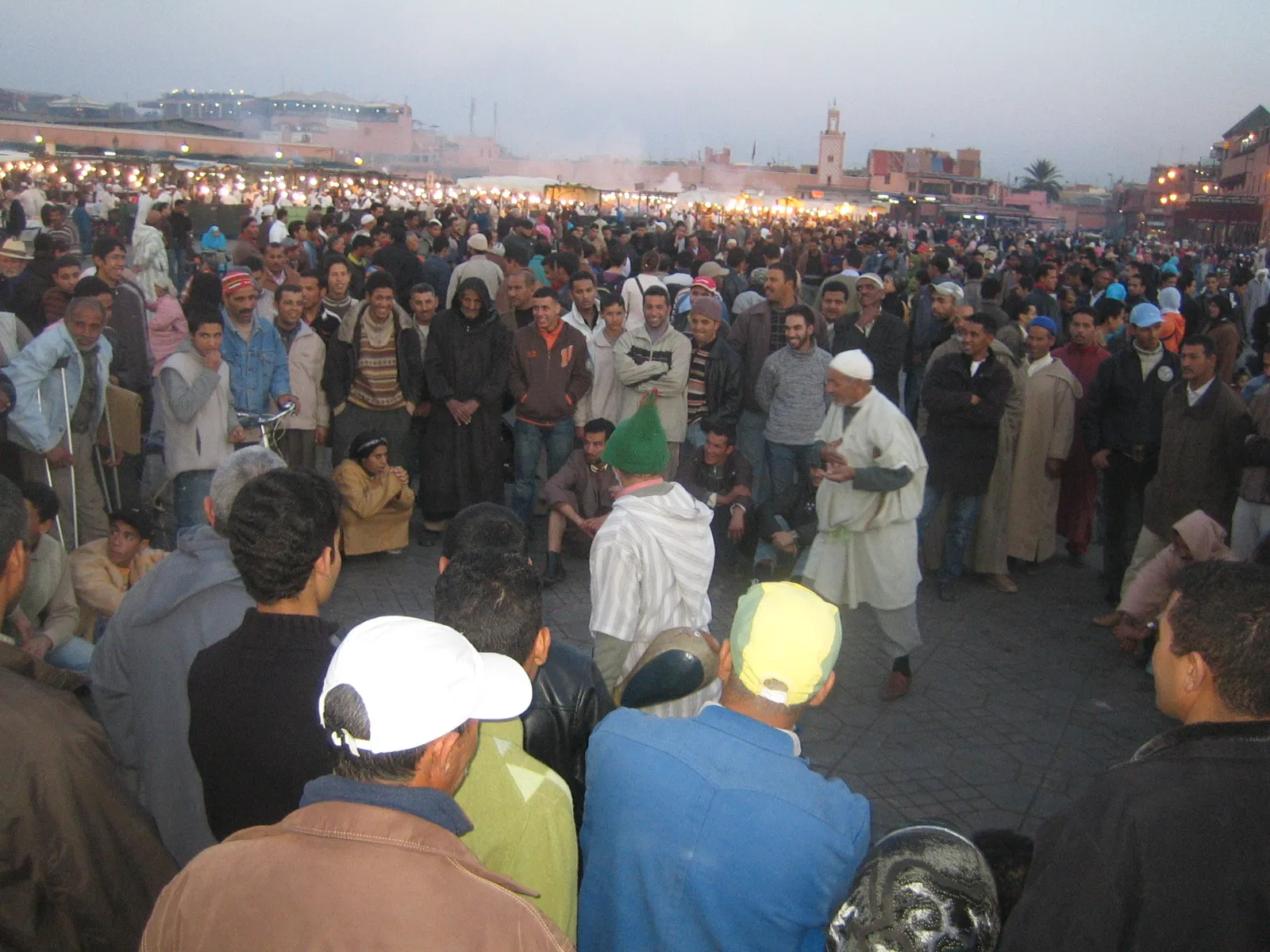
To go further, dive into our complete feature on the history and meaning of Jemaa el-Fna, discover what to do and what to see on the square, or explore the surroundings of Jemaa el-Fna to understand how this nerve centre fits into the Marrakech medina. You can also consult the detailed Wikipedia entry on the square.
Frequently asked questions
What does “Jemaa el-Fna” literally mean?
The name combines jemaa (“assembly” or “mosque”) and fna (“death/annihilation” or “esplanade”). The most common translations are “the assembly of the dead” and “the mosque of annihilation.” None is officially established: the exact meaning remains debated.
Where does the name Jemaa el-Fna come from?
The dominant theory attributes it to the Saadian sultan Ahmad al-Mansur (1578–1603), who wanted to build a great mosque on the square, called Jemaâ el-Hna (“mosque of tranquillity”). An outbreak of plague halted the work and carried off the sovereign; the place was then ironically renamed Jemaa el-Fna, “the mosque of ruin.”
Were there really executions on the square?
Tradition holds that condemned prisoners were executed there and their heads displayed, which is said to have inspired the “assembly of the dead” meaning. Public executions were indeed a reality in old Marrakech, but no source proves that the square’s name derives directly from them.
Since when has the square borne this name?
The place name “Jemaa el-Fna” appears in the texts only at the beginning of the 17th century, whereas Marrakech was founded in the 11th century by the Almoravids. The square therefore existed long before it bore the name that made it famous.
Why do three different translations coexist?
Because the Arabic word fna is ambiguous: depending on its vocalisation, it evokes death, mystical annihilation, or simply the esplanade in front of a building. This polysemy allows for several readings, none of which imposes itself definitively on historians.
Is the plague theory proven?
It is the most credible, as it is supported by the chronicler Abderrahmane es-Saâdi, a 17th-century contemporary, and consistent with the date the name appears. It rests, however, on this single testimony, which leaves a measure of uncertainty.