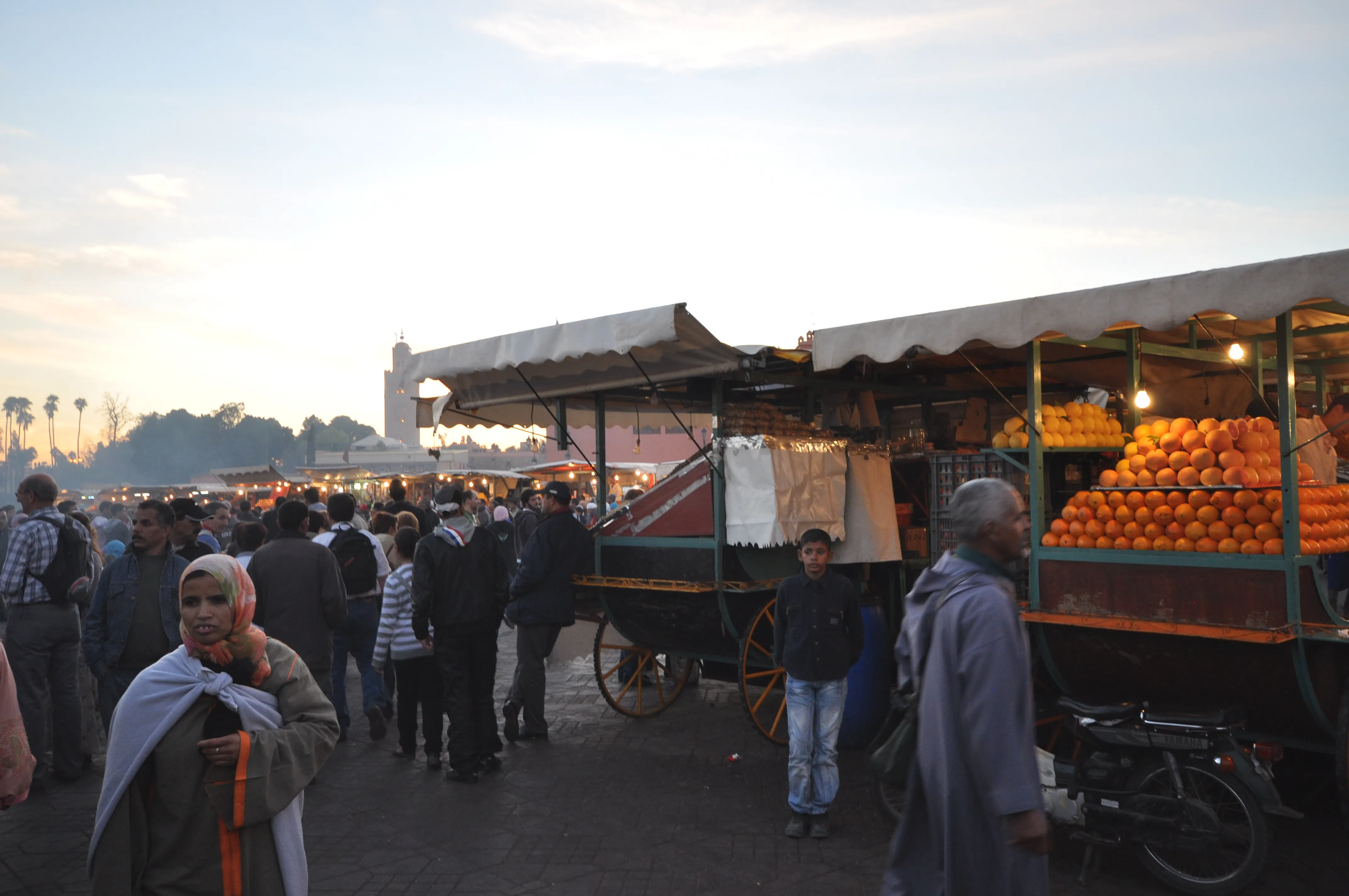
Jemaa el-Fna feels very different depending on the weather. In summer, under a heat that often tops 40°C, the square empties in the afternoon and only comes back to life after dark: you visit it early in the morning or in the evening, never between 1 pm and 5 pm. In winter, the days stay mild and sunny (18-20°C), but the evenings turn distinctly chilly (5-8°C): a jacket is essential to hold out on a terrace. As for rain, rare but very real from November to March, it briefly transforms the square by thinning it out — that’s when it’s time to take shelter under the arcades, on a covered terrace or in the sheltered souks.
In other words, there is no “bad” season to discover Jemaa el-Fna: there are mainly schedules and habits to adapt to the day’s weather. This article is a practical guide, purely about the weather: how to survive the summer heatwave, how to avoid shivering in winter, and what to do on the rare rainy days. For a broader comparison of periods and crowds, see our guide to the best time to visit the square.
Marrakech’s climate in brief
Marrakech enjoys a semi-arid climate: very hot, dry summers, mild and sunny winters, low rainfall concentrated in a few spells. The city averages more than 300 days of sunshine per year, which explains why rain surprises visitors so much. For detailed month-by-month averages, the climate data for Marrakech on Wikipedia gives a good overview of temperatures and rainfall.
Here are some indicative benchmarks to help you plan your visit by season:
| Season | Day (max) | Night (min) | Rain | Key habit |
|---|---|---|---|---|
| Summer (June-Aug) | 38-42°C | 20-24°C | almost none | come early / in the evening, stay hydrated |
| Autumn (Sept-Oct) | 28-32°C | 15-18°C | low | ideal, few constraints |
| Winter (Dec-Feb) | 17-20°C | 4-8°C | rare but possible | jacket for the evening |
| Spring (Mar-May) | 22-30°C | 10-15°C | brief spells | adaptable outfit |
What all these seasons have in common: the swing between day and night is large. You can feel hot at noon and cold three hours after sunset. That’s the first thing to keep in mind, whatever the time of year.
Jemaa el-Fna in summer: facing the heatwave (+40°C)
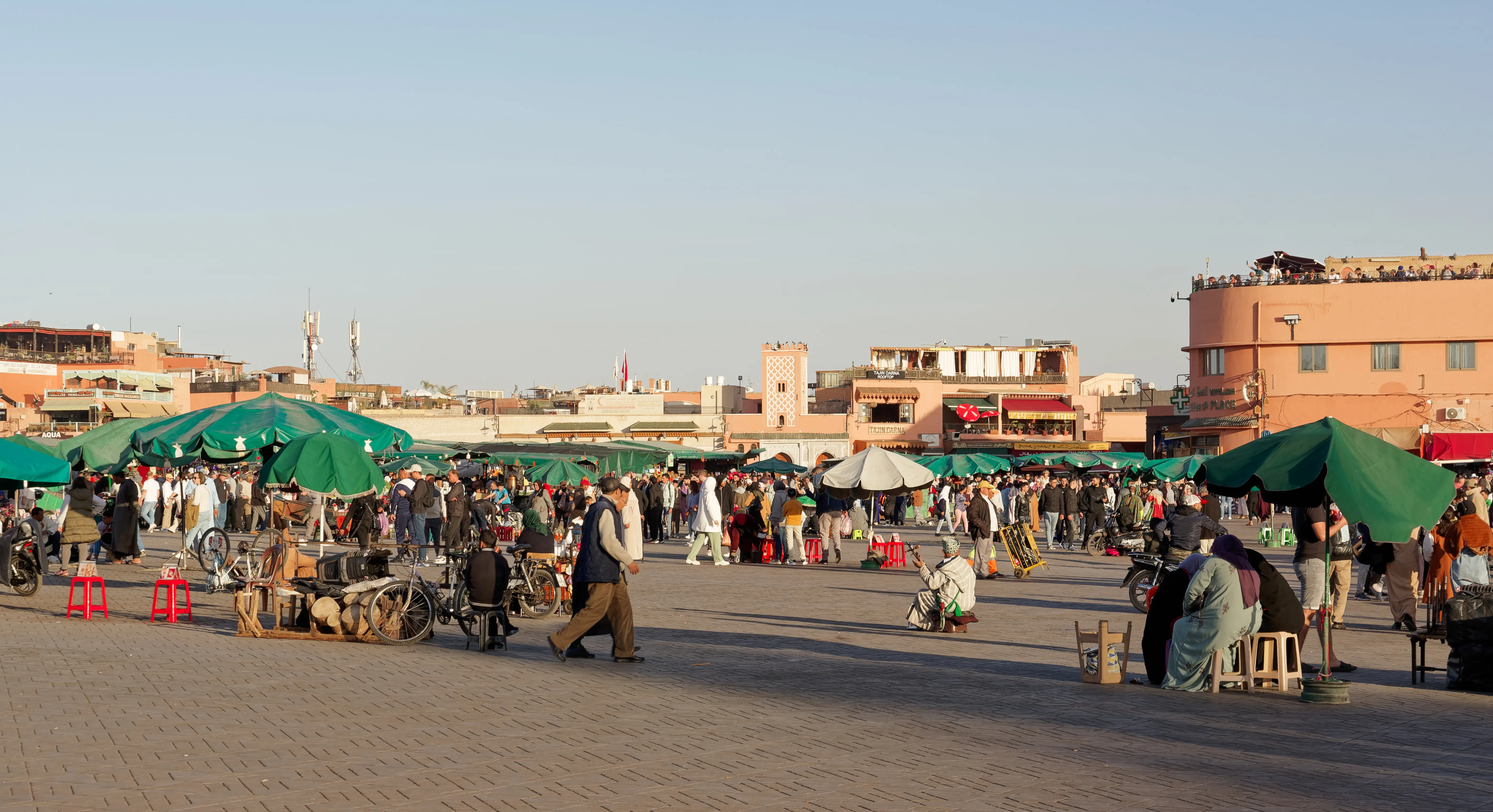
Summer is the most demanding season. From June to August, the thermometer regularly climbs above 40°C in the early afternoon, and the bare stone esplanade, without shade, acts like a hotplate. The result: between 1 pm and 5 pm, the square empties almost entirely. Trying to visit it at that time is not only disappointing (little going on) but potentially dangerous for your health.
Come early in the morning or in the evening
The golden rule in summer can be summed up in one sentence: avoid the middle of the day. Two time slots work perfectly.
- Early in the morning (7 am-10 am): the air is still breathable, the light is soft, the orange juice sellers and the first stalls set up quietly. It’s the best moment to photograph the square without the crowd or the furnace.
- In the evening, from sunset onward: this is when Jemaa el-Fna comes back to life. In summer, the sun sets late (around 8 pm-8:15 pm), and the atmosphere only reaches its peak between 9 pm and midnight, once the heat has dropped. The food stalls go up, the musicians settle in, the crowd flows in. To learn all about this atmosphere, read our guide to Jemaa el-Fna in the evening and at night.
Stay hydrated and protected
Marrakech’s dry heat is treacherous: you sweat without realizing it because the perspiration evaporates instantly. A few habits help you avoid heatstroke:
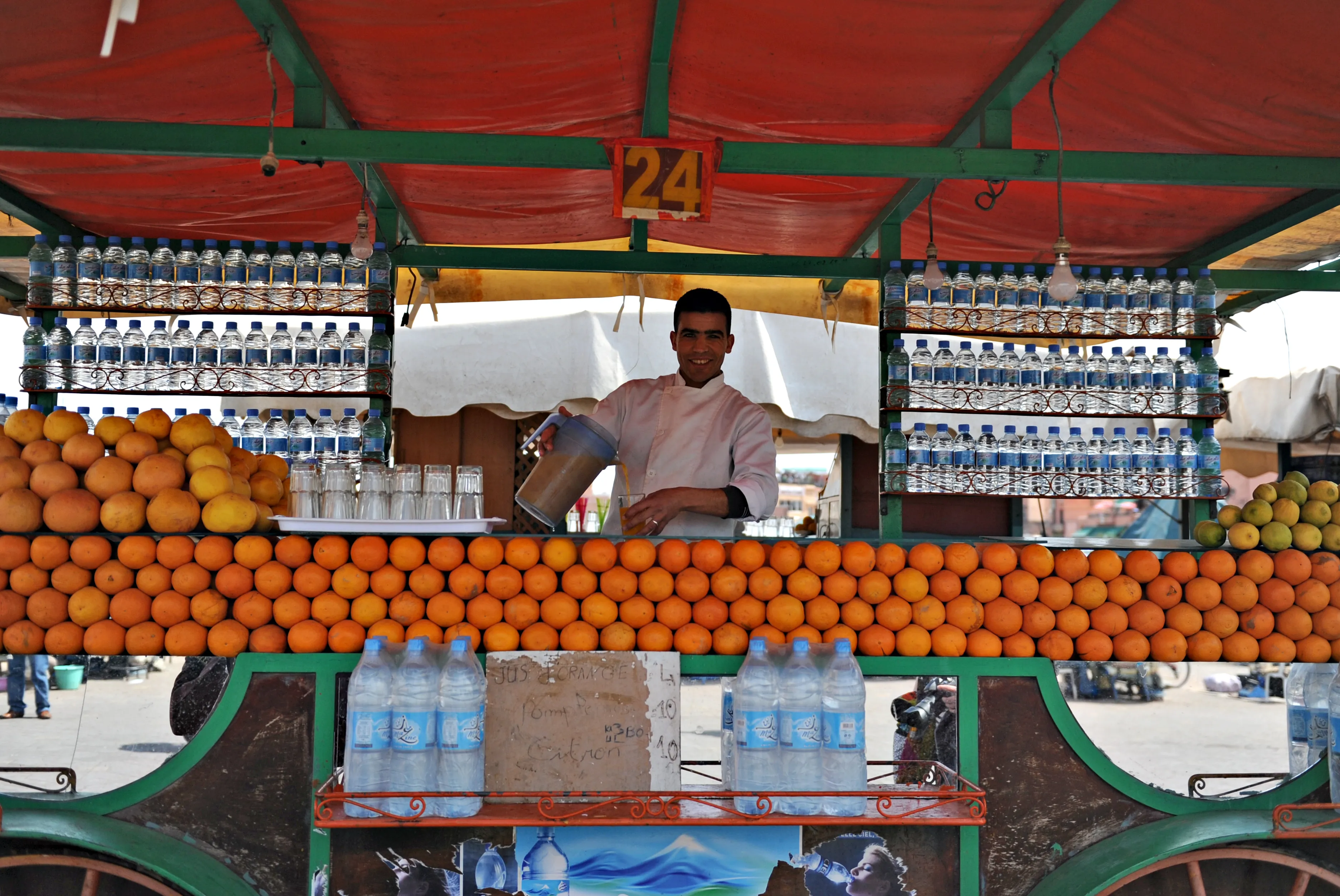
- Drink continuously, before you feel thirsty. Always keep a bottle of water on you. The famous freshly squeezed orange juices on the square (usually 4 to 15 dirhams, indicative price) are an excellent hydration break.
- Cover your head: hat, cap or scarf. The Moroccan sun beats down hard and sunstroke is a real risk.
- High-factor sunscreen, sunglasses, and light, loose, pale clothing (cotton and linen breathe better).
- Look for shade: the café terraces lining the square offer parasols, fans and sometimes misting sprays. A mint tea or a juice is enough to settle in.
Good news: the summer night stays mild (20-24°C), pleasant for strolling and dining outside very late. Summer rewards those who flip their rhythm — sleep in, take a sheltered nap in the afternoon, and stay on the square late into the night.
Jemaa el-Fna in winter: mild by day, cool in the evening
Marrakech’s winter is one of the destination’s best-kept secrets. From December to February, the days are often bright and mild, with 17 to 20°C in full sun: ideal conditions for exploring the square, the souks and the monuments without suffering from the heat. The tourist crowd is also thinner than in spring.
But winter holds a trap: the day/night contrast is brutal. As soon as the sun sets (early, around 6 pm), the temperature drops quickly and can fall to 4-8°C in the evening, with a chill sharpened by the wind coming down from the snow-capped Atlas. Many visitors, misled by the mild afternoon, find themselves freezing on a terrace at dinnertime.
The jacket, the essential accessory
The winter watchword: dress in layers (like an onion). A t-shirt or shirt during the day, plus a sweater and a warm jacket to slip on as soon as the sun sets. Add a scarf if you’re sensitive to the cold: the panoramic terraces, very exposed, are especially cool in the evening. The food stalls on the square, for their part, warm you up with their braziers and steaming dishes.
In winter, with the sun setting early, the nighttime atmosphere starts earlier too (from 6 pm-6:30 pm), which is handy for dining at a European hour. The square stays lively, just a little less late than in summer.
Jemaa el-Fna in the rain: what changes?
Rain in Marrakech is rare but not exceptional: the spells concentrate from November to March, in the form of showers that are often brief rather than long grey days. When it falls, it clearly changes the face of the square.
What changes in practice
- The square thins out fast. The performance circles (halqa), snake charmers and open-air musicians pack up as soon as the rain sets in: the open-air entertainment depends on good weather.
- The ground becomes slippery. The esplanade and the paved alleys of the souks can be soaked: closed shoes with non-slip soles are recommended.
- The evening food stalls may be reduced or tarped over. Some stay open under their canvas, others don’t set up if the shower is heavy.
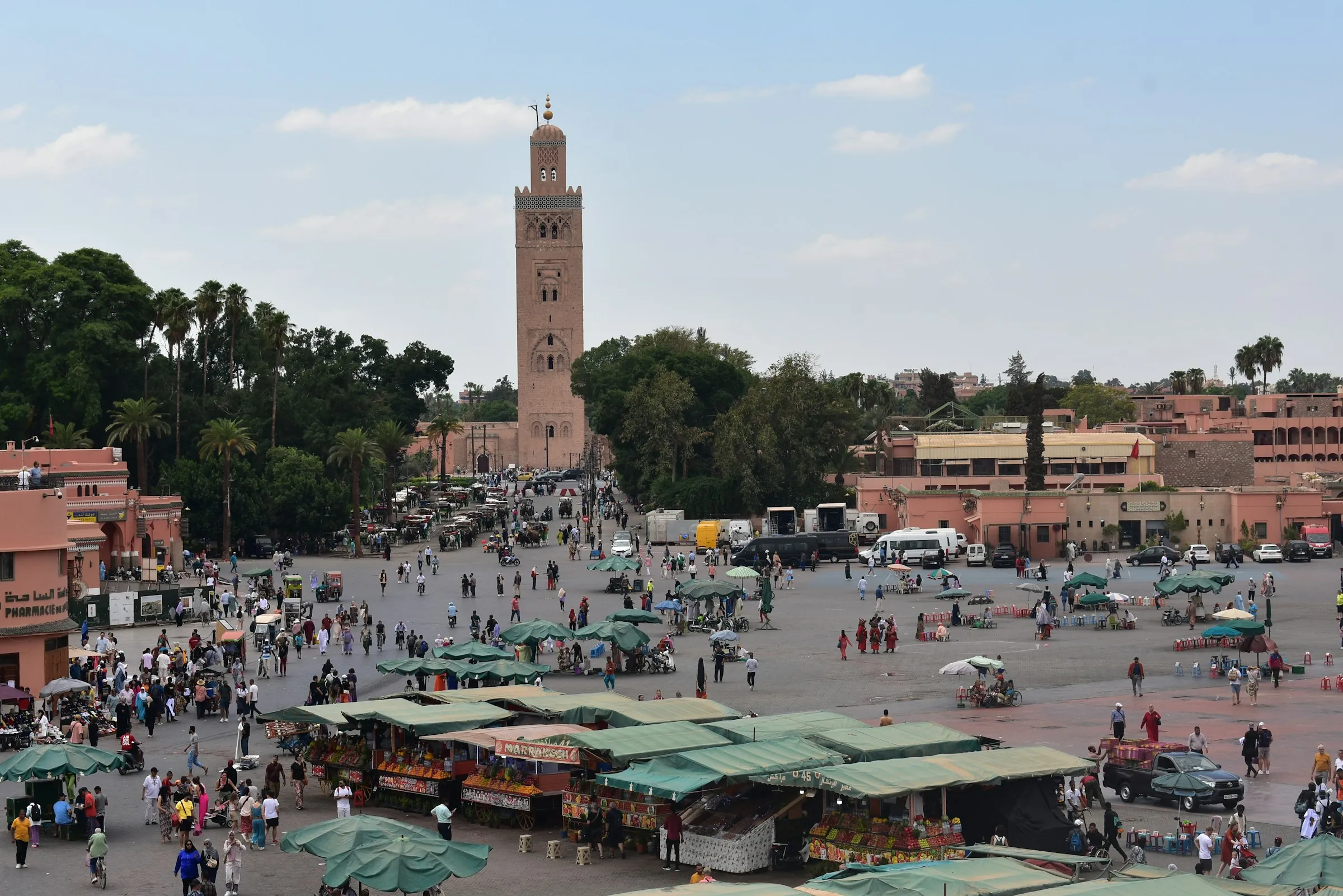
- The light becomes photogenic: reflections on the wet cobbles, a dramatic sky behind the Koutoubia. Rainy days offer images that bright sun never gives.
Where to take shelter when it rains
Good news: you’re never far from cover around Jemaa el-Fna. Here are the best refuges:
- The covered café terraces lining the square (Café de France, Café Glacier and their neighbors): most have sheltered floors or verandas from which you can keep watching the esplanade while staying dry.
- The covered souks, just north of the square. A large part of the souk network is protected by slatted roofs or tarpaulins: you can stroll, haggle and shop there sheltered from the shower. Discover them in our guide to the souks around the square.
- The nearby museums and covered venues: several heritage sites a few minutes’ walk away let you wait out the rain in the dry. See our ideas around Jemaa el-Fna.
Recap: the right habit depending on the weather
Whatever the season, keep in mind these three reflexes that make all the difference on Jemaa el-Fna:
- In case of intense heat: come early in the morning or after sunset, drink nonstop, cover your head and avoid the square between 1 pm and 5 pm.
- In case of cool weather (winter evenings): add a jacket and a scarf, take advantage of the mild daytime to visit, warm up with the square’s hot dishes.
- In case of rain: retreat to a covered terrace or the sheltered souks, wait out the shower (often brief), and make the most of the special light for your photos.
To plan your visit in detail (opening hours, transport, safety, addresses), see our full page of practical info on Jemaa el-Fna.
Frequently asked questions
Is it too hot to visit Jemaa el-Fna in summer?
No, as long as you adjust your timing. In July-August, the square often exceeds 40°C in the afternoon and empties between 1 pm and 5 pm. Visit it early in the morning (7 am-10 am) or in the evening after sunset, when the atmosphere is in full swing and the heat has dropped. Stay hydrated continuously and cover your head.
Is it cold at Jemaa el-Fna in winter?
During the day, no: from December to February, it’s mild and sunny (17-20°C). But in the evening, the temperature drops to 4-8°C, sometimes with cold wind from the Atlas. Be sure to bring a warm jacket and a scarf to stay on a terrace or dine on the square after sunset.
What to do at Jemaa el-Fna when it rains?
The rain thins out the square and interrupts the open-air performances, but the showers are usually brief. Take shelter on a covered terrace (cafés around the square) or in the covered souks to the north, where you can haggle under cover. Bring non-slip shoes, as the cobbles become slippery.
When does it rain in Marrakech?
Rarely. Marrakech has more than 300 days of sunshine per year. The rare rains concentrate from November to March, often as short showers rather than whole days of rain. Summer (June-August) is almost entirely dry.
What to wear at Jemaa el-Fna by season?
In summer: light, loose, pale clothing, a hat, sunglasses and sunscreen. In winter: dress in layers, with a warm jacket and a scarf for the evening. In the shoulder seasons and on rainy days: an adaptable outfit, plus a windbreaker or a light poncho in your bag.
Should you avoid certain hours because of the weather?
Yes, especially in summer: avoid the 1 pm-5 pm slot, when the heat is at its peak and the square deserted. The rest of the year, the constraints are fewer, but keep in mind that night falls early in winter (around 6 pm) and it quickly turns cool.