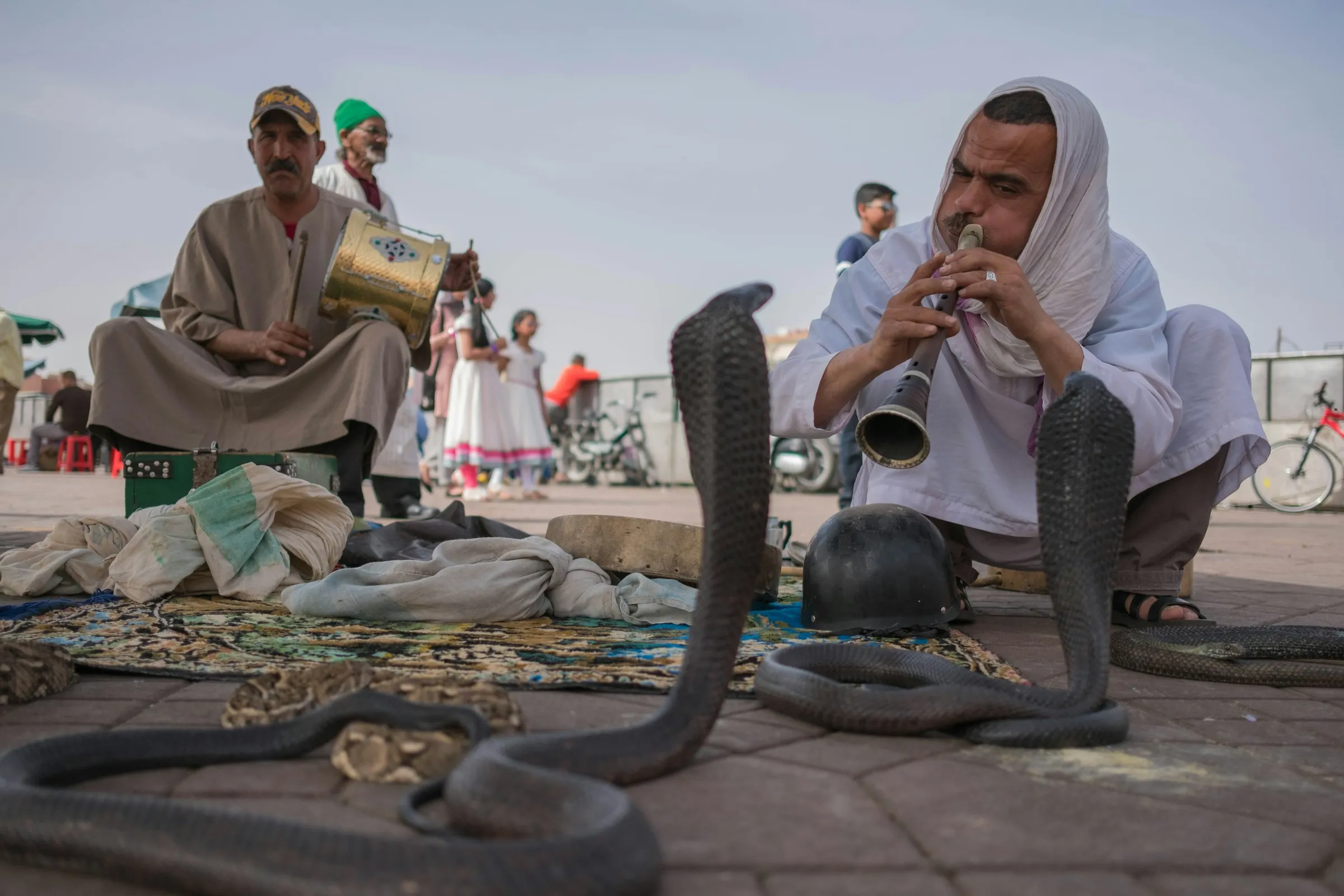
The snake charmers of Jemaa el-Fna are one of Marrakech’s most iconic sights: a man sitting cross-legged, cheeks puffed with breath, coaxing haunting notes from a flute while a cobra rears up, hood spread wide, as if under a spell. The scene is striking. But behind the folklore lies a genuine five-century-old brotherhood tradition, a stubborn myth (snakes don’t hear the music) and a difficult ethical reality: most of these reptiles are mutilated and kept in conditions that doom them within a short time.
This article explains where the practice comes from, how the “charm” really works, what you need to know about animal welfare, and how to handle the charmers’ approach and the notorious paid photo in practical terms. The goal: to help you understand this heritage without naivety, and to make your own informed choices.
Who are the snake charmers? The Aissawa brotherhood
The charmers of Jemaa el-Fna are historically linked to the Aissawa brotherhood (or Aissaoua), a mystical Sufi order founded at the turn of the sixteenth century by Sidi M’hammed ben Aissa (1465-1526), nicknamed the “Cheikh al-Kamil,” the Perfect Master. The mother zaouia is in Meknes, and the brotherhood is renowned across the Maghreb for its spiritual music, its religious hymns and its trance rituals.
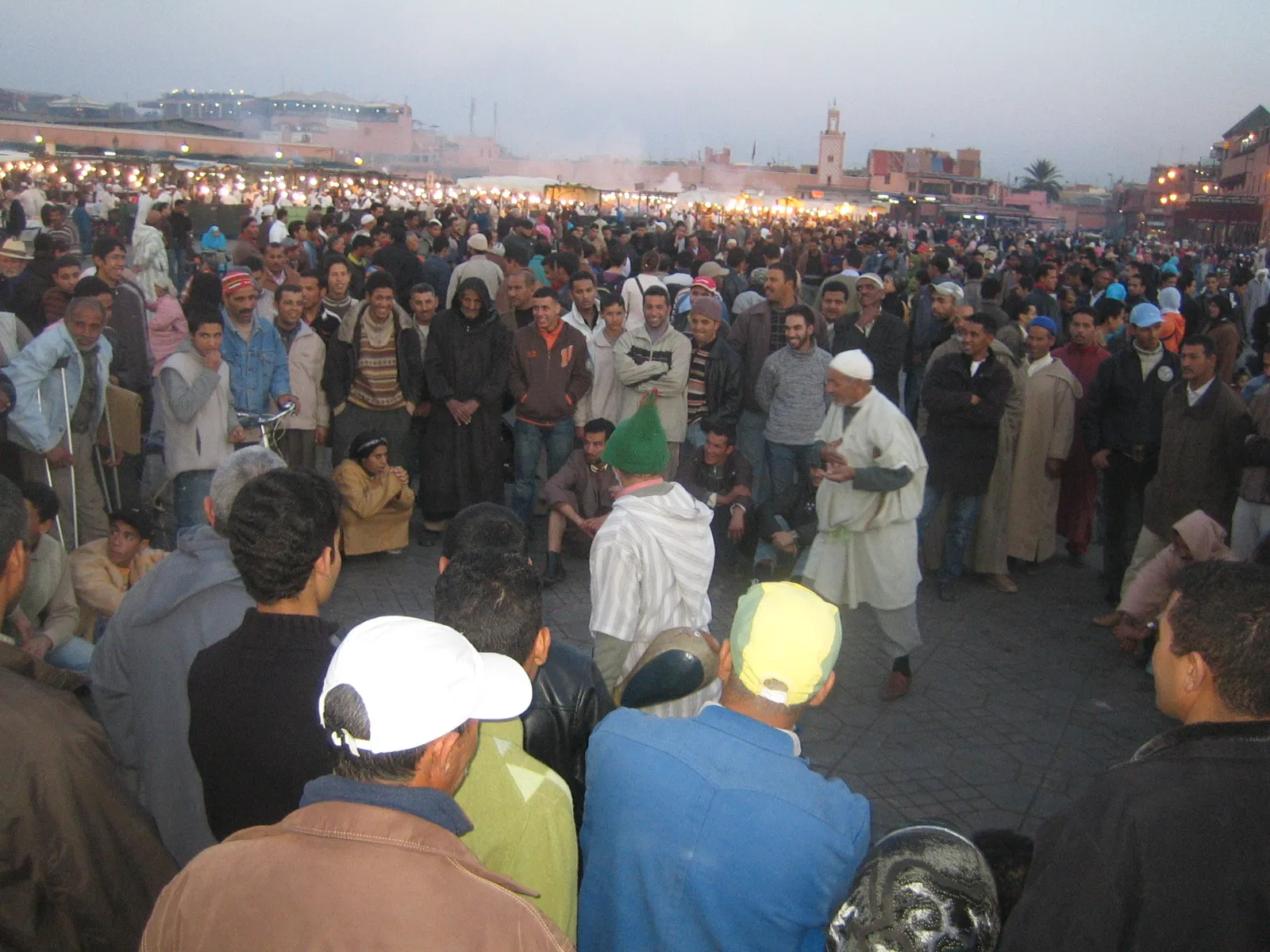
According to tradition, the order’s disciples developed a special relationship with snakes and scorpions, tied to a reputation for immunity to bites and venom during their ceremonies. It is from this heritage that the charmer’s trade, as seen today on the square, descends in a heavily folklorized, tourist-facing form. Handling reptiles has been part of it for centuries: it belongs to the arts of the halqa, the performance circles that bring Jemaa el-Fna to life.
The ghaita and the myth of the “charm”: snakes are deaf
The charmer’s signature instrument is the ghaita, a traditional oboe with a nasal, piercing sound, sometimes joined by the nay (flute) and the bendir (frame drum). The musician sways the instrument left and right above a basket, and the cobra rises up and “follows” the movement. The impression of a snake hypnotized by the melody is complete.
Yet it is an illusion. Snakes have no external ear and perceive airborne sounds very poorly: they do not “dance” to the flute’s sound. What makes them react is the movement of the instrument and the presence, felt as a threat. The cobra in particular instinctively adopts a defensive posture: it rears up and spreads its hood in the face of what it perceives as danger. Far from being enchanted, the animal is actually on the defensive, ready to protect itself. The swaying of the ghaita does not soothe it: it keeps it on alert.
The “charm,” then, owes less to musical magic than to a clever staging that exploits the reptile’s natural behavior. Understanding this takes nothing away from the musicians’ virtuosity — but it dismantles the story of a peaceful communion between man and animal.
The ethical reality: mutilated, stressed reptiles
This is the dark side of the show, extensively documented by the press and animal rights advocates. To render snakes harmless and “docile,” many charmers resort to practices that amount to mutilation:
- Fang removal: vipers and cobras are pinned at the neck to force their mouths open and pull out their venom fangs, often without hygiene or anesthesia.
- Piercing or sewing: some venom glands are pierced, or the mouth is partially sewn shut to prevent any bite. The animal can then no longer feed and slowly starves to death.
- Captivity conditions: dehydration, lack of suitable food, inability to thermoregulate properly, constant stress from noise, crowds and handling.
The result: many snakes survive only a few weeks or months, victims of post-operative infections or exhaustion. On top of this comes a conservation issue: capture takes reptiles from the wild, including some protected species such as the Egyptian cobra (Naja haje), already under local pressure.
It’s also worth avoiding caricature. Not all the performers on the square are the same, and the Aissawa tradition holds a genuine cultural and spiritual depth that goes far beyond the tourist act. But the commercial version that visitors encounter today at Jemaa el-Fna rests, in practice, on animals that suffer.
How much does a photo with a snake charmer cost?
On the square, photos come at a price the moment a charmer, a snake or a staged scene appears in your frame — even if no one warned you in advance. It’s one of the main sources of friction (and scams) at Jemaa el-Fna.
| Situation | What you’ll often be asked | Reasonable benchmark* |
|---|---|---|
| “Stolen” photo of a circle from afar | Nothing, if you don’t come closer | Free |
| Close-up photo of the charmer and basket | 50 to 200 MAD demanded | 10 to 30 MAD if you accept |
| Snake draped on your shoulders for the photo | 100 to 300 MAD demanded, sometimes more | Best avoided |
*Indicative prices, for information only: they vary with the season, the crowds and your ability to negotiate. Nothing is official.
The classic ploy: a charmer drapes a snake around your neck before you’ve agreed, an accomplice snaps a photo with your phone, and then a high sum is demanded, playing on your embarrassment in front of the crowd.
How to handle the charmers’ approach on the square?
A few simple reflexes are enough to enjoy the square’s spectacle without unpleasant surprises:
- Decide in advance whether or not you want to take part. If not, a polite, steady refusal without slowing down defuses everything.
- Don’t hold out your hand or your neck. The staged scenes are triggered by the first welcoming gesture.
- Agree the price before any close-up photo, out loud, and pay that amount, no more.
- Watch from the terraces. The cafés lining the square offer a bird’s-eye view of the circles: you see everything, for free, without being solicited.
- Film or photograph from afar for a wide shot: a general view of the square remains free and unrestricted.

If animal ethics matter to you, know that Jemaa el-Fna is full of other living traditions that are just as spectacular and snake-free: the storytellers (hlaykia), the Gnaoua musicians, the acrobats, the fortune tellers. You can discover all of this in our guide to what to see and do at Jemaa el-Fna.
Should you boycott the snake charmers?
There’s no single answer. On one hand, this is a genuine cultural heritage, tied to a centuries-old Sufi brotherhood and recognized by UNESCO. On the other, the practice today rests on mutilated, mistreated animals. Many travelers reconcile the two by watching without paying: they acknowledge this tradition’s place in Marrakech’s history, but refuse to financially fuel the cruelty by avoiding paid photos and contact with the reptiles.
It is, ultimately, the same trade-off as with the Barbary macaques or the horse-drawn carriages: enjoying the square’s unique atmosphere while voting, with your wallet, for the activities that don’t make animals suffer.
Frequently asked questions
Are the charmers’ snakes dangerous?
Most are cobras and vipers whose fangs have been pulled out or whose mouths have been sewn shut, precisely to prevent bites. The immediate risk to visitors is therefore low — but that comes at the cost of the animal’s mutilation. Never assume a snake is completely harmless, and avoid any uncontrolled contact.
Why does the cobra rear up in front of the flute?
Not out of musical pleasure: snakes are almost deaf to airborne sounds. The cobra reacts to the movement of the ghaita and to the presence it perceives as a threat, adopting its natural defensive posture (body raised, hood spread). The “charm” is a piece of staging, not hypnosis.
How much does a photo with a snake charmer cost?
You’ll often be asked for 100 to 300 MAD, especially if a snake is placed on you. If you want a close-up photo, negotiate and set the price beforehand (10 to 30 MAD is a reasonable benchmark). A general view of the square, taken from a distance, remains free.
Where does the snake charmers’ tradition in Marrakech come from?
It’s linked to the Aissawa Sufi brotherhood, founded in Meknes by Sidi M’hammed ben Aissa (1465-1526), renowned for its ritual relationship with snakes and scorpions. The practice has been present at Jemaa el-Fna for centuries and belongs to the arts of the halqa.
Is it ethical to attend the show?
The show itself is ambiguous: paying for a photo encourages practices of cruelty (mutilations, lethal captivity). Many travelers choose to watch from a distance, for free, without any contact with the animals. To avoid the pricing traps, also read our article on the scams of Jemaa el-Fna square and our guide to safety and scams.
For more on the brotherhood behind this tradition, see the Aissawa entry on Wikipedia. The prices given are indicative and may vary.