On Jemaa el-Fna, as day fades, a deep, round sound begins to pulse through the hubbub: it is the guembri of the Gnaoua, the three-stringed bass lute that sets the tempo of a trance music unlike any other in the world. The Gnaoua (or Gnawa) are the heirs of a brotherhood founded by the descendants of sub-Saharan slaves; their music blends African spirituality, mystical Islam and Berber rhythms. On the square, they form one of the most hypnotic circles: a few minutes are all it takes to be swept away by the metallic clatter of the iron castanets and the repetitive chants.
This music is no mere folklore for tourists. It lies at the heart of an ancestral healing ritual, the lila, and in 2019 it was inscribed on UNESCO’s Representative List of the Intangible Cultural Heritage of Humanity. On Jemaa el-Fna you encounter the “street” version, festive and concentrated; each summer, the famous Gnaoua Festival of Essaouira offers the stage version, open to the world.
In this guide, we explain where the Gnaoua come from, what their instruments and colours mean, how a lila unfolds, why UNESCO singled them out, and above all how to experience their music on the square without missing a beat (including the question of tipping).
Who Are the Gnaoua? A Brotherhood Born of Slavery
The word “Gnaoua” refers both to a musical style and to a spiritual community. The Gnaoua are the descendants of men and women deported from sub-Saharan Africa — notably present-day Mali, Senegal, Ghana and Guinea — to Morocco, as part of the trans-Saharan slave trade active from at least the 16th century onward. Enslaved, these populations rebuilt an identity far from home through music and ritual.
From this uprooting arose an original mystical Muslim brotherhood that fused three legacies:
- ancestral African practices (trance, possession, a pantheon of spirits);
- Sufi Islam and the veneration of saints (the names of Allah, the Prophet and the saints recur constantly in the chants);
- Berber and Arab influences specific to Morocco.
The result is a therapeutic and spiritual music in which the sacred and the profane intermingle. The iron castanets, the qraqeb, indeed evoke the sound of slaves’ chains: the memory of bondage is inscribed in the very sound. Understanding this changes everything: when you listen to the Gnaoua on Jemaa el-Fna, you are hearing several centuries of Moroccan and African history. To place this community within the wider story of the square, our feature on the history of Jemaa el-Fna sheds light on the context.
Guembri, Qraqeb, Drums: The Instruments of Trance
Gnaoua music rests on a set of simple yet formidably effective instruments for inducing trance. Each has its role, and it is their hypnotic repetition that “carries away” the listener.
| Instrument | Description | Role |
|---|---|---|
| Guembri (or hajhouj, sintir) | Three-stringed bass lute, wooden body covered with camel skin | Bass line and melody; it is the master’s instrument |
| Qraqeb (or qarqabou) | Large forged-iron castanets, held in pairs | Insistent metallic percussion, evoking chains |
| Tbel / drums | Large drums struck with sticks | Rhythmic pulse during processions and the opening |
| The voice | Call-and-response chants (the master calls out, the chorus answers) | Invocations of the saints and spirits |
The musician who leads the ensemble is called the maâlem (the “master”). He is the one who plays the guembri, leads the singing and knows the repertoire in the precise order that structures the ceremony. Around him, the qraqeb players mark the rhythm and often dance in whirling motions, sending the long silk tassels of their colourful caps flying.
The Lila (Derdeba): The Real Ritual Behind the Music
On Jemaa el-Fna, you see the public, festive face of the Gnaoua. But their original setting is a nocturnal ceremony called the lila (“the night” in Arabic) or derdeba. It is a rite of possession and healing that takes place in private, often in someone’s home, and can last all night.
The principle: through music, song and incense, a series of spirits (the mlouk) are invoked one after another, each associated with a colour, a scent and a specific piece of music. Those seeking healing enter a trance in order to “negotiate” with the spirit affecting them and regain their balance. It is a spiritual therapy, overseen by the maâlem and by a seer-healer, the moqadma.
The colours you see on the costumes are therefore not decorative: they refer back to this pantheon.
- White: purity, the saints;
- Sky blue: the spirits of air and water;
- Red: powerful, “hot” spirits;
- Black: spirits linked to the earth and to African origins;
- Green: Islam and the protective saints.
What you hear on the square is a condensed, profane form of this sacred repertoire. To respect it is to understand that these musicians are not “putting on a show”: they are sharing a living tradition.
The 2019 UNESCO Listing: Worldwide Recognition
Long viewed with condescension, the Gnaoua achieved a major consecration: in December 2019, during the 14th session of the intergovernmental committee held in Bogotá (Colombia), Gnaoua culture was inscribed on UNESCO’s Representative List of the Intangible Cultural Heritage of Humanity.
The organisation describes the Gnaoua as “a set of musical productions, performances, brotherhood practices and therapeutic rituals in which the profane mingles with the sacred.” This official recognition made the Gnaoua an openly acknowledged pillar of Morocco’s plural cultural identity — on a par with the cultural space of Jemaa el-Fna itself, listed by UNESCO as early as 2001.
To delve deeper into the heritage value of the square and its oral traditions, see the official UNESCO page devoted to the Gnaoua, as well as the reference article on Wikipedia about the Gnaoua.
The Gnaoua Festival of Essaouira: Trance on the Big Stage
If Jemaa el-Fna gives you a taste for this music, know that there is an unmissable event for experiencing it in concert: the Gnaoua and World Music Festival of Essaouira. Created in 1998 (first edition on 7 June 1998) at the initiative of producer Neila Tazi, it is held every year in June in the coastal town of Essaouira, about a 2.5-hour drive from Marrakech.
Its principle: to bring the great Gnaoua maâlems into dialogue with jazz, blues, funk and world-music artists, in “fusions” that have become legendary. Free on its main stages, it draws hundreds of thousands of festival-goers every year and has played a decisive role in the worldwide rehabilitation of this long-marginalised “music of the slaves.”
- Where: Essaouira, on the Atlantic coast (a day trip or weekend excursion is possible from Marrakech).
- When: every year in June, over three to four days.
- Atmosphere: giant open-air concerts, processions through the medina, unprecedented fusions.
It is the perfect complement to the “street” experience of Jemaa el-Fna: on one side the spontaneity of the square, on the other the great international stage.
How to Experience the Gnaoua on Jemaa el-Fna (and the Tip)
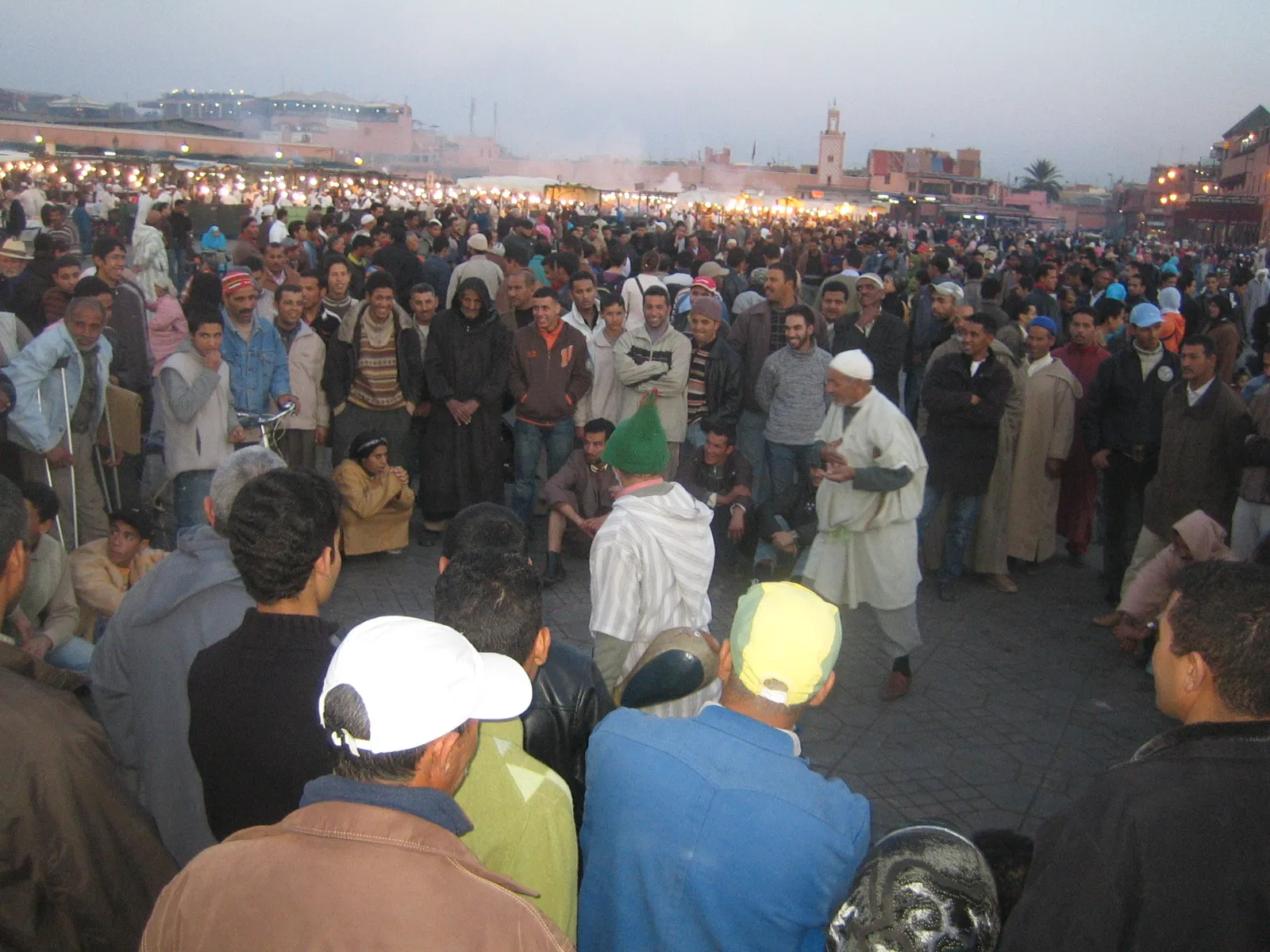
The Gnaoua are among the musical circles that animate the square, especially in the late afternoon and evening, when the halqa (the circular gathering) forms around the musicians. Here is how to make the most of it, the right way.
- Track the sound of the guembri: this round, insistent bass is your compass. Approach discreetly and join the circle.
- Stay, listen, feel: the Gnaoua magic works over time. Give yourself several minutes to let the repetition take effect.
- Film tactfully: taking out your phone is possible, but ask with a glance, stay discreet, and be aware that filming calls for a contribution.
- The tip is the rule: these artists live on the public’s donations. It is neither a scam nor a hidden obligation, but a normal custom.
How Much to Give?
There is no official rate, but a few common-sense benchmarks:
| Situation | Suggested tip |
|---|---|
| You listen for a while without taking photos | 5 to 10 MAD |
| You take photos / a short video | 10 to 20 MAD |
| You stay a long time or request a piece | 20 to 50 MAD |
One last piece of advice: keep in mind that the square is also a place of solicitations. Stay friendly but firm, don’t flash large bills, and give what feels fair to you. To fit the Gnaoua into a complete programme, our guide on what to see and do at Jemaa el-Fna lists all the circles not to be missed, and our article on Jemaa el-Fna at night details the nighttime atmosphere, the ideal moment to come across the musicians.
Frequently Asked Questions
Who are the Gnaoua of Jemaa el-Fna?
The Gnaoua are members of a Moroccan spiritual brotherhood founded by the descendants of slaves brought from sub-Saharan Africa from the 16th century onward. On Jemaa el-Fna square, they are the trance musicians recognisable by the deep sound of the guembri and the metallic clatter of the qraqeb. Their music blends African heritage, mystical Islam and Berber rhythms.
What are the instruments of Gnaoua music?
The three emblematic instruments are the guembri (a three-stringed bass lute covered in skin, played by the maâlem), the qraqeb (large iron castanets that recall the sound of chains) and the drums (tbel). The voice, with its call-and-response chants invoking saints and spirits, completes the ensemble.
What is the lila (or derdeba)?
The lila, which means “the night,” is the healing ritual of the Gnaoua. It is a ceremony of possession and trance that can last all night, during which a series of spirits (the mlouk) are invoked, each associated with a colour and a piece of music. The version played on Jemaa el-Fna is a condensed and festive form of it.
When was Gnaoua culture inscribed by UNESCO?
Gnaoua culture was inscribed in December 2019 on UNESCO’s Representative List of the Intangible Cultural Heritage of Humanity, during the committee held in Bogotá. The cultural space of Jemaa el-Fna square had already been recognised by UNESCO since 2001.
Should you tip the Gnaoua on the square?
Yes, it is the custom: these street musicians live on the public’s donations. Count on about 5 to 20 dirhams if you listen or take a photo, more if you stay a long time. Have small change ready and, ideally, agree on the gesture before filming up close to avoid any misunderstanding.
Where can you see the Gnaoua in concert in Morocco?
The great event is the Gnaoua and World Music Festival of Essaouira, created in 1998 and held every year in June, about 2.5 hours from Marrakech. There you can see the Gnaoua maâlems in fusion with jazz, blues and world-music artists. On Jemaa el-Fna, you come across them all year round, especially at the end of the day.