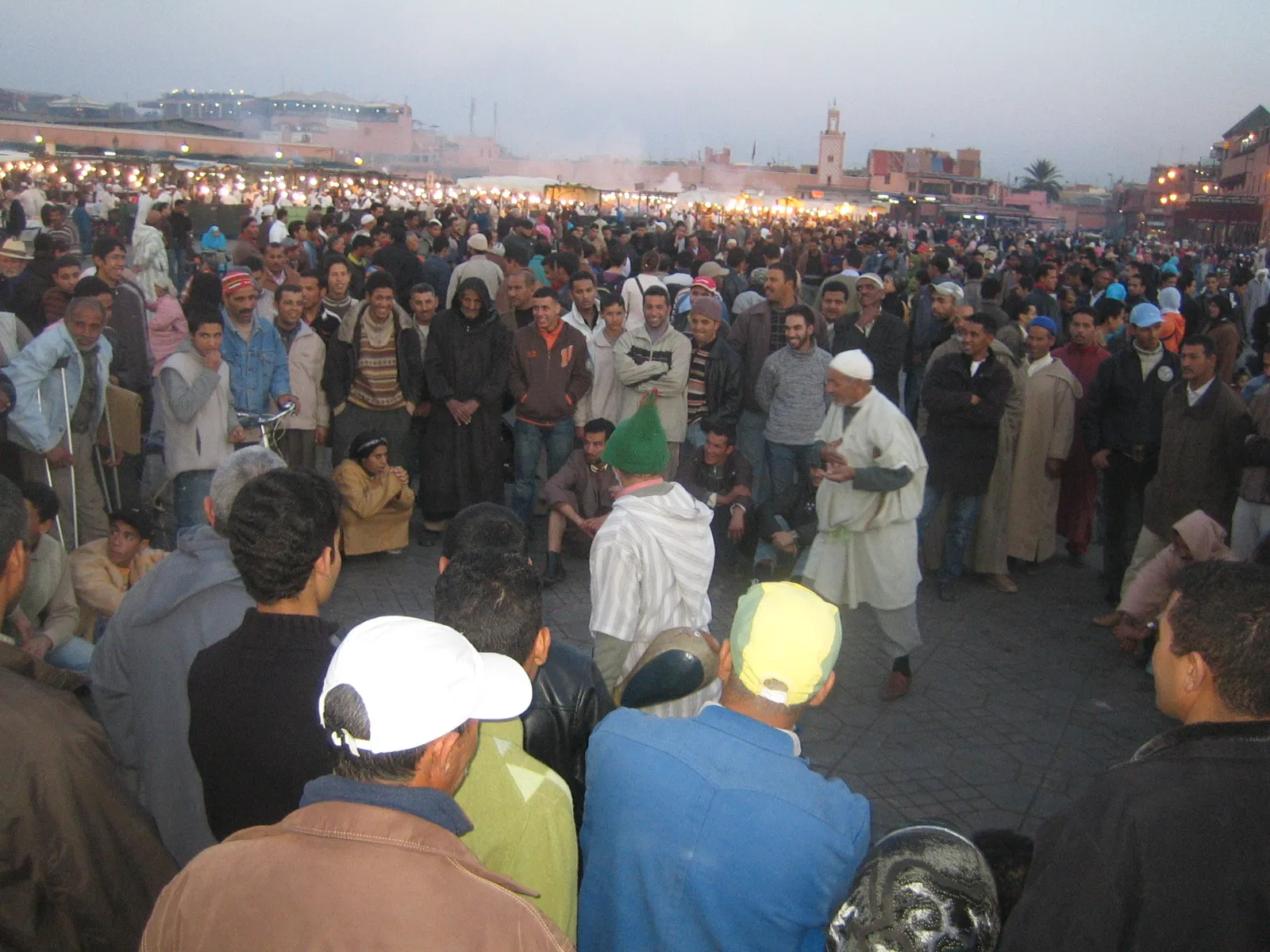
The storytellers of Jemaa el-Fna, known as hlaykia (singular hlayki), are the intangible heart of the square: since the sixteenth century, they have stood at the center of a circle of spectators and unfolded, in dialectal Arabic, epics, moral tales, and legends. It is this living word, even more than the grills or the snake charmers, that earned the square its UNESCO recognition. And it is also the most threatened today: there were eighteen storytellers in Marrakech in the 1970s; only a handful remain.
To understand the hlaykia is to understand why Jemaa el-Fna is not a simple night market but a fragile oral heritage, passed from mouth to ear and never fixed in writing. In this guide, we explain what the halqa is, what the storytellers tell, why this art is declining, what UNESCO actually protects, and how you, as a visitor, can still attend a session and help keep the tradition alive.
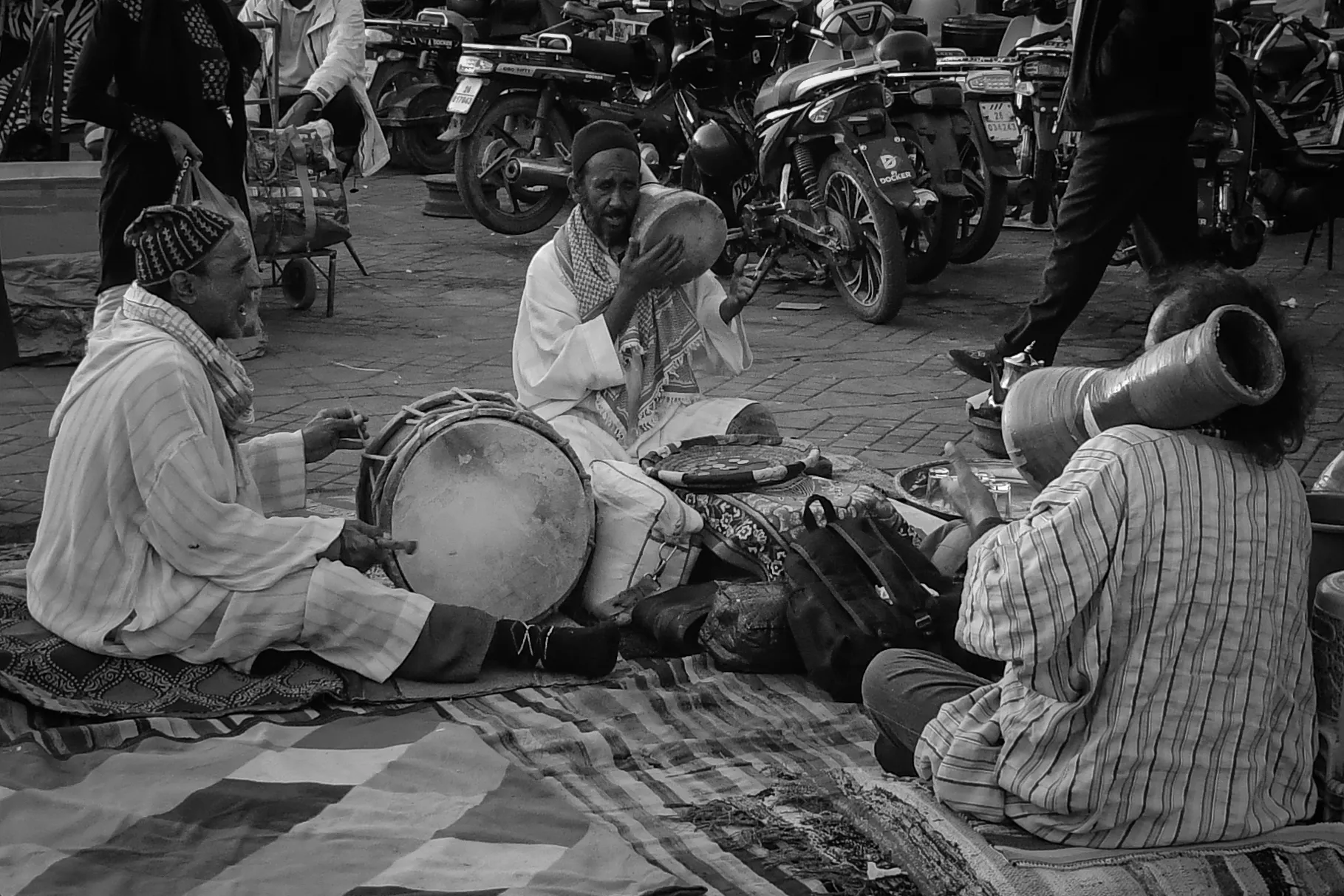
What is the halqa, the storyteller’s circle?
The halqa (literally “the circle” or “the ring”) is the basic theatrical form of Jemaa el-Fna. A performer — storyteller, musician, acrobat, or animal handler — takes up a space on the ground, and a circle of spectators spontaneously forms around them. Nothing is fixed: no stage, no seats, no set schedule, no ticket. Everything rests on the performer’s ability to capture and then hold attention.
For the storyteller, the halqa is a complete art. He does not simply recite: he performs, he paces, he lowers his voice to build suspense, he addresses the audience, he times his effects and breaks off his tale at the most intense moment — often to pass the collection bowl and gather a few coins before resuming. The circle is never passive: listeners react, laugh, chime in, protest. It is this constant dialogue that sets the Jemaa el-Fna tale apart from a fixed performance.
This open-air theater has existed on the square for a long time: as early as the beginning of the seventeenth century, the Moroccan scholar al-Youssi mentions the halqa and its storytellers in his chronicles. That tells you the antiquity of a tradition that four centuries have not extinguished — but that the twenty-first century is putting to a severe test.
What do the storytellers of Jemaa el-Fna tell?
The repertoire of the hlaykia is vast and draws on several sources. It includes:
- The great Arab epics: the Sīra of Antar, the deeds of Abu Zayd al-Hilali, tales of conquests and warrior heroes, sometimes recited over several evenings.
- The tales of the One Thousand and One Nights: Scheherazade, the schemes, the genies, the merchants and the kings — an inexhaustible fund from which the storytellers cut and improvise.
- Religious and hagiographic accounts: lives of saints, moral parables, edifying stories drawn from the Muslim tradition.
- Folk tales and comic anecdotes: animal stories, the tricks of Joha (the mischievous figure of folklore), local legends of Marrakech and the High Atlas.
The storyteller does not learn a text by heart: he masters a framework and recomposes it at each session, adapting the length, the tone, and the digressions to his audience. This oral improvisation is precisely what makes the tradition so precious and so vulnerable: nothing is written down, everything lives in the memory of men who are ever rarer.
Why is the hlaykia tradition in danger?
The reality is stark. Where there were eighteen active storytellers in the 1970s, only a handful remain today, often elderly. The president of the association of halqa professionals himself summed up the situation in one bleak phrase: the storytellers’ fate seems to be extinction. Several factors combine.
Competition from screens. Television, cartoons, smartphones, and social media have replaced the evening gatherings where parents and children came together to listen to stories. The oral tale has lost its natural audience, especially the youngest.
The break in transmission. The storyteller’s art was learned through apprenticeship, in years spent at a master’s side. Yet few young people today accept a precarious life of long hours on their feet for uncertain earnings. Without apprentices, the chain breaks.
Commercial and tourist pressure. The square has been transformed: food stalls, kiosks, and photogenic attractions take up the space and draw a hurried crowd. The tale, which demands time, silence, and an understanding of the language, finds itself marginalized in favor of more immediately “consumable” performances.
The language barrier. The narrative unfolds in Moroccan dialectal Arabic (darija). Foreign visitors, who make up a growing share of the audience, have no access to it — which further reduces the crowd willing to stop and give.
What UNESCO protects: the oral heritage, not the walls
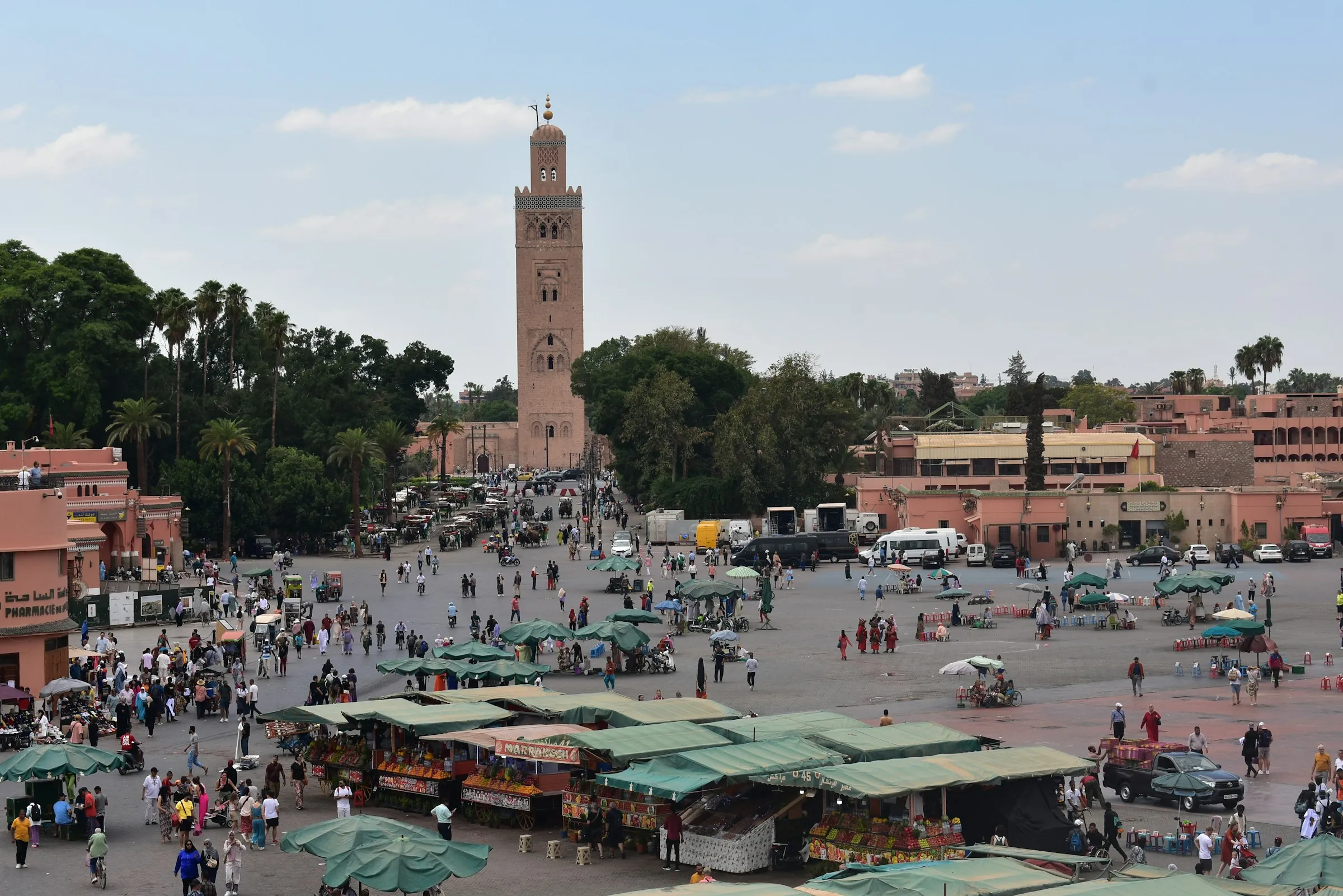
This is where the status of Jemaa el-Fna takes on its full meaning. In May 2001, UNESCO proclaimed “the cultural space of Jemaa el-Fna square” a masterpiece of the oral and intangible heritage of humanity, before inscribing it, in 2008, on the Representative List of the Intangible Cultural Heritage.
The distinction is crucial: here UNESCO does not classify stones, monuments, or a landscape, but living practices — the tale, the music, the knowledge, the gestures that pass from person to person. The square in fact inspired the very notion of “oral and intangible heritage”: its case helped bring this new category into being within UNESCO’s thinking. In other words, it is the hlaykia and their like who are the treasure — not just the esplanade that hosts them.
This recognition has a downside: listing is not enough to save. Intangible heritage cannot be preserved in a display case; it survives only if it continues to be practiced and passed on. The challenge, in Marrakech as elsewhere, is to keep a community of tradition-bearers alive enough that the art does not die out with its last masters. To place this square in the long view, our history of Jemaa el-Fna traces how a site of public executions became a sanctuary of the spoken word.
Elias Canetti and “The Voices of Marrakesh”
No text has better captured the power of these storytellers than The Voices of Marrakesh by Elias Canetti, the writer who won the Nobel Prize in Literature in 1981. Following a journey made in 1954, he recorded in this short account the sounds, gestures, and faces of the city.
Before the storytellers of Jemaa el-Fna, Canetti is fascinated even though he does not understand a word of what they say. In their art he perceives “an enclave of ancient, inviolable life” — a word arising from the depths of ages, indifferent to the passing of time. This paradox — being captivated by a tale whose literal meaning you do not grasp — says everything about the purely oral and bodily power of the halqa. It is also an invitation to today’s visitor: one can be moved by a storyteller without grasping his words, provided one takes the time to stop. Canetti’s gaze nourished a whole lineage of writers, from Juan Goytisolo — a great champion of the UNESCO listing — to many other travelers won over by the square.
How to attend a storytelling session (and support it)
Seeing a hlayki at work today takes a bit of patience and method. Here is how to maximize your chances.
| Tip | In practice |
|---|---|
| The right time | In the late afternoon and evening, when the halqa form (from around 5 p.m.). |
| The right place | Look for the circles where only a single voice can be heard and where the audience is seated or still: that is the sign of a storyteller, not a musician. |
| The right behavior | Enter the circle discreetly, stay, listen. A loyal audience encourages the performer to continue. |
| The tip | It is the storyteller’s only income. Slip a few dirhams into the bowl that circulates (10 to 20 MAD is an appreciated gesture; indicative amount). |
A few points of etiquette. Do not film frantically: ask with your eyes, and favor listening over capturing. Do not leave when the collection bowl comes around: that is precisely when the storyteller needs his audience. And if you do not understand the language, stay a few minutes anyway: your presence, and your coin, are direct support for a threatened tradition.
To organize your evening around the square and take in storytellers, music, and food stalls one after another, see our guide to what to see and do at Jemaa el-Fna, as well as our article on Jemaa el-Fna in the evening and at night, the best time to catch a halqa in full action.
Frequently asked questions
Who are the hlaykia of Jemaa el-Fna?
The hlaykia (singular hlayki) are the traditional storytellers of the square. Standing at the center of a circle of spectators — the halqa — they declaim in dialectal Arabic epics, tales from the One Thousand and One Nights, legends, and moral stories, improvising from a memorized framework.
Why are the storytellers of Marrakech disappearing?
Several causes add up: competition from television and screens, the break in transmission between masters and apprentices, commercial and tourist pressure on the square, and the language barrier for an increasingly foreign audience. From eighteen storytellers in the 1970s, only a handful remain.
Why did UNESCO list Jemaa el-Fna?
Because the square is home to an exceptional intangible cultural heritage: storytellers, musicians, herbalists, and other bearers of oral traditions. UNESCO proclaimed it a masterpiece of the oral and intangible heritage of humanity in 2001, then inscribed it on the Representative List in 2008. The treasure being protected is the living practices, not the buildings. See the official UNESCO listing.
Can you understand a storyteller without speaking Arabic?
Not literally, but the experience remains powerful. The theatricality — gestures, intonations, silences, audience reactions — transcends language. This is what Elias Canetti experienced in The Voices of Marrakesh, fascinated by tales of which he did not understand a single word.
Should you give money to the storyteller?
Yes, it is the custom and the performer’s only income. A bowl circulates during or after the tale: a few dirhams (10 to 20 MAD, as a guide) are enough and constitute real support for a threatened tradition. Do not leave the circle at the moment the collection is taken.
Where and when can you see a storyteller’s halqa?
On the square itself, in the late afternoon and evening, from around 5 p.m., when the circles form. Spot the silent gatherings organized around a single voice: that is where a storyteller stands, to be distinguished from the halqa of musicians or acrobats.